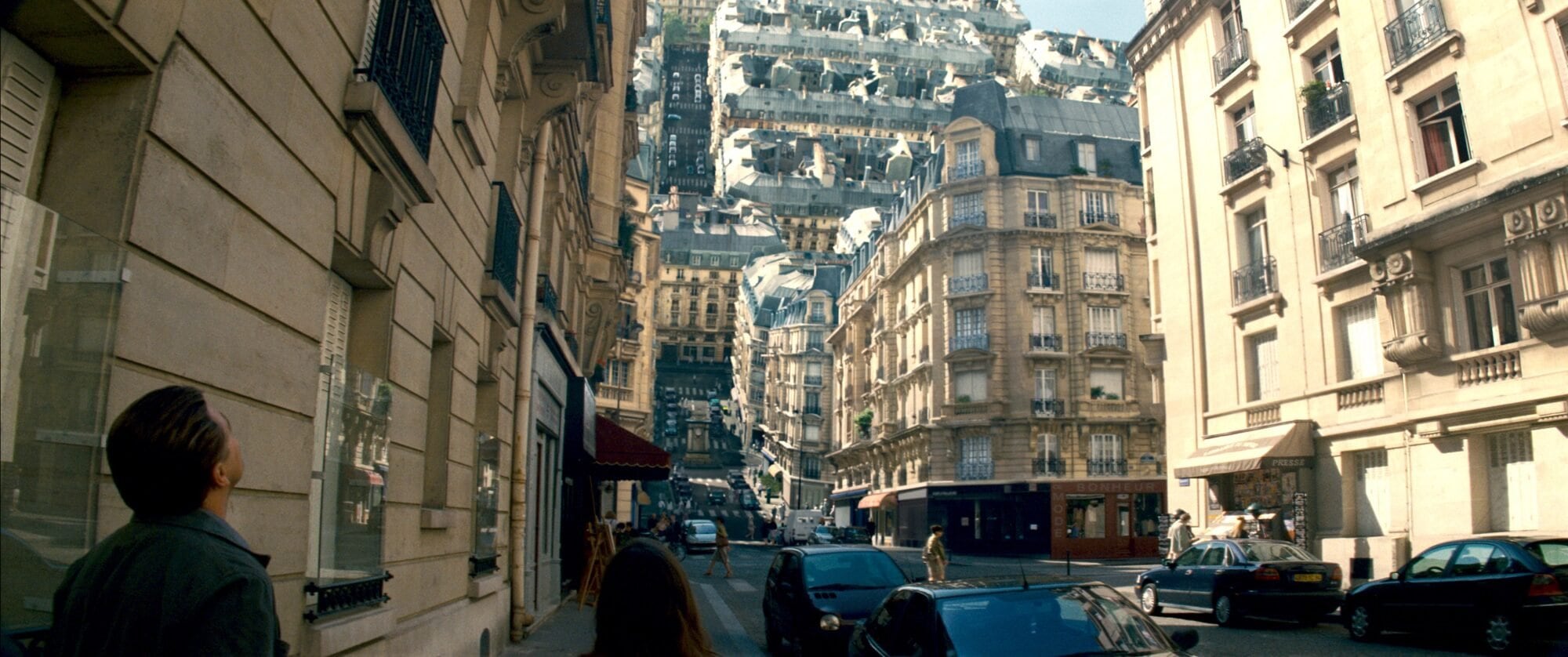
Christopher Nolan’s Inception is Instruction Manual Cinema, a film that spends so much time explaining—and explaining, and explaining—the rules of its narrative conceit that it fails to either emotionally engage or, except in a few notable spots, viscerally thrill. Working from a canvas at once larger than The Dark Knight and yet markedly reminiscent of it (not to mention countless other celluloid sagas), Nolan’s would-be epic is a work of sometimes stunning imagery but only affected heart, a pseudo-heist film that borrows liberally from all corners of the cinematic world (The Matrix, eXistenZ, Last Year at Marienbad, the canons of David Lynch and Michael Mann) in service of a tale that’s as hollow as its reality-bending Rubik’s Cube ruses are intricate.
Focusing on a secret agent man named Cobb (Leonardo DiCaprio), who enters people’s dreams to steal vital pieces of well-kept information, Nolan’s sci-fi latest is enraptured by the sense of falling down the rabbit hole, not simply via its dreams-within-dreams-within-dreams centerpieces, but through the sheer wealth of information it vomits up at every turn. Head-spinning exposition takes the place of wonder throughout, leaving only the transient rush of particularly vivid visuals and a faint whiff of a better film that could have been.
Nolan wastes no time with setup, immediately thrusting viewers into a perplexing scene in which Cobb washes up on a sunny shore, sees a vision of two young children playing in a grassy yard, and then visits an elderly Japanese man whom he seems to know. This encounter takes place in a gorgeously decorated chamber with wall panels and hanging lamps, but lingering to admire the sights isn’t Inception’s strong suit, and soon the film is off into other apparent realities, with chitchat filling in the gaps at breakneck speed. Turns out, Cobb is trying to pilfer valuable knowledge from corporate bigwig Saito (Ken Watanabe) as a test to see if he’s up for a larger task—one that involves not taking info from someone’s mind (a process called “extraction”), but rather, inserting a new idea (dubbed “inception”) in the noggin of energy magnate Maurice Fischer’s (Pete Postlethwaite) only heir, Robert (Cillian Murphy). For mysterious reasons related to his dead wife, Mal (Marion Cotillard), who has a penchant for showing up unannounced in dreams and thwarting Cobb’s robberies, Cobb isn’t instantly interested in this dangerous, difficult gig. Nonetheless, Saito’s promise that performing the job will mean Cobb can finally return home to the U.S.—where his kids are, and from which he’s been exiled for enigmatic legal reasons—quickly seals the deal.
From there, we’re treated to a lengthy middle section in which Cobb assembles his team and concocts his ruse, a standard heist-film structure that quickly proves most notable for the myriad rules governing dream infiltration, and for the wholesale lack of importance of said regulations. Phony tech, philosophical, and psychological terminology abounds but it’s all of little concern except as a means of generating confusion, which in turn distracts attention from the inconsequentiality of the heist itself. Inception’s interest in Robert’s daddy issues only extends to the point that those hang-ups allow for inordinate talk about how one might plant the seed of an idea in a man’s mind and then allow it to flower naturally so that it seems homegrown. It’s a tantalizing notion, or at least would be if Nolan imbued this scheme with some sort of standalone significance. Instead, the film courts engagement with Cobb’s inception plan only through the operation of its mechanisms, which are at once migraine-inducing complicated (Cobb aims to plunge through layers and layers of dreams, and escape through wakeup signals known as “kicks”) and yet—as with the actual defibrillator-ish contraptions used to enter dreams—embarrassingly undeveloped.
Whereas David Lynch’s Mulholland Drive expresses every nuance of its protagonist’s fractured psyche through suggestive aesthetics and plotting, Nolan merely relies on blather about the guidelines of plumbing the subconscious. And, like Martin Scorsese’s Shutter Island (DiCaprio’s previous say-don’t-show head game), he compensates for this situation by indulging in baroque imagery, though as is his penchant, Nolan’s latest doesn’t radiate hothouse need and passion through standout compositions, but rather, cool, icy menace. The director’s favored aerial shots of a twinkling nocturnal metropolis lend the action a chilly beauty, and a phenomenal extended bit in which Cobb’s accomplice (Joseph Gordon-Levitt) battles enemies in zero-gravity hotel corridors potently captures the dizzying down-is-up nature of the mind-bending material. Yet too often, Inception’s signature moments seem derivative of others (a trippy bedroom set recalls, without thematic warrant, 2001), as well as his own prior work, from a train barreling through a crowded city street (shades of The Dark Knight’s underground semi chase) to a random arctic mission that’s equal parts Batman Begins and James Bond. Such duplication furthers the impression that Nolan has constructed his thriller in only certain dimensions, favoring some elements at the expense of others and figuring that 100-mph pacing will obscure the proceedings’ familiarity and thinness.
Still, regardless of Hans Zimmer’s grating loud-louder-loudest tonal score, at least the film’s construction has a sleek, shiny elegance, something that can’t be said of the script’s nonexistent characterizations. With Gordon-Levitt as Sidekick, Bronson’s Tom Hardy as Second-Banana, and Ellen Page as Gifted Newbie, Inception flaunts its disinterest in human beings, such that when Sidekick cons Gifted Newbie into a kiss, the moment amazes because it’s the first glimmer of personality from either. Cobb, on the other hand, boasts identifiable traits and dilemmas, and yet he too is constantly positioned as a stick figure knowable only via what he tells us about himself. Cobb’s tortured feelings about Mal, whom he’s trapped in the basement of his brain out of guilt over her death, are intended to be the film’s emotional crux. But as every word out of DiCaprio’s mouth has only a functional purpose, there’s no heat to this central thwarted romance-across-realities, only ominous totems (spinning tops, chess pieces, pinwheels) and a few sumptuous visions, such as a shot from Cobb’s POV as he rises above Mal in an elevator. Admittedly, Nolan is less after heartrending surrealism a la Mulholland Drive than stylized puzzle-box intrigue. However, his inability to enter into his characters—a glaring irony given his fascination with probing the landscape of the mind—is a fatal flaw here, leaving one to marvel only at the often-striking scenery.
Inception’s third act features four separate, intertwined narratives that showcase the director’s skill at parallel editing as well as his knack for staging sequences of escalating tension and suspense. Alas, his action choreography has regressed since the admittedly middling level of The Dark Knight, thereby sapping an armed chase through Parisian streets and the climactic arctic siege of any entrancing lucidity that might have made up for the general who-cares nature of these moments. Even so, formal shortcomings are ultimately less problematic than simply a dearth of meaningful ideas. Despite the characters’ endless jibber-jabber, Nolan crucially never delineates—in terms of importance, or impact—between waking and slumbering thoughts and feelings, thereby undercutting his entire premise. And his story’s final insights are the stuff of torpid platitudes: the necessity of distinguishing imagination from reality, the vital value of letting go, and the cinema’s role as a dream factory. “An idea is like a virus,” opines Cobb on multiple occasions, one with the power to grow like a cancer in unpredictable, dangerous ways. It’s a metaphor that quite nicely fits Inception itself, an ambitious, initially absorbing film that mutates into something unpleasantly unwieldy.
Since 2001, we've brought you uncompromising, candid takes on the world of film, music, television, video games, theater, and more. Independently owned and operated publications like Slant have been hit hard in recent years, but we’re committed to keeping our content free and accessible—meaning no paywalls or fees.
If you like what we do, please consider subscribing to our Patreon or making a donation.