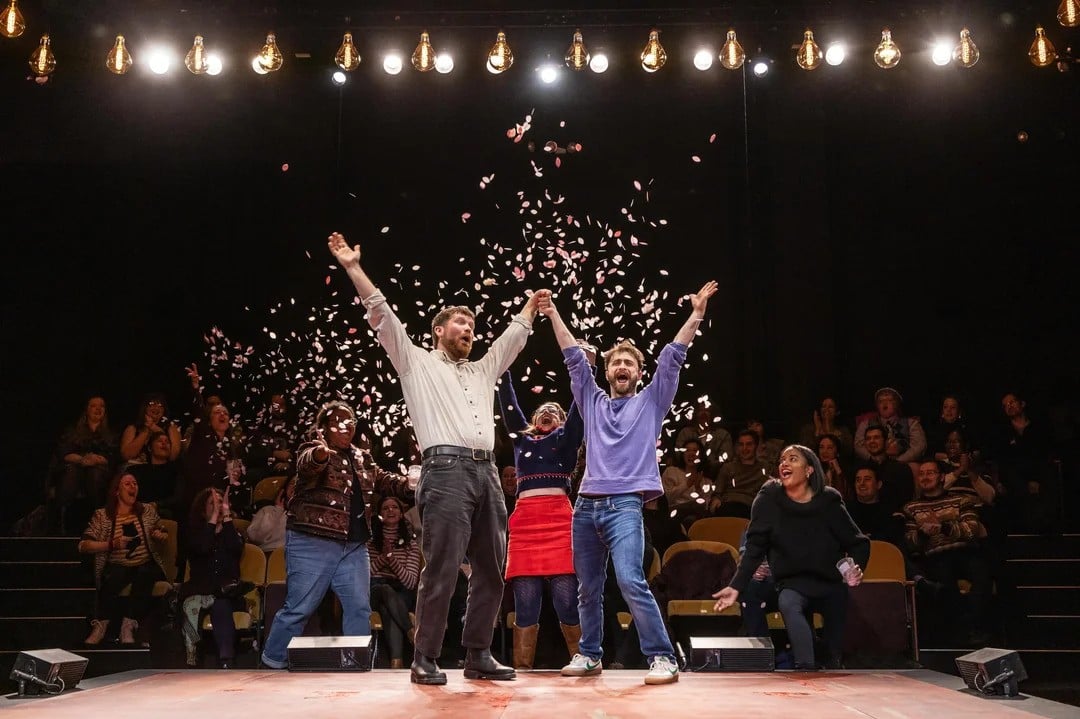
A solo play-cum-mental health PSA-cum-community improv workshop, Every Brilliant Thing is an interesting career choice for Daniel Radcliffe’s after his Tony-winning turn in Merrily We Roll Along. Dressed here in unassuming jeans and a purple shirt, he seems, more or less, like himself. He’s playing an unnamed narrator, but, on press night, whenever he asked audience members to take on roles and speak to him, they just kept calling him Daniel.
Audience participation (mercifully voluntary) motors Every Brilliant Thing, so it’s safe to assume that much of the audience has arrived in hopes of some face-to-face time with a childhood hero. (A footnote in the press script indicates that when Radcliffe solicits a book from the audience to use as a prop, he will not accept proffered copies of Harry Potter.)
Duncan Macmillan’s script (written with Johnny Donahoe, who originally starred in 2013) is rather gossamery, which is to say, there’s not much of it. Radcliffe plays a man reflecting on the list he’s kept, ever since his mother’s first suicide attempt, of “everything worth living for.” He keeps delivering excerpts of the list to his mother, desperate to keep her connected to all that makes her and her family happy. Select audience members have been instructed to shout out list items written on cards when their time comes. Number one: “Ice cream!” Number seven: “People falling over!” Number 724: “The look on a dog’s face as it leans out of the window of a moving car.” As Radcliffe’s narrator ages from little kid to shy undergraduate to hopeful groom, the list grows with him, until he’s forced to confront his own mounting depression.
The narrator’s story is deliberately lean to make room for us. Audience members hop in to play Radcliffe’s stony-faced dad, prospective love interest, family veterinarian, and college lecturer, sometimes engaging in high-risk improv. When the narrator apologizes to a former school counselor, since retired, for calling so late at night, the newly minted actress came up with a wistfully world-weary response following a sigh: “I was doing nothing.”
This is the kind of interplay that, in less capable hands, could go woefully off the rails. No doubt, throughout the myriad productions that it’s enjoyed while appearing multiple times on American Theatre’s list of most-produced works, the play has come across as trite or cheaply manipulative. Certainly, since neither actor nor audience ever embody the character of the mother, there’s no attempt to understand her mental health on a deep, specific level. She’s just an example (her illness is described in the broadest terms as “big ups, crashing downs”—“the ‘why,’ it turns out, is unknowable”) and, so, the narrator also becomes more or less a stand-in.

But, directed by Macmillan and Jeremy Herrin, Radcliffe is so affable a presence and so charming an interlocutor in each of his audience exchanges that the conceit works as well as it possibly can. On press night, his selected paramour (the character’s name is the gender-flexible Sam) was a man, so Radcliffe riffed delightfully when the book an audience member handed him for a library meet-cute was a copy of Rachel Reid’s Heated Rivalry. Even when the script hits its preachiest crescendos—at one point the narrator reads aloud from another long list, this one the Samaritans’ guidelines for media reporting on suicides—there’s enough wry warmth to keep the aggressively good intentions from growing maudlin.
As with the time-leaping Merrily We Roll Along, there’s something paratextually powerful about watching Radcliffe play his character growing up when we’ve watched the bespectacled boy actor he once was become a bearded dad in real time. Maybe, then, by performing a play in which he spends 30 minutes pre-show taking selfies with audience members and later sprints through the theater high-fiving as many people as he can, Radcliffe’s taken control of the glow of celebrity, like Albus Dumbledore absorbing the light of a streetlamp into his Deluminator.
The mightily famous can, it turns out, use their powers for good, and Radcliffe, though he’s doing a fair bit more emceeing than acting across Every Brilliant Thing, has gathered his disciples together to communicate a vital message. And the play offers not only the sentiment that none of us are alone but the on-stage practice of that idea. Per Number 2440: “The fact that any group of strangers, albeit briefly, can become a choir.”
As the audience shouts one of the brilliant things in unison or dances together beneath a disco ball, Radcliffe casts a subtle spell that encourages us to turn toward each other, collectively celebrating each brave Broadway cameo. We may have come for the boy wizard, but he leaves us just a little bit more grateful to be sharing 80 minutes with a theater full of Muggles.
Every Brilliant Thing is now running at the Hudson Theatre.
Since 2001, we've brought you uncompromising, candid takes on the world of film, music, television, video games, theater, and more. Independently owned and operated publications like Slant have been hit hard in recent years, but we’re committed to keeping our content free and accessible—meaning no paywalls or fees.
If you like what we do, please consider subscribing to our Patreon or making a donation.