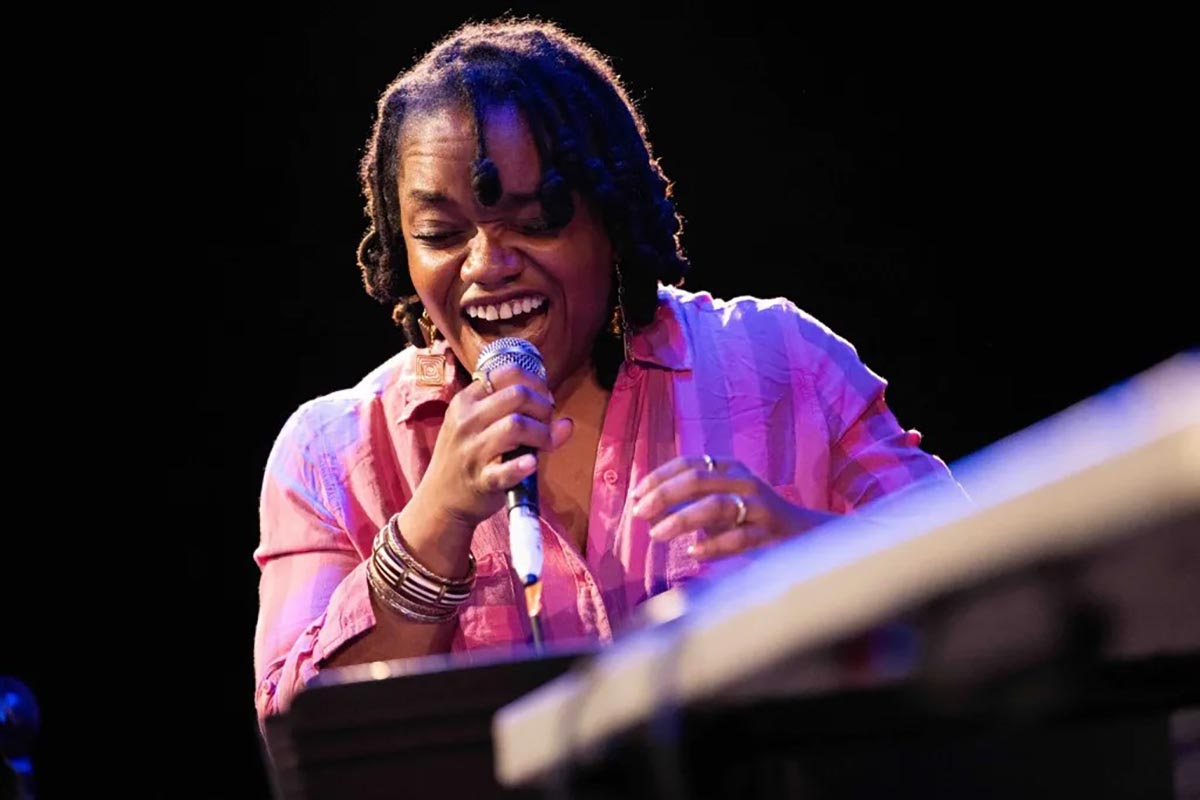
“Everything is intricately wrapped in simplicity,” sings performance trio HawtPlates over and over again in Dream Feed, a ravishingly lyrical music theater piece at HERE Arts Center. That sentiment, its slight inscrutability included, could be the mantra of this year’s Under the Radar, which co-produced Dream Feed, along with more than two dozen other experimental and international theater works across New York venues this month.
The tension between the simple and the intricate runs throughout the works of Under the Radar artists who tend to weave familiar images or actions into patterns with unpindownable meaning. Take Dream Feed, nearly entirely sung through by the Hicks family, who mostly just explore the sounds they make together, their taut harmonies producing rebounding overtones through joyous composition. As they circle round a mound of dirt amid splintering lighting, they keep excavating new percussion instruments to explore. If their thematic thesis never comes into focus, the feeling sure does. It’s the sense of comfort and warmth found in sharing the strangeness of your most disorienting dreams with people you care most about.
The best of Under the Radar can’t be easily summed up in terms of plot or moral. But the evocation of emotion, the simple responses that fold these intellectually indecipherable puzzleboxes into something nonetheless whole and satisfying, is what these standouts achieve.
Ambiguous Landscape
Under the Radar thrived this year in its most maximalist form, thanks to two wildly different wordless pieces at NYU Skirball Center. First, Mami, a gorgeously poetic piece from the fast-rising Albanian-Greek director Mario Banushi, mesmerizes in a series of vignettes with a fresh language of movement that oscillates between the hyper-realistic and the sensually stylized. An elderly woman totters out of her home, ever so slowly, step by step, toward a flickering lamppost. A naked man crabwalks, his body contorted, toward a caressing couple.
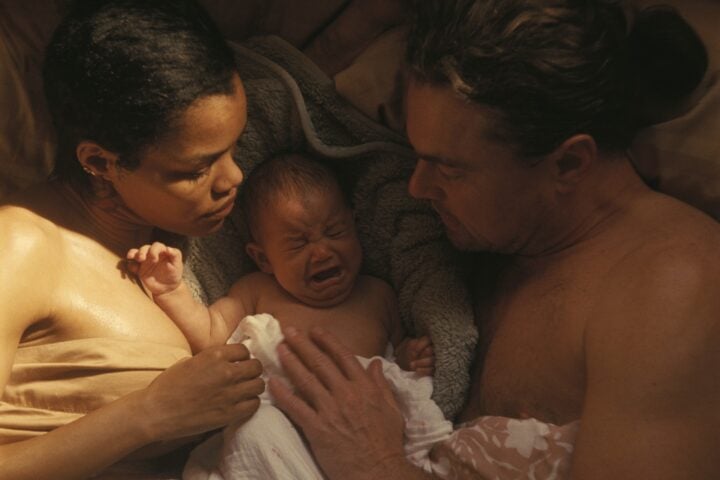
Banushi’s art is like the unexpected lovechild of Annie Baker and Pina Bausch. And though the details of Mami’s story are intentionally up for interpretation, the tender depictions of a young mother caring for her infant son and a grown son caring for his aged mother never feel random or without purpose. In the piece’s most stunning, silent sequence, a man changes his frail mother’s diaper as she holds her hands, in seeming shame, over her eyes.

But shame is nowhere to be found in Voyage Into Infinity, a rousing celebration of girls playing with fire and never ever getting burned. Narcissister is the stage name of the anonymous performance artist behind the work, and she’s done much of her work in the nightlife space (her bio describes her as “masked and merkin-ed”). In Voyage Into Infinity, three doll-like figures, in 1950s dresses and curls, emerge from a giant birdhouse into an abandoned attic chockful of objects to be set in motion in a proscenium-high Rube Goldberg machine.
Narcissister takes inspiration from the 1987 German short film “The Way Things Go,” a riveting chain reaction of everyday materials crashing into one another in a 30-minute fantasia of fire, water, and kinetic energy. Here, though, the women construct and disrupt the machines in front of us, their precision setups an exercise in patience with giddy pay-offs. (Just wait as they ever-so-slowly burn through a rope, releasing a punching bag that collapses on to a statue that topples on to a ladder and so forth.) The specifics of Voyage Into Infinity’s punk-infused feminist messaging are deliberately up for grabs. But when playtime is over, and the trio leaves the world they’ve conquered behind, seemingly to return to docile domesticity, it’s a gut punch.
Over in Queens at the Chocolate Factory Theater, Autumn Knight’s Nothing: more is Voyage Into Infinity’s mirror image: Three performers mess about again with found objects, but here, the precise purposefulness of the Rube Goldberg machine is gone and a relaxingly lazy chaos reigns. Nothing: more’s choreography seems like a series of accidental collisions, noises, and patterns. The performers appear to be following their impulses—to strike the ground with a microphone and see what sound it makes, to bounce on a ball while wrapping themselves in aluminium foil, to guide each other around with Gatorade coolers on their heads. One of the objects on stage is a digital clock, and it’s a fun game to watch how time passes in a piece unembarrassed by its formlessness: in the span of a minute, so much—and so little—can transform, nothing dictated by the mores of scripted theatrical inevitability.
Old Tales Reimagined
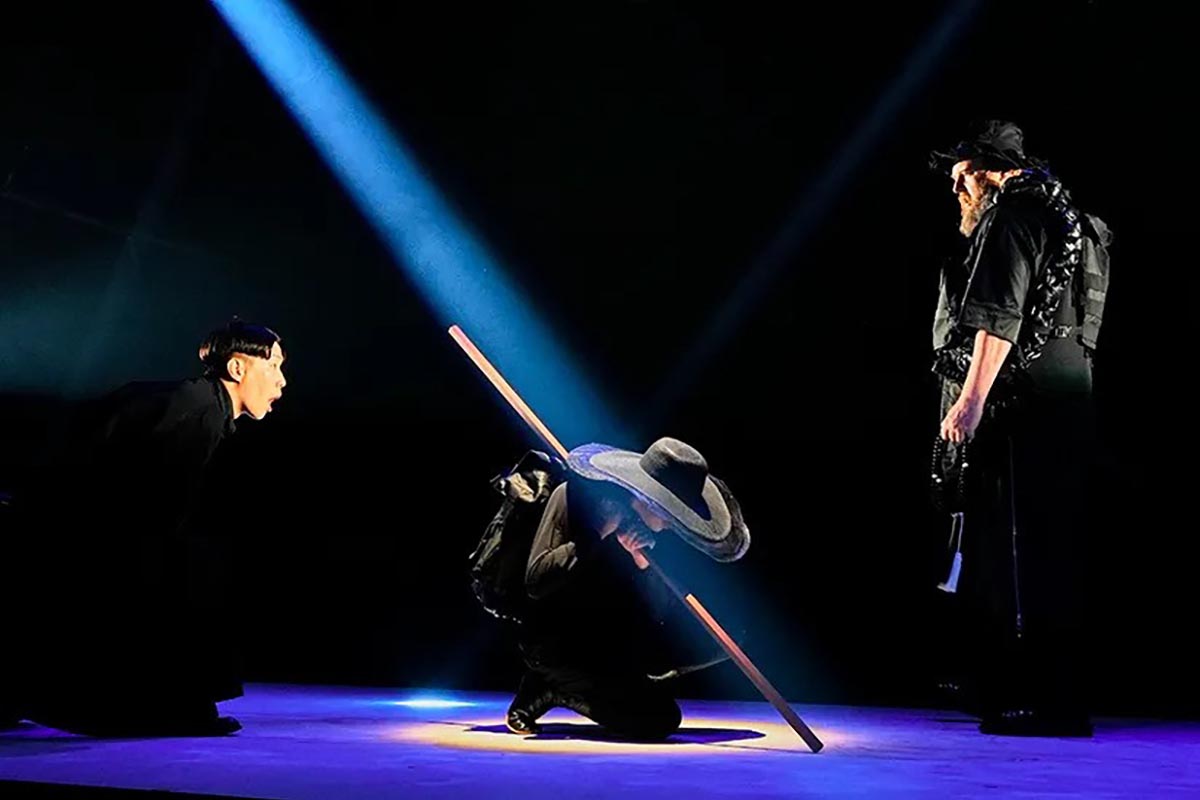
Some Under the Radar shows strive to resurrect old texts like the Japanese theater company Kinoshita Kabuki’s stylistically contemporary mounting of the classic 1840 kabuki play Kanjincho. In a sleek staging, director Sugihara Kunio breathes tensely funny life into Kinoshita Yuichi’s adaptation of the story of two warring clans that face off at a barrier gate, each group believing they’re bound to a mission and a leader who’s morally right.
The humor in Kinoshita’s updated language doesn’t quite land in the supertitles for audiences who don’t speak Japanese, but the lively spirit of reinvention is palpable. In an interesting bit of cross-cultural casting, a white American actor plays a Japanese character, becoming what looks like a white savior figure. (That’s probably an interpretation out of step with how Japanese audiences would understand the risks of color-blind casting, but it’s a fascinating move for this reimagined take on a culturally-rooted form.) By programming non-English pieces like this one (presented by the Japan Society), Under the Radar challenges New York audiences to separate themselves from their own cultural vantage point as they encounter foreign work.
This year isn’t the first at Under the Radar that a new look at a Samuel Beckett text has reminded us that weird stuff has been happening on stage for more than a century. This time, it’s All That Fall, Mabou Mines’s staging of Beckett’s 1957 radio play. The story follows the anxious, somewhat saucy Maddy Rooney as she makes her way to the train station to surprise her blind husband, stopping along the way for near-tiffs and near-trysts with her neighbors. The stage set is a miniature model of Maddy’s village, gorgeously rendered in fine pastoral detail. Lights trace Maddy’s journey as we listen to the pre-recorded play. The visual and audio never fully integrate into a whole that feels like a true live experience (the show uses pre-recorded audio), and it’s often unclear where on the map we’re meant to look, but this wry, mysterious play, a sort of Waiting for Godot on the move, is compellingly acted.
Striking Image
The Spanish production Birdie, staged in Lincoln Center’s studio space, never quite coheres its collection of visual impulses—clips of Hitchcock’s The Birds, slow-moving projections of page after page of a newspaper, the arrival of a giant fan—to tell the story of a border city and the gulf between its bougie inhabitants and the asylum seekers on the other side of the fence. But in its most effective sequence, Birdie’s creators pan their cameras over 2,000 miniature figures of animals lined up on stage, a parade of allegorical displacement that culminates in a pile-up of figurines on one side of a fence. The layout is meant to invoke the 2022 crowd crush in Melilla, Spain, that killed 23 migrants and asylum seekers, and if the history isn’t explicitly laid out in the piece, the sorrow of that projected camera shot is undeniable. The tiny, tiny figures blown up on-screen indicate that these thousands represent just a fraction of the displaced.
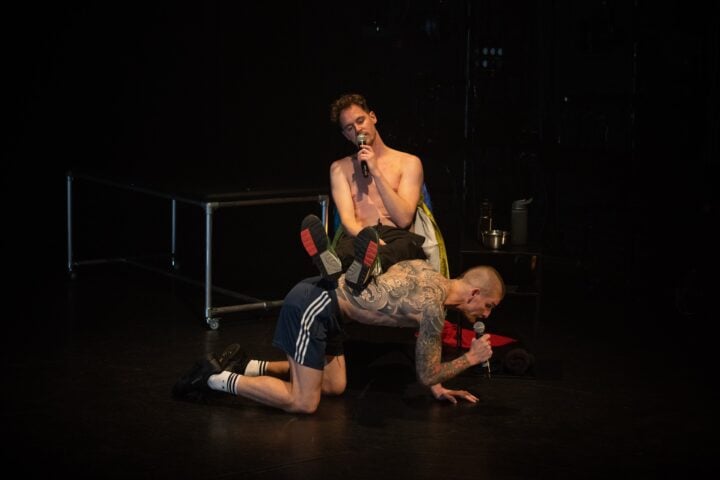
And though there are some shockingly anatomical gestures in the genderfluid British drag artist Wet Mess’s solo show Testo at Dixon Place, the piece’s most haunting image comes from fake body parts. Throughout, Wet Mess lip-syncs to audio interviews with people on testosterone replacement therapy, initially stripping down to a silicone muscle suit. But the costume doesn’t fit right, and they tug and tug at the false skin, stretching the chiseled abs to cover their knees and then tautening the plastic shoulders up over their eyes. Even if much of the anarchically elegant Testo pulsates with its playful distortions of gender, there’s a deeply felt discomfort in this sequence as Wet Mess pulls at skin that might never feel like home, even after it’s shed.

Experimental clowning isn’t just a young person’s game either. If Wet Mess represents themselves as a gender rebel wrestling with their own, well, messiness, there’s a gentler series of contortions in the frolic toward journey’s end in The Rest of Our Lives, a half-dance, half-clown duet at La MaMa featuring the Welsh duo Jo Fong and George Orange. The middle-aged pair are delightfully limber, and they relish playing up the fragility of their high-risk choreography as they reflect upon their “age against the machine.”
In a gracefully lopsided pas de deux, Fong tilts directly forward toward an audience member’s lap, threatening to faceplant, but Orange catches her by the shoulder just in time, heartily apologizing for Fong’s near miss. Later, Orange lowers Fong to the ground and starts to spin her with centripetal acceleration: she screams bloody murder. “There is a lot of expectation in this room,” Fong acknowledges early on, gesturing to Orange. “He will fly.” Assisted by a dotty sense of humor, Fong and Orange come close to delivering on the promise.
Deathbed Vigil
In Onassis Onx’s presentation of We Have No Need Of Other Worlds (We Need Mirrors), creator Graham Sack reads from his father’s journals as he recalls a long night beside the man’s deathbed. But he isn’t alone on stage. The company LedPulse has built Sack a series of pillars of beads of light which illuminate to form recognizable shapes, like the waves of the Riviera, a hospital bed, even his father’s face.
It’s a frequently brilliant effect, especially when Sack steps in between the strands of light, and it’s refreshing to see innovative on-stage animations that aren’t projected or playing on screens. But Sack is consistently upstaged by the show’s design: Instead of sharpening Sack’s storytelling as he navigates the journals that chart a months-long journey his father took in early adulthood, the technology more often competes with him for attention.
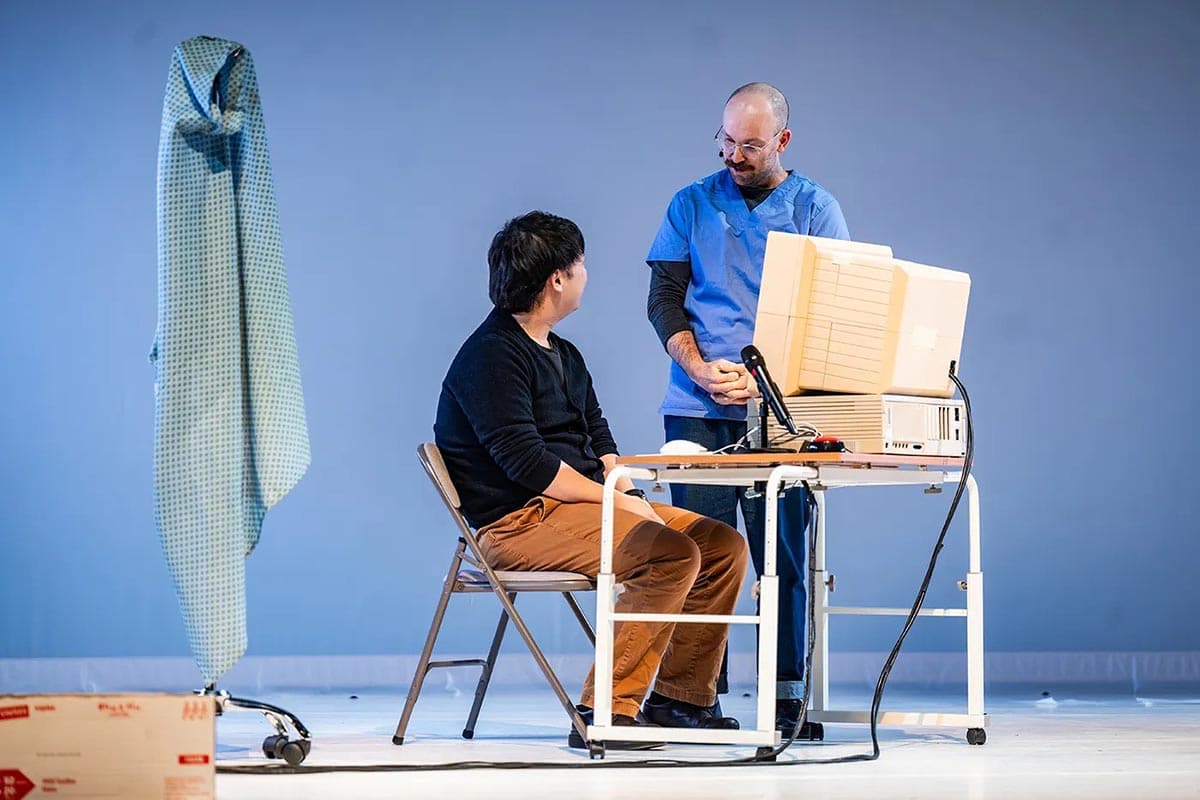
It’s harder to look away from the child saying goodbye to her parent in Mitu’s 2021, in which the Canadian performance artist Cole Lewis invites audience members on stage to play a video game she’s designed. They’re playing as Lewis’s father Brian, a Trump-loving veteran who ended up in and out of the hospital while living in his car early in the pandemic when his daughter was across a sealed border in Canada. Lewis imagines her father’s misadventures, mostly involving attempting to bust out of the hospital, and she narrates the game players’ progress as they try to find Brian’s test results, choose their favorite responses in a father-daughter phone call with Cole, and, at one point, shoot at zombie nurses during a Vietnam flashback.
There are clever throwbacks to visual and gameplay styles of old, and one of the game’s co-programmers, Patrick Blenkarn, provides amusing live musical accompaniment, plus hospital food to audience volunteers. Though the game has a couple too many levels to remain gripping, and there’s an unnecessary A.I. diversion at the end, 2021 is an entertainingly raw depiction of the painful task of imagining what a loved one might have experienced in their darkest moments of unobserved isolation. Sometimes it’s better to play it out together.
Since 2001, we've brought you uncompromising, candid takes on the world of film, music, television, video games, theater, and more. Independently owned and operated publications like Slant have been hit hard in recent years, but we’re committed to keeping our content free and accessible—meaning no paywalls or fees.
If you like what we do, please consider subscribing to our Patreon or making a donation.