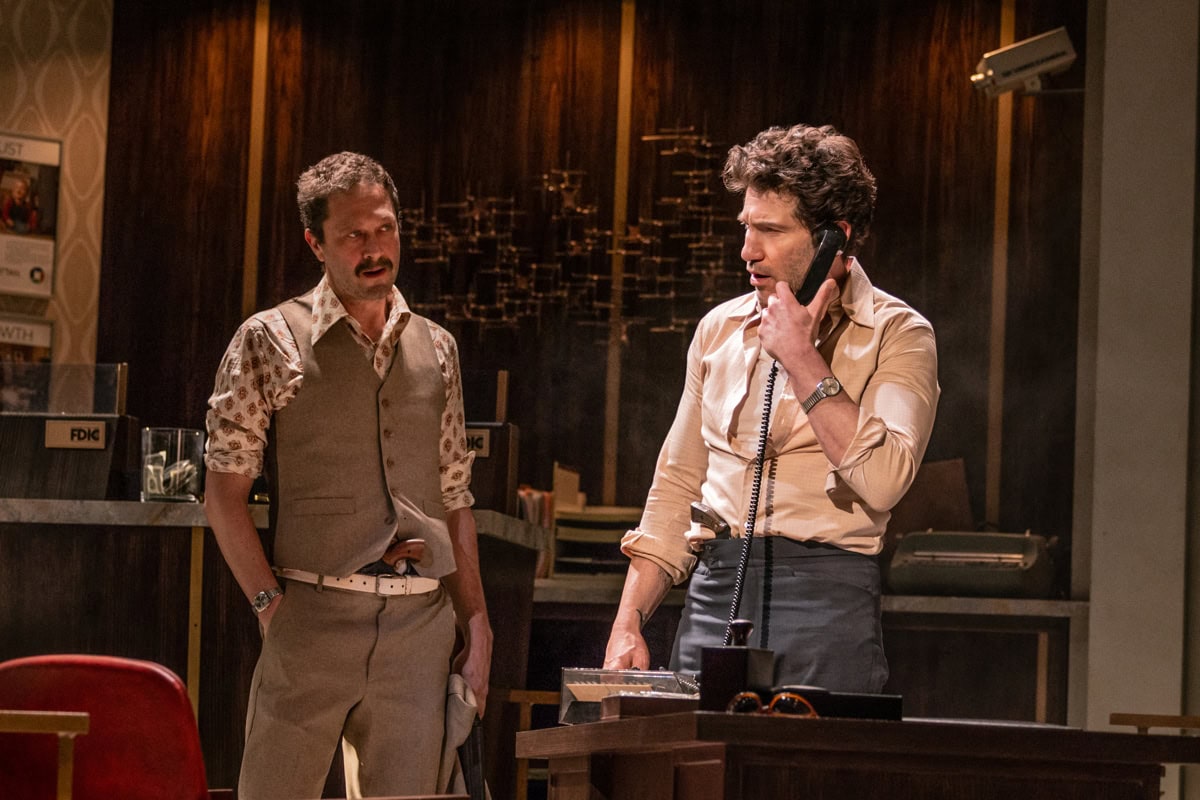
Playwright Stephen Adly Guirgis recently told the New York Times that he was skeptical when invited to adapt Sidney Lumet’s 1975 crime thriller Dog Day Afternoon, about a heist gone very wrong, into a Broadway play. But then he asked himself, “If somebody is going to screw this up, why shouldn’t I be the one to take a crack at it?”
To be fair, Guirgis makes sense on paper for the job. He’s the king of writing unique New York voices, the street-smart wisecrackers or street-dumb losers who populate such funny, moving, and raunchy plays as Between Riverside and Crazy, Halfway Bitches Go Straight to Heaven, and The Motherfucker with the Hat. He’s got an empathetic ear, but he treats his characters—and his audiences—with a crusty tough love, kind of like if David Mamet was chill.
But this adaptation, especially in comparison with the fleet-of-foot, tonally spry film that inspired it (itself based on true events), has the runny quality of a chicken pot pie left out in the summer sun. You can still see the meat, but it’s in all the wrong places, its juice dribbling out diffusely. By the denouement, a tension-free 10 seconds that entirely replaces the film’s high-blood-pressure final 10 minutes, it’s collapsed entirely. Deprived of its fidgety tension, this Dog Day Afternoon isn’t so much a slow burn as a slow melt.
It’s possible to imagine Guirgis inventing characters on his own like the bumbling bank robbers Sonny (Jon Bernthal), a herky-jerky first-time criminal who can’t help but order pizza for his hungry hostages, and Sal (Ebon Moss-Bachrach), a prison vet, a little dead behind his eyes, who tells Sonny with angry, clueless earnestness that the foreign country he’d like to escape to is Wyoming. They plan for a quick get-in-and-getaway heist but almost everything goes wrong: Most of the money’s already been removed from the vault, the security guard passes out, and the bank tellers really have to pee. By the time the police (John Ortiz as a chatty local cop and Spencer Garrett as an all-business F.B.I. agent) get involved, it’s a full-blown hostage situation with a mounting crowd outside anarchically cheering on the perpetrators.
But Guirgis, who closely adheres to the film’s plot but rewrites most of the dialogue in padding out almost every scene (he swaps the pizza for donuts and cuts the Wyoming joke), leaves the characters feeling palely written. He keeps interrupting the tension, unable to capture the way the film deepens Sonny and Sal in smaller moments. And Bernthal and Moss-Bachrach seem trapped between delivering homages to Al Pacino and John Cazale’s performances and fully fleshing out the new versions of the characters. They’re most effective in the contrast between them, Bernthal’s scratchy agitas building friction with Moss-Bachrach’s quiet rage.
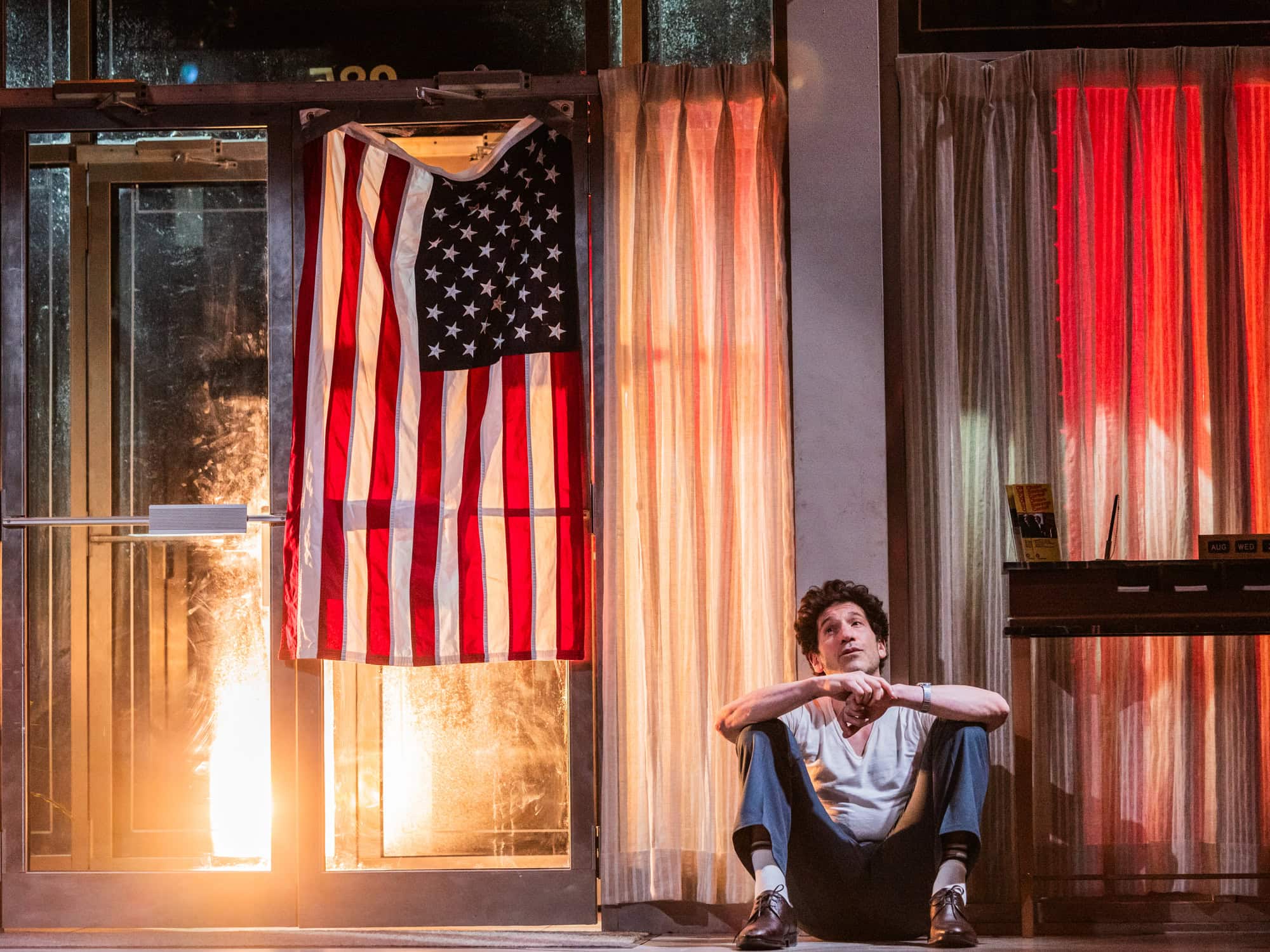
Guirgis, of course, doesn’t bungle things all on his own. (After all, according to another Times piece, he was recently banned from rehearsals.) Director Rupert Goold has a track record of slickly tense film-to-stage reimaginings, but, in the absence of Lumet’s thriller-paced techniques, the longer the hostage situation continues, the less suspense there is left in the room. (Adding an intermission only deflates the tires further.)
The film builds an anxiously expanding world, crash-cutting between the interior of the bank, the growing rabble in the streets, and the shop where the police have headquartered themselves, sometimes even ricocheting up to a helicopter’s-eye view. When Goold wants to switch locations, he has to swivel David Korins’s monumental bank set. The first two times the building moves, it’s exciting, but the set does exactly two things, neither of them very quickly. Those scene changes that are essential to the story’s momentum end up slowing the play down.
In the film, as it travels throughout the bank, the camera catches snatches of quirky behavior and conversation in close-up, especially as the hostages develop a bit of rapid-onset Stockholm syndrome. But it’s trickier to direct a theater audience’s attention without close-ups or panning shots available. The play keeps lurching to a halt to get us to look in the right place: Since everyone in the bank is visible all the time, what might be five different short, swiftly intercut scenes in different spaces on screen all run together as one very long sequence on stage.
Goold, then, hasn’t replaced any of Lumet’s cinematic tools with stage-specific devices of his own, making it hard to ignore just how much extra dialogue there is here. The hostages talk incessantly about their backstories; even the head teller who has to go to the bathroom, played with hard-edged bite by Jessica Hecht, has an added speech about the bladder issues that have plagued her since childhood. The F.B.I. agent launches into long diatribes about N.Y.P.D. corruption. And everyone keeps pausing for the jokes. The film, even in its funniest moments, never loses sight of the fact that everybody’s very much in mortal peril the whole time.
Strangely, Guirgis, who’s caringly created transgender characters before, fumbles the characterization of Leon (Esteban Andres Cruz), whose need for expensive gender-affirming surgery spurred Sonny’s heist plan in the first place. What played in 1975 as an impressively humanizing mainstream depiction of a trans woman struggling with her mental health becomes a coarse stereotype here of promiscuity (“I’m like McDonald’s—over a million served!”). That’s a cheapening approach, and it makes Sonny’s motivations hard to believe in too.
Guirgis also removes a particularly cutting moment from Lumet’s classic—the kind of irony he’d typically relish in his own work. When Pacino’s Sonny releases John Marriott’s ailing Black security guard (Danny Johnson in the play), the cops immediately cuff him, assuming he must be the hostage-taker and not the hostage. That’s grim, socially conscious satire, and Broadway’s lethargic Dog Day Afternoon offers not a whiff of it.
Dog Day Afternoon is now running at the August Wilson Theatre.
Since 2001, we've brought you uncompromising, candid takes on the world of film, music, television, video games, theater, and more. Independently owned and operated publications like Slant have been hit hard in recent years, but we’re committed to keeping our content free and accessible—meaning no paywalls or fees.
If you like what we do, please consider subscribing to our Patreon or making a donation.