As the adage goes, a picture is worth a thousand words. Viewfinder has at least a hundred of them to spare, but the real magic of developer Sad Owl Studios’s first-person photographic puzzle game lies in its artistic, interactive approach to science. Your character is immersed in a simulation created by four individuals—Mirren, Chi Leung, Aharon, and Hiraya—and is desperately searching for the results of a weather-related experiment that might somehow help reverse the devastating effects of climate change in the real world.
Wisely, the game doesn’t get bogged down on the technical aspects of the scientific and mathematical theories that your character wrestles with, or on the ins and outs of the teleporters that Chi Leung has engineered. Viewfinder ends up focusing more on Hiraya’s guitar hoppy than the botanical expertise that she was presumably hired to bring to the simulation. And the game clearly wants players to approach the simulation experiment through the contributions of the artistically inclined Aharon, who’s described at one point as a voice actor, which centers the problem-solving importance of different perspectives working in tandem.
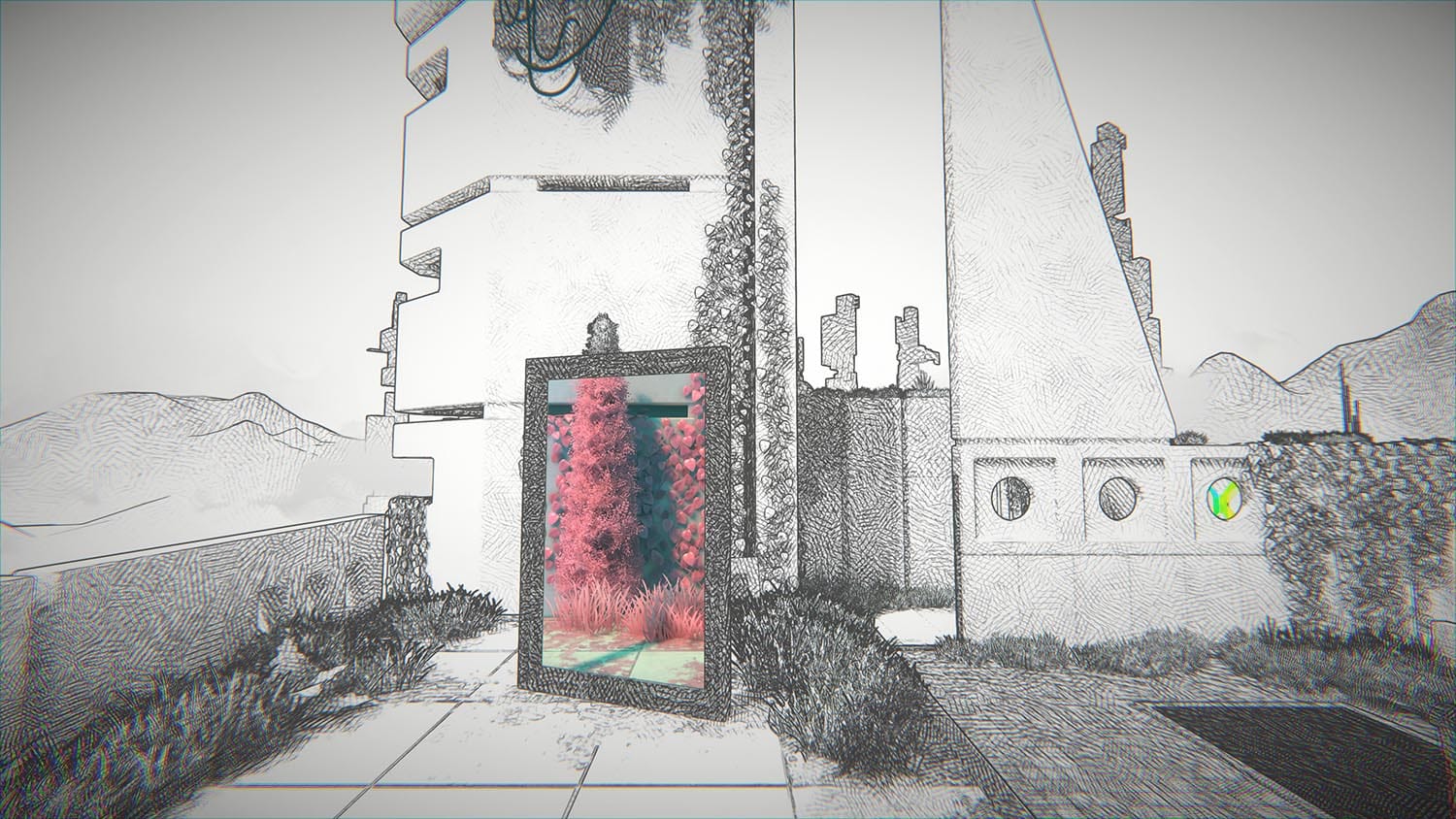
So far as the puzzles go, Viewfinder takes a literal approach to perspective. You’ll collect photographs (you’ll eventually even take your own using an instant camera) before then placing them into the environment, turning 2D objects into 3D ones. Things start simply enough, with, say, the placement a photo of a bridge across two islands so that you can cross to one level’s exit. But you’ll soon be rotating a picture of a wall by 45 degrees so that you can make a ramp or insert a photo of the sky into the environment and slice through a no-longer-impassable wall.
With the exception of a perhaps ill-advised but understandable final level that’s timed, Viewfinder doesn’t rush the player, and it’s all the better for it. The game’s levels abound in interactive found objects and art that sometimes take a moment to notice, from playing cards to a screenshot from the original The Legend of Zelda, and which you’ll want to relish at length. Throughout, the developers thoughtfully acknowledge the way in which our hobbies and pastimes can sometimes lead us to make unexpected discoveries in our work, allowing us to feel clever when we discover how to repurpose something like Edvard Munch’s The Scream.
Not to give it away too much, but your guide through the simulation is a program called the CAIT, and it appears and disappears throughout the game like the Cheshire Cat. As such, it’s only apt that as Viewfinder progresses, it increasingly feels like a journey through the looking glass, with entire sections of the game operating around traversing optical illusions or filters.
Viewfinder’s sense of joy allows it to stand above similar perspective-shifting games like Maquette and Subliminal whose physics, at times, feel much too rigid. It also has a strong narrative through line, with the interactive marginalia of the levels filling in the backgrounds of the four individuals responsible for the simulation. That alone will appease players who found visual thrill rides like Manifold Garden or Antichamber to be too unhinged.
It helps that Viewfinder is no one-gimmick pony, expanding on the use of pictures by introducing fixed objects that cannot be overwritten (or photographed) and timed cameras that enable swift players to go so far as insert their character’s visage into a shot. Solutions are built upon but rarely repeated, and some of the optional levels go so far as to introduce elements, such as a weight-activated scale, that aren’t used anywhere else.
The background music that plays in each of the hub worlds is jazz, and it’s just as intentional as any of the photographs. Jazz is filled with spontaneous moments of harmony, which turns out to be the main ingredient and lure of Viewfinder. This is a game that, as you retrace the steps of four disparate people who did their best to save humanity, lets you riff along the way.
This game was reviewed with code provided by Plan of Attack.
Since 2001, we've brought you uncompromising, candid takes on the world of film, music, television, video games, theater, and more. Independently owned and operated publications like Slant have been hit hard in recent years, but we’re committed to keeping our content free and accessible—meaning no paywalls or fees.
If you like what we do, please consider subscribing to our Patreon or making a donation.