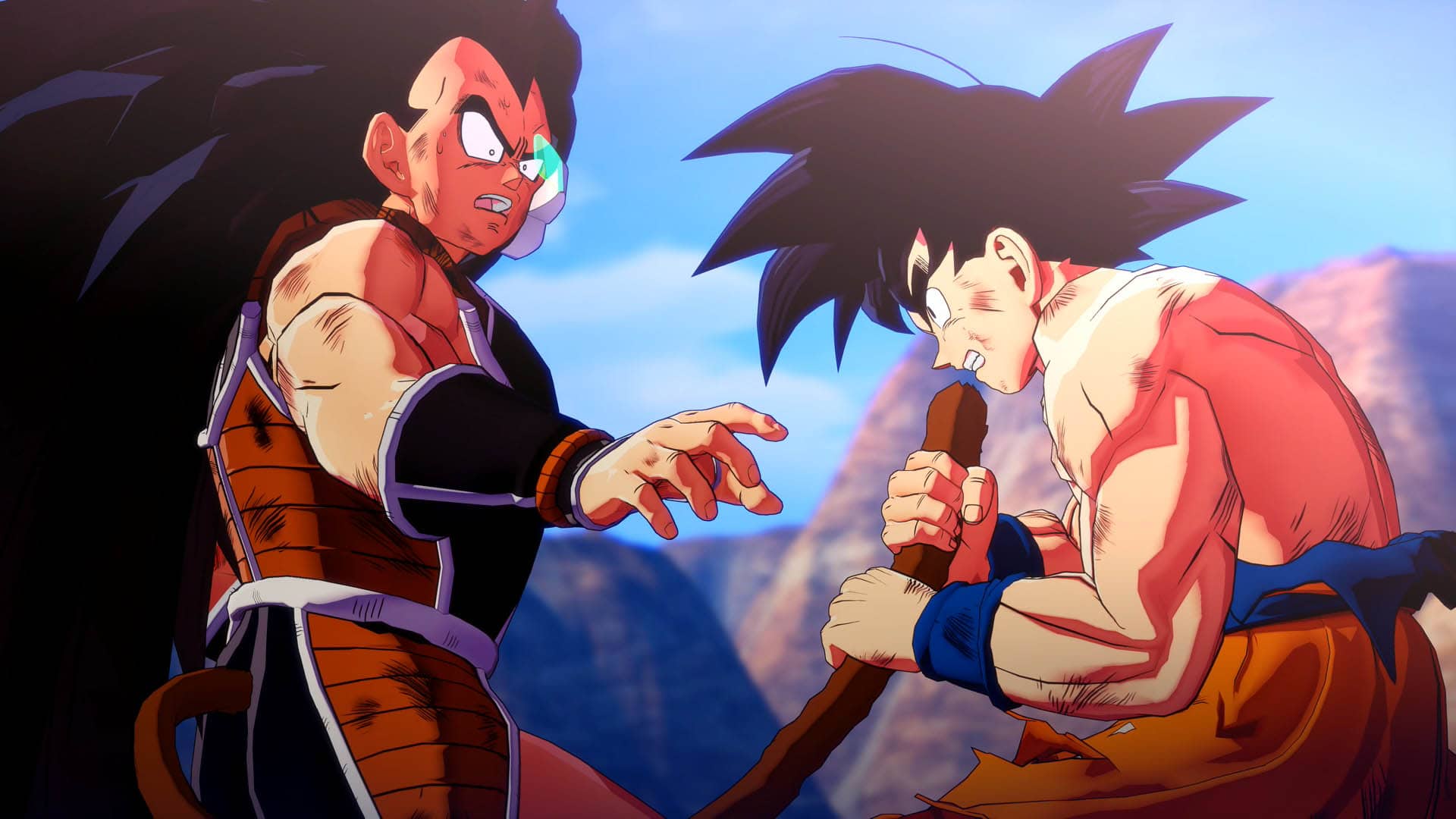
With over nearly 40 years of material to draw from, for any Dragon Ball video game to retell the story of the first Saiyans to arrive on Earth and Goku awakening to his lineage is as lazy as a Star Wars game going to Hoth. And yet, that’s exactly the story that Dragon Ball Z: Kakarot tells, without doing anything new to make it worth telling.
It’d be nice to say that Kakarot at least represented a sea change in telling that story as an RPG, but “DBZ as an RPG” has also been done to death, even done quite well a couple of times. And, for what it’s worth, Kakarot isn’t even remotely the worst example of a Dragon Ball RPG: For that, look no further than the awful, throwaway card-based games.
Visually, this game is largely on par with 2018’s stellar Dragon Ball FighterZ. The combat, while extremely simplified, does capture much of that trademark DBZ flash and destructive flair. And quite a bit of work has gone into recreating the show’s TV-style presentation through interstitials, narration, and music, bringing back the playful tone of the original Japanese production (every version of the show broadcast in the West tries to introduce an edginess that isn’t there in Japanese cuts). The best thing about the game is that it’s the most faithful adaptation of the saga, but that also happens to be the worst thing about it.
The anime was notorious for padding out each episode and each story arc with startling amounts of filler material. That included special attacks that would literally take multiple episodes to charge and fire, slapsticky interludes involving characters light years away from the main action, and, at times, characters just standing around waiting to continue a fight.
There’s a sequence early in the DBZ metaseries where Saiyan baddies Vegeta and Nappa face off against Earth defenders Piccolo, Krillin, and Gohan, but when they sense that Goku—killed in a previous battle with his brother, Raditz—is being resurrected, they literally stop the fight to wait for him to arrive. There’s legitimate reason for that on the show—the anime was in production while the manga was still being drawn, which left the animators stalling for time—but, for reasons beyond explanation, this and other excruciating wheel-spinning has been replicated perfectly in Kakarot. And there’s easily over 25 hours of that sort of scene here. Indeed, this is an RPG that won’t allow the next major story beat to be advanced until you’ve done unrelated busywork to stall for time. What should be rousing nostalgia for the early days of the DBZ series ends up bringing back painful memories of playing Anthem.
What makes Kakarot particularly egregious is how much its padding issues apply to its design. This is, ostensibly, an open-world game, abundant in massive countrysides and cityscapes, but these environments are largely empty. The world here is littered with side missions out in the wild, and most of them amount to uninspired fetch quests. There are cooking and fishing mini-games, though neither of them are as crucial to the plot, character development, or your survival as similar mechanics in The Legend of Zelda: Breath of the Wild or Final Fantasy XV.
In Kakarot, you can fly around collecting orbs that can be spent to unlock new moves, which is fun but not nearly enough to justify all that empty, unused space. There are training grounds scattered across the game’s open world where you can defeat random characters to learn new moves, and there are stores that sell healing items to use during battle. These are both useful resources, but they’re tiny points of light across what’s otherwise miles and miles of nothing.
Though Kakarot comes alive during combat, that’s also not without its flaws. You can perform all manner of light-show-inducing Super Moves by holding the left shoulder and pushing a button. However, as long as you can maneuver properly and you’re stocked up with enough healing items, you can so very easily cheese your way through the entire game by just spamming your most basic attacks. Super Moves wind up being for your own satisfaction than a vital cornerstone of a fight. That’s despite having an entire Final Fantasy-style grid/job system meant to provide enhancements to your team of fighters, and the lack of tension or challenge from fights provides you with absolutely no urgency or incentive to use it.
Kakarot’s overarching problem is one of focus. This is a game made with all the resources necessary to create a great Dragon Ball title, and no small amount of affection for the universe. It also has no ambitions of being more than a set of weak, timewasting barriers between you and witnessing a storyline that fans have seen recreated dozens of times before. Even the folks behind the anime knew there was room to reduce the story to its strongest elements, which is how the abbreviated Dragon Ball Z Kai came about. It’s not certain who exactly needed Dragon Ball Z regressed to its most bloated form, but it does this story no favors.
The game was reviewed using a review code provided by fortyseven communications.
Since 2001, we've brought you uncompromising, candid takes on the world of film, music, television, video games, theater, and more. Independently owned and operated publications like Slant have been hit hard in recent years, but we’re committed to keeping our content free and accessible—meaning no paywalls or fees.
If you like what we do, please consider subscribing to our Patreon or making a donation.