Though plenty of open-world action games have subsumed RPG elements to varying degrees of complexity over the years, the ambitions of Biomutant extend beyond the largely decorative progress bars of its contemporaries. Even with the aid of a marginally helpful tutorial, the sheer amount of stuff going on in the game can initially feel overwhelming, an issue compounded by its affinity for cutesy jargon that sounds like the result of force-feeding Redwall books to Dr. Seuss. The whimsical British narrator constantly chimes in to translate the gibberish languages spoken by the game’s animal characters, while staying amusingly faithful to terminology, as a gun is a “pew-pew” and quest objectives sometimes come in half-intelligible sentences like “find Klink to stronken the klunkfist.”
At the start, the narrator urges you to assign your humanoid mutated animal a class, race, and physique that affects its attributes. And then, soon enough, you find yourself in a post-apocalyptic open world, which is absent of humans and at the center of which is an enormous tree that’s under attack by monsters gnawing at its life-giving roots. You’re urged to take a side in an ongoing tribe war, but you can also start building the separate vehicles that will allow you to take on the world-eaters across a story, while threadbare, is still beholden to overlong sections of dialogue. Additionally, Biomutant features rideable creatures to be tamed; an offshoot of its morality system tied to how people remember you during childhood flashbacks; five elemental resistances, four of which you strengthen or weaken during character creation and can further augment through what armor you use and where you spend upgrade points (which can also be saved up to unlock spell-like abilities); and, of course, color-coded loot.
And yet, even after getting used to everything that Biomutant throws at you, the array of options at your disposal spreads the game rather thin, leaving precious little room for depth. Though certain characters respond differently based on your moral alignment, this system is confounded if you don’t rigidly commit to light or dark and offers dialogue that doesn’t always make sense in context. Likewise, the differences between weapon types are primarily in damage output rather than meaningful shifts in play style, to the point where the button combinations you unlock on a per-weapon basis are all largely the same.
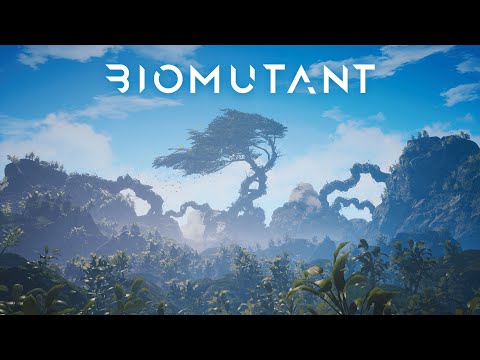
Biomutant seems most committed to presenting players with a variety of options rather than ensuring that any of them are particularly good in the first place. The only one that stands out is the in-depth loot system, where the enhancements or alterations you’ve crafted for an item are not only visible in menu close-ups but also on your mutant character while you run around the game’s open world. The firearms in particular are pleasantly modular, allowing you to cobble disparate types of junk into extremely DIY weapons that might have, say, an ordinary wooden handle in addition to what appears to be the nozzle of a ray gun, while a melee weapon might have a pencil sticking out of it. With a respectable number of visually distinct combinations, Biomutant manages to make its loot treadmill feel rewarding in a way that thinner mechanics like a limited range of psychic powers never really achieve.
Of course, even when Biomutant appears to be in its element, interface irritations abound. Crafting depends on scavenged materials that may be sporadically acquired from combat, from breakable resource totems that don’t always stand out against the foliage, or (most often) from scrapping items that you don’t need. But you can’t immediately break down any loot on the spot, as you have to page through your inventory one item at a time and check each one individually (there’s no option to sort according to resource yield). And because crafting requires the player to open an entirely separate menu tab, any time that you realize that you’re short on materials means quitting out to again sift through the inventory—and that there are five distinct types of raw materials only compounds the issue.
There are other frustrations, too, like enemy health bars and attack indicators all presented in the same indistinct shade of gray, as well as a pointless variety of healing items that only pave the way for more inventory management. At times, these complications seem to suggest that the developers at Sweden-based Experiment 101 are consciously rebelling against the streamlining of so many modern games, which are designed to let players quickly and painlessly suck up crafting materials while they vacantly shamble between waypoints. There is, for example, no on-screen minimap, as if to encourage players to locate points of interest by sight and therefore engage with the environment in a more direct and thoughtful fashion.
However, where other games tend to have a greater purpose and complexity behind more granular mechanics that demand closer attention from the player, Biomutant remains a rather simplified, if overstuffed, game of loot-hoovering. In practice, you’re still chasing objective markers and wandering salvageable areas in hopes of spotting the “interact with object” indicator. But while Biomutant’s breadth of options does indeed make that familiar process more rewarding than the norm, it never quite offsets the accompanying increase in tedium.
The game was reviewed using a code provided by Evolve PR.
Since 2001, we've brought you uncompromising, candid takes on the world of film, music, television, video games, theater, and more. Independently owned and operated publications like Slant have been hit hard in recent years, but we’re committed to keeping our content free and accessible—meaning no paywalls or fees.
If you like what we do, please consider subscribing to our Patreon or making a donation.