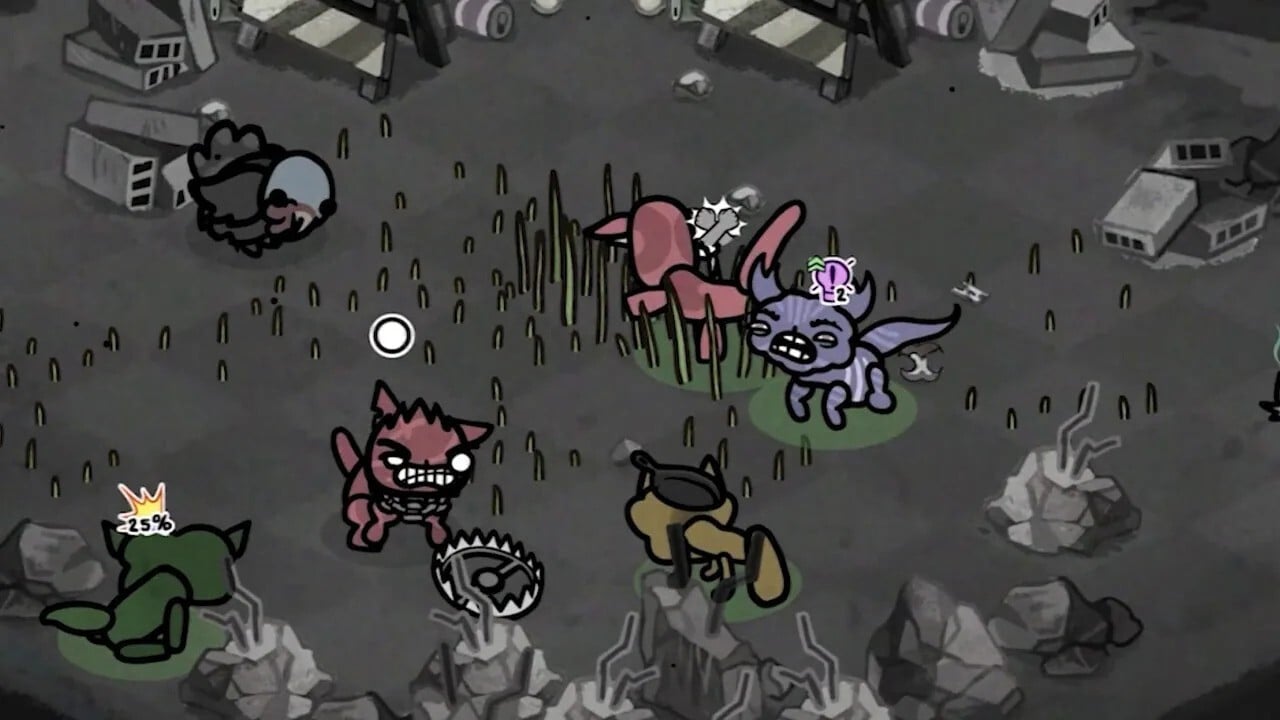
The cats aren’t alright in Mewgenics. If a cat’s health bar depletes in one of the game’s grid-based battles, it suffers a permanent injury that affects its stats. A torn tendon lowers movement range, while a concussion slows regeneration of mana. Cats can also die outright, so if you’re the type who goes to Reddit to find out if anything bad happens to an animal in a piece of media, then this strategy RPG probably isn’t for you.
This is a game where a cat stands no chance against a shark or carnivorous plant. Certainly it will meet its end if its unconscious body takes too many hits. And if a cat goes down while afflicted with the “infested” status acquired from a small spider burrowing under its skin, the body will simply explode and leave only the spiders behind. Don’t get too attached to your feline warriors, and don’t get too comfortable around any zombie helpers you might summon, because they don’t stop to check the allegiance of an incapacitated body before they settle down to eat it.
Despite its simplistic and cutesy art style, Mewgenics is also not for the squeamish. It’s unpleasant in the way that co-creator Edmund McMillen’s other big roguelike, The Binding of Isaac, was unpleasant, boasting shock-value humor that’s been zapped in from the heyday of Flash animation. (Your cats can equip a colostomy bag that spawns little poop avatars, or a necklace of rat entrails.) But like The Binding of Isaac, the game is largely worth gritting your teeth through the juvenilia: Mewgenics is a truly enormous game jam-packed with secrets and synergies, surprising and rewarding even when its pacing frustrates.
To start a run, you tag your hand-picked party of felines with collars that assign them standard RPG classes like fighter, mage, or ranger. From there, they progress through battles and random events, amassing loot and leveling up to learn new abilities and boost their stats. Yet for as much as it might resemble The Binding of Isaac in its visual style and arsenal of scatological weaponry, Mewgenics is all about persistence between runs. The cats that make it home alive can’t be sent back out again, but they hang around and potentially breed new feline adventurers, with parents passing down honed stats and hard-won abilities to their offspring. (In Mewgenics, a kitten is birthed immediately and needs only a day to grow to adulthood.)

With that said, you don’t have as much control over the inheritance process as you might expect. Cats don’t exactly take orders when it comes to breeding, and what skills offspring inherit is limited and random. The feeling is less of careful calculation than of being overwhelmed by sheer numbers; a new stray cat shows up each day, on top of a new kitten or two or three depending on what your residents have gotten up to overnight. Many variables are invisible, revealed only once you’ve reached certain progression thresholds with the game’s NPCs, who will accept excess cats as payment. And that explains the game’s touted 200-hour playtime.
Assorted upgrades (and even some badly-needed organization features) are locked behind rather steep requirements. Ten retired cats to upgrade your inventory space is quite a tall order when you can only send out four at most per run, which means you’re doing three runs at minimum, and only if you don’t lose any cats along the way, keep some around for breeding, or send them to the other NPCs offering different rewards (a house expansion will run you 25 cats).
Which isn’t to say the game gets stale while you’re slowly earning upgrades. Practically every run showers you with something you’ve never encountered before, from items to enemies to skills. So many roguelikes run on the thrill of discovering new systems and strategies, and Mewgenics unlocks an astonishing level of depth and variety through its mechanics. Like the best roguelikes, your discoveries feel seismic and game-breaking, as your necromancer fills the screen with an enormous number of leech companions or your thief refreshes a powerful, coin-powered attack because their passive ability earns them a coin whenever they do damage.
But the game’s slower pace also amplifies the effect of a bad run—when all the randomized variables don’t fall your way and you have to soldier through anyway. Where some games spread their content too thin, Mewgenics has so much that its sluggish meta-progression feels designed to get you to see as much of it as possible, albeit at the cost of satisfying pacing. Even when you’re technically earning something new on each new run, the goal remains nowhere in sight.
This game was reviewed with a code provided by Guillotine Agency Limited.
Since 2001, we've brought you uncompromising, candid takes on the world of film, music, television, video games, theater, and more. Independently owned and operated publications like Slant have been hit hard in recent years, but we’re committed to keeping our content free and accessible—meaning no paywalls or fees.
If you like what we do, please consider subscribing to our Patreon or making a donation.