The best Hitman missions are big and open, set in a picturesque place where bald assassin Agent 47 can go about murdering his targets in a variety of elaborate ways. Most of those options involve impersonating other people by wearing their clothes. But every so often, the series tries linearity on for size. Its worst levels constrain your sense of freedom as you try to off an architect of some illicit criminal operation, funneling you into a more rigid style of play that restricts 47’s movements. With the exception of 2012’s Hitman: Absolution, where they’re the main focus, these levels tend to come late in the games, when developers ratchet up the tension by guiding players through increasingly flashy, bombastic sequences where being able to deviate from the script would ruin the drama.
Starting in 2016, Hitman reclaimed its mojo with the release of the sixth mainline entry in the series, simply titled Hitman, which features some of the most complex, freeform levels ever devised by the development team at IO Interactive. While Hitman 3 still follows that same blueprint, the series’s restrictive instincts again rear their head just as they have in the climaxes of the pre-Absolution games. And that was perhaps inevitable, given that this game is the dramatic conclusion to what IO has called the World of Assassination trilogy and dramatic conclusions have never been Hitman’s strong suit. Hitman 3 is another attempt, for better and worse, to split the difference between player freedom and focused storytelling.
Some levels now, for example, begin or end on set paths made to dole out plot details. The first mission finds 47 scaling the outside of a Dubai skyscraper, nudging you toward a mission story that shepherds your two targets into one room so another character may confront them with a dull monologue on a TV screen. In Chongqing, you must eliminate two targets in order to access a computer terminal, which then triggers a lousy escape sequence that throws squads of guards toting automatic weapons into your path. The game doesn’t, at least, force you to complete these sections again on any further playthroughs, which is important for a series built on replay value, but creating shortcuts to bypass them feels like a begrudging admission of how extraneous the story segments are compared to the meat of the game.
Lest there be any mistake, the familiar rhythms of the latter-day Hitman games are intact here, as the open levels are filled with amusingly convoluted assassinations and “accidents” to set up, as well as disguises that let you access areas otherwise off limits to civilians. Levels from 2016’s Hitman and 2018’s Hitman 2 also slot neatly into this game’s menu, accessible to anyone who owns the prior titles or paid for an access pass. Hitman 3 visibly has the bones of two of the greatest stealth games ever made, which is a tough thing to ruin in one fell swoop. For one, it’s wickedly inventive, from a hilarious drug dealer outfit that 47 can use to lead victims off into secluded corners, to deaths involving things like an industrial grape crusher and an experimental mind-meld. And your deadpan avatar still cracks ominous little jokes to himself across storylines that intersect in bizarre, surprising ways.
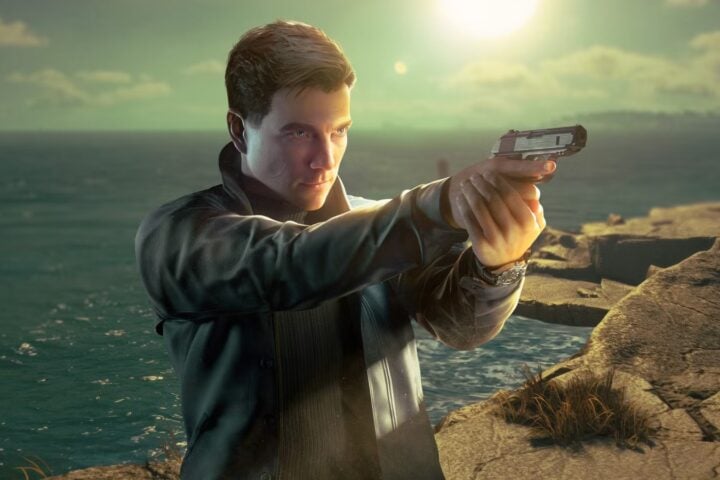
But not all of the game’s tweaks to the series’s winning formula are successful. One much-touted mission drops 47 inside a British mansion, where a murder mystery that doesn’t involve him is in progress. While there are various ways of killing your target, the level seems primarily designed around one path where you impersonate a detective character and search the mansion for clues, in the process showing off the new camera gadget that hacks certain locks and scans objects for information. And beyond the disappointing dearth of possibilities outside the central detective story, the camera feels extraneous at best and harmful to the flow of Hitman 3 at worst, requiring you to repeatedly select it from the inventory screen and look around in first person for something to scan. Combined with the occasional need to search an environment for fuses or keypad codes, the game slows itself down at odd times, encumbering an elegant design with extraneous layers that culminate in a terrible, if mercifully brief, epilogue that strands 47 in the most narrow space that this series has imagined to date.
One of the game’s best levels, set at a Berlin rave, finds 47 roaming a crowded factory in an attempt to identify and eliminate enemy agents, able to pick and choose targets based on who you think you can get to. Compared to the more story-heavy flourishes, this level finds Hitman 3 going back to the basics of having 47 simply hunt down targets in a large area, sans any guided mission stories. Compared to the convoluted cartoon heights of the best assassinations from prior games in the series, the factory level may sound disappointingly simple. But in the context of this particular game, it marks a momentarily invigorating shift for a series that, while still quite enjoyable, seems in danger of once again losing the plot.
The game was reviewed using a review code provided by Tara Bruno PR.
Since 2001, we've brought you uncompromising, candid takes on the world of film, music, television, video games, theater, and more. Independently owned and operated publications like Slant have been hit hard in recent years, but we’re committed to keeping our content free and accessible—meaning no paywalls or fees.
If you like what we do, please consider subscribing to our Patreon or making a donation.