

“On our terms.” That phrase is gravely intoned by revolutionary outlaw Cidolfus “Cid” Telamon repeatedly in Final Fantasy XVI. It points to many things in the story: from the slave class that’s cursed to exhaust their magic powers until they crumble into dust, to those living in far-flung empires, forced to watch their homes invaded and colonized time and time again, and refusing to do so again. But most importantly, it’s the adopted mantra of Cid’s young charge, the orphaned prince Clive Rosfield, who’s borne witness to all the various atrocities staining the land of Valisthea with blood, and resolves to see it all end.
His could have been a simple story of revenge, especially given how Final Fantasy XVI plays throughout its campaign. This is a seamless, thrilling hybrid of open-world exploration and third-person character-based combat that sees Square Enix overwriting much of what passes for traditional RPG mechanics with a loving embrace of combos and aerial juggles.
The affectionate nickname “Devil May Clive” had been bandied about for months before Final Fantasy XVI’s release for a reason. Revenge has its place in the story, but when the game finds its footing a few hours in, Clive and the player will discover themselves on a far more intricate journey, seeking to tear down an established order based on feudalism, class warfare, and inhumanity in order to birth a better world, where people can live and die on their own terms.
Final Fantasy XVI is very much of a piece with the series’s recent efforts, as it takes a much more nuanced, adult approach to the themes that have largely taken a backseat to whimsy for much of Final Fantasy’s lifetime. But it also reveals the limits of Square Enix’s imagination, or, at least, how far the developer is willing to examine the ideas that it sets forth.
The first hours of Final Fantasy XVI wear its Game of Thrones influences on its sleeves. It’s in the political maneuvering, the bespoke fantasy-book vocabulary, and the sex that’s very much intended to raise the audience’s pulse. It’s even in the way that the names of dead kings and eldritch gods fall from the mouths of the characters. A distraction, perhaps, but at least said influences are operating at a fun, imaginative, even scintillating level.
It helps that if a certain term, bit of history, or character backstory flies over the player’s head, there’s an in-game lore guide—even accessible during cutscenes—that will help to clear the air. There are betrayals, murders, mutinies, the fall of a kingdom, one jaw-dropper of a kaiju fight between Eikons—Final Fantasy XVI’s summon monsters—and a 10-year time jump, all before the game takes off its training wheels and lets the player begin their journey in earnest.
In trying to show the player just how epic and edgy it is, though, the early hours do a scattershot job of engaging with the great, all-encompassing cruelty at the story’s center: the unending prejudice and slavery of the magic-wielding Bearers. The story certainly recognizes the problem for the evil that it is, but it flits through the early plot points with a sort of baffling naïveté about how, historically, slaves consider and occasionally solve the problems of their own bondage, as well as the roles that the ruling classes and their privilege play in upholding that oppression.
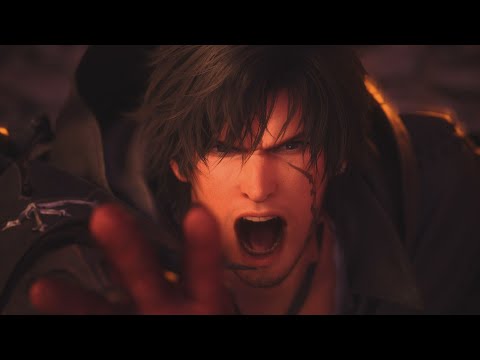
Compounded by a near-total lack of people of color in the story—one nation in Valisthea, the Algeria-modeled Dhalmekia, has brown people in it, and they sound just as British as the rest of the cast—it feels like Final Fantasy XVI is cherry-picking what it wants players to experience throughout the game’s depiction of slavery in order to avoid any real-world allegory. As such, Cid and Clive’s rebellion against oppression comes off more like a flinch than a fist in the air.
As Final Fantasy XVI progresses, though, the evolution of Clive’s arc is executed with deep consideration and empathy. When Clive sees people treated like cattle, the game eschews kneejerk venom and rage for something far more crucial. Clive and Cid’s dreams of freedom start with maintaining and building the Hideaway, a safe haven for freed Bearers to learn and live, and the bulk of Final Fantasy XVI’s most poignant and powerful stories revolve around the use of Clive’s powers, his influence, and his privilege to hear these stories told. Those stories lead him and Cid to view things at the systemic level. Many of the sidequests do allow them to make a difference on a more personal level, but taking down bad apples, reprehensible as they are, isn’t nearly as useful to Clive and Cid’s goals as chopping down the trees they grew on.
The “trees,” in this case, are the Dominants, the royalty of each of Valisthea’s countries, each symbiotically tied to an Eikon, and each embodying not just greed and amoral lust for power, but the colonizer mindset gone nuclear. It may be a misstep on the part of the developers to allow Final Fantasy XVI’s story to stand back from allegory in order to plant its flag firmly in applicability, but the narrative has no problems drawing a straight line from classism to racism to eugenics, even taking things to their ultimate, cosmic horror-flavored conclusion.
The road to taking the worst of these people down is where Clive must draw his sword, and once the game lets him off the chain, it’s a breathtaking sight to behold. The most dazzling moments here, during which you’ll be slaying monsters, rabid animals, mythological creatures, and unholy abominations, are deliberately made accessible to every player, regardless of skill level. While veterans of Devil May Cry or Bayonetta will find that it veers into too-easy terrain, the game is successful at putting the kind of power Clive wields into anyone’s hands.
To be certain, all of that represents a rather massive paradigm shift for a series that even within the past five years spent significant stretches of time on material like sending its protagonists on sidequests for, say, Cups O’ Noodles and performing elaborate magical drag shows to help them sneak into brothels. Even as the Final Fantasy games have touched on some heavy themes in a more adult way of late, Final Fantasy XVI sees the series doubling, even tripling down on grimdark fantasy aesthetics and storytelling at the expense of some measure of wonder.
There are still astonishing displays of magic, series hallmarks like chocobos and moogles as major parts of the plot, and heartwarmingly light touches, as in Clive’s relationship to his steadfast companion, a wolfhound named Torgal. But in its way, Final Fantasy XVI is a game that simply evolves the things that made the series powerful to begin with.
This series has always lived and died on investment in the world, and the characters doing their best to save it. The lion’s share of this game’s creative power has gone into weaving incredible stories of humanity, courage, of broken faith, of failure and redemption, or reconciliation, of pain, and joy in the worst of circumstances. And all of that is held high aloft by stellar voice performances and one of the greatest feats of localization in recent memory.
The most fundamental flaw of Final Fantasy XVI is its inability or unwillingness to delve too deeply into the machinations of inequality, but its greatest strength is how the story details the way that people march forward toward freedom. There’s absolutely no doubt that Clive believes in his home, and while he may be one of only a few to swing a sword, bringing houses and bridges and feeding those with empty stomachs is the work of many. Watching Clive’s work come to fruition and build the world for future generations may be the most powerful summoning spell ever cast in the entirety of Final Fantasy.
This game was reviewed with code provided by fortyseven communications on June 22.
Since 2001, we've brought you uncompromising, candid takes on the world of film, music, television, video games, theater, and more. Independently owned and operated publications like Slant have been hit hard in recent years, but we’re committed to keeping our content free and accessible—meaning no paywalls or fees.
If you like what we do, please consider subscribing to our Patreon or making a donation.


I liked the way you wrote this. It’s a very familiar way of writing, to me personally. The thing with the greatest of FF games is exactly as you describe them; they are like good books you can settle into with a fine glass of wine and be engrossed from start to end. That is the hallmark of a good game.
There is too much trash around these days to waste your time dealing with but Square Enix will not bend or break on identity politics or social Justice issues. They simply want to tell a compelling story and draw people in to play along… and it’s now one of the greatest selling titles in the history of FF for that very reason.
I look forward to starting my journey with this one and seeing what it has to offer, which by all intents and purposes, is promised by many to be a lot.