Games
Review: Far Cry 5
With this entry, the Far Cry series has suddenly decided to crib story ideas from real American nightmares.

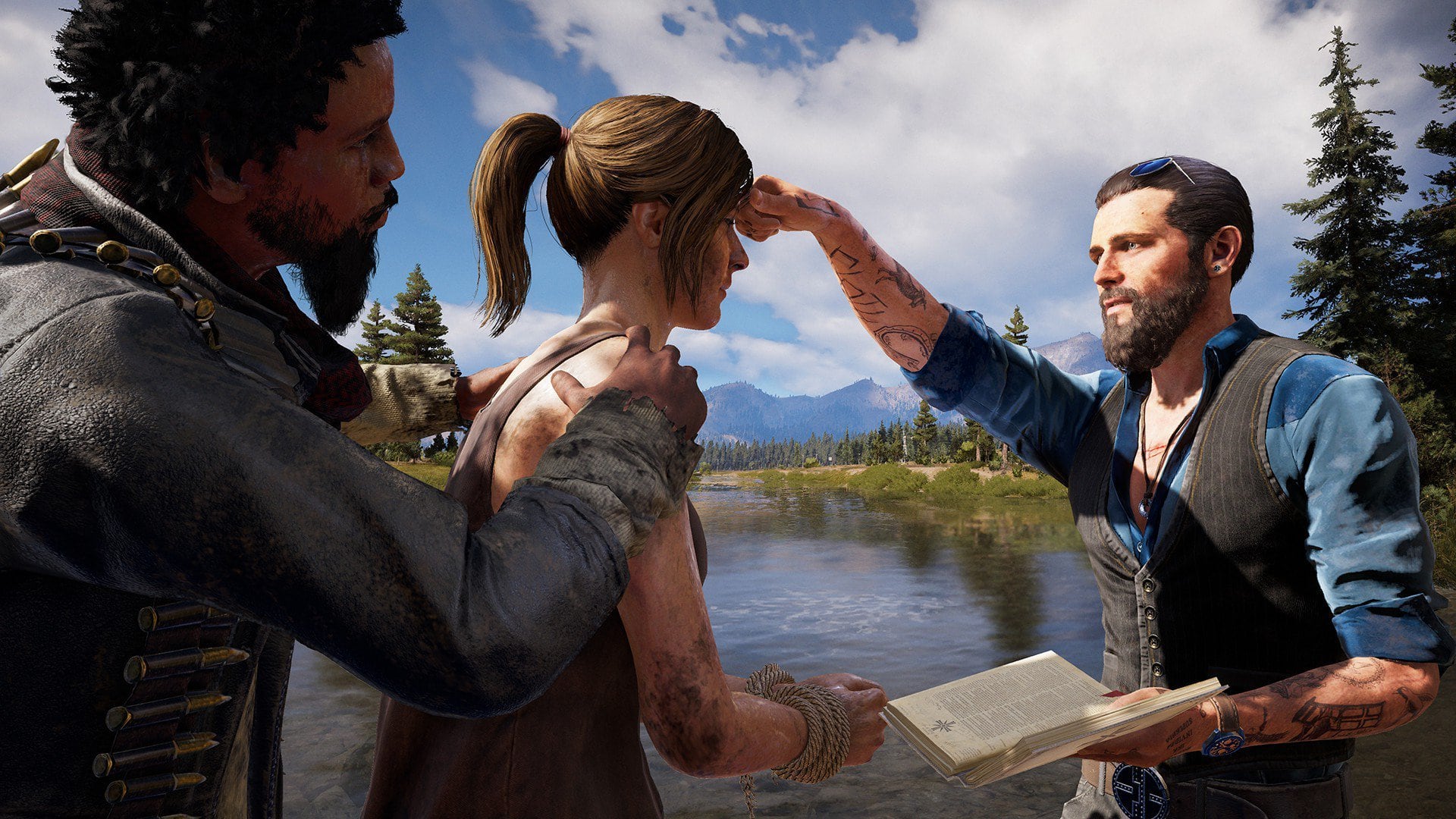
After years playing at guerilla warfare in foreign countries, Far Cry now brings the terror home to the U.S. of A. In Far Cry 5, the despot of the day is Joseph Seed, a hyper-evangelical doomsday preacher who, with his apostolic family, has completely taken over an entire chunk of Montana and enslaved most of its populace using a mix of hallucinogens and old-time religion. You play as a deputy federal marshal—gender and skin color customizable at the game’s outset—who gets sent in with a small fire team to Seed’s compound with a warrant for his arrest. In Far Cry 5’s most unnerving sequence, the arrest goes awry, eventually leaving your deputy broken, bleeding, and half mad scrambling through the backwoods for help, with his or her entire team killed or taken captive by the cult—and with no backup coming.
This would be a uniquely effective setup for a Triple-A title if that game, Outlast 2, didn’t already exist. For all of that game’s faults—chief among them its poorly designed enemies, propensity to lean on shock value, and spiteful cynicism about even the idea of someone choosing to pray to a god at all—it took full narrative advantage of the justified fear of a certain brand of American zealotry. It had the courage to have a conviction, to allow itself to feel disgust, dread, even pity toward its cult. It allowed its protagonist to have his own relationship with faith and internalize the effects of that faith.
Outlast 2 wasn’t subtle, but its approach to exploring the worst aspects of religious fanaticism is far more appropriate to the game’s material than Far Cry’s cartoonish approach to, well, pretty much everything. With the exception of the surprisingly thoughtful Far Cry Primal, all of the Far Cry games have been outlandish to varying degrees. It’s not an accident that the series’s best entry—the gleefully ridiculous Far Cry 3: Blood Dragon—drops the pretense of realism altogether. Far Cry 5 has no convictions. It lacks the courage to say anything about its proximity to very real problems, at a time when “they’re just characters in a video game” has never been further from the truth.
With this entry, the Far Cry series has suddenly decided to crib story ideas from real American nightmares: the Ammon Bundy standoff, Jonestown, the Heaven’s Gate cult, Waco, the Westboro Baptist Church. It indulges a certain level of ejaculatory N.R.A. fantasy about a day when the Second Amendment saves the world, when all those guns hoarded by frightened men, all those survivalist bunkers, all that cynical preparation for the collapse of society proves useful. A regular supply item in this game is called a Prepper Pack. Major secrets are hidden in bunkers filled with canned food and ammo. These little hat tips toward the gun-toting survivalist sect might’ve been worthy of an eye roll had the game come out, say, prior to 2016. But at this particular moment in American life, those tips of the hat feel downright sinister.
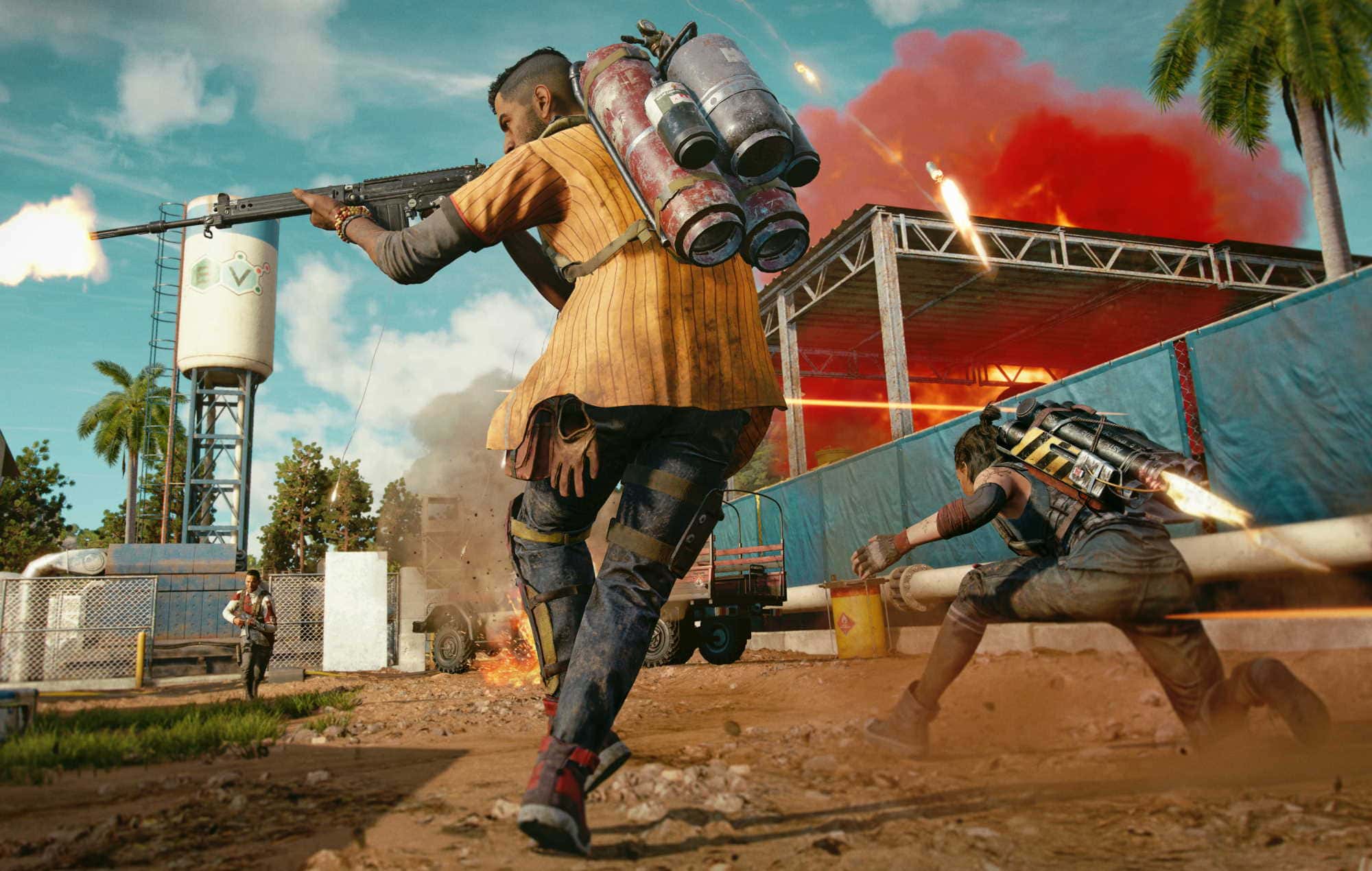
Once the game takes your unnamed deputy marshal off rails, you wake up in a bunker run by a gravelly vet named Dutch who gives you the lowdown on how Montana’s good citizens are resisting the cult, and there are zero scenarios that don’t amount to “I know a guy who has a lot of guns, and if you help kill all the cultists on his property, he might give you some.” The fine details might vary—maybe the cult took over a fertilizer company to make drugs, maybe it cut some phone lines, maybe its members decided to occupy a small town or a trailer park—but there’s nary a problem to be solved that doesn’t involve gunning down any long-haired Jesus freak in a white outfit you come across. Beating one mission means the people you liberated have another mission for you, usually involving procuring more weapons. You earn Resistance Points for every mission, and as you free more of the county from the yoke of the cult, you can eventually earn enough points in that area to take down the Seed relative in charge of that area in a big, dramatic showdown.
In fairness, and Blood Dragon and Far Cry Primal notwithstanding, this isn’t any different from the way every Far Cry game operates; this game’s only real tweak to the formula is that you’re not flitting back and forth between rival factions vying for supremacy. You’re also not constantly climbing radio towers for long stretches, which is a tiny blessing. Divorce it from its narrative and Far Cry 5’s biggest overall problem is just how little mechanical innovation separates the game from Far Cry 4. Once the entire county opens up for exploration, you set about finding a weapon set and vehicle you’re comfortable and effective with, and once you do, you can steamroll through the rest of the game with it. At that point, you are your own cavalry. Co-op becomes redundant, as do the NPC partners you gain. Even the novelty of having animal companions is a step backward from the previous titles. Having your own bear friend around to maul enemies is kind of old hat when you’ve spent a previous game riding an elephant or saber-toothed tiger into battle.
In context, though, Far Cry operating as if it’s business as usual is the series at its most oblivious. Far Cry 5 takes place in a Montana with no indigenous population, but there’s black people on every corner, which is more hilariously implausible than owning a pet bear. And whether intentionally or not, the game gives glory to a brand of grassroots militia fetishism that, just days before the its release, millions of Americans marched in the streets to oppose. It posits that people would need to be brainwashed to follow men like Joseph Seed, blind to how deep Christian fanaticism already runs, and how many would follow such a man if he only said the word “please.”
Developer: UbiSoft Publisher: UbiSoft Platform: PlayStation 4 Release Date: March 27, 2018 ESRB: M ESRB Descriptions: Blood and Gore, Intense Violence, Sexual Themes, Strong Language, Use of Drugs and Alcohol Buy: Game
Features
The 100 Best Video Games of All Time
Greatness is about the way a game can capture the imagination regardless of genre or canonical status.

Two years doesn’t sound like a long enough time to justify updating a list, but as a medium, video games move in bounding strides. Trends come and go, hardware changes, and brand-new games emerge as towering influences on the medium. When we published our initial list of the 100 Greatest Video Games of All Time in 2014, the Xbox One and PlayStation 4 were only a year old. The same can be said with the Nintendo Switch and our 2018 iteration of the list. If four years is just about an eternity, two years is only slightly less so. The medium continues shifting, regardless of when we decide to stop and take stock.
Some games from the two prior iterations of our list have shifted positions, while others are absent entirely; old favorites have claimed the spots of what we treated as new classics, and vice versa; and some of the ones that vanished have triumphantly returned. Those changes speak to the fluidity of an evolving medium as well as to the broadness of experiences to be had within it. How can the same narrow handful of games, the accepted canon that looms large over every games list, hope to represent that diversity? How can a list of the greatest ever be anything but constantly in flux?
When compiling this list, my colleagues and I elected to consider more than historical context. Greatness, to the individual, isn’t just about impact and influence. It’s as much about feeling, about the way a game can capture the imagination regardless of genre or release date or canonical status. The titles on this list come from every corner of the medium—represented for the precision of their control or the beauty of their visuals or the emotion of their story. We’ve chosen to cast a wide net, so as to best represent the individual passions incited by saving planets, stomping on goombas, or simply conversing with vivid characters. Steven Scaife
Editor’s Note: Click here for a list of the titles that made the original incarnation of our list on June 9, 2014.
100. Ico (2001)
Single-player video games are lonely. Ico made loneliness feel magical by giving you a companion, even as it constantly reminded you how alien her mind must be. Just like Princess Yorda’s gnomic utterances imply a story that she just can’t share with you, so does the game’s environment imply a vast narrative of which this story is only a part, creating a potent illusion of context through the very act of withholding backstory. While the gameplay itself is basic puzzle-solving and crude combat, it’s the mood that makes it special, the constant sense that there’s something vast just outside the frame. Daniel McKleinfeld
99. The Talos Principle (2014)
The Talos Principle articulates the conflict between skepticism and the order of God. This juxtaposition comes in the context of a series of puzzles, implying that human and deity have a natural interest in making sense out of chaos. Without moralizing about sin or catering to secularist values, the game implies that inquisitiveness mechanically binds humanity to a common fate. This conflicted but life-affirming perspective trumps the adolescent nihilism that oversimplifies player choice as an illusion. Even if the philosophical angle in The Talos Principle didn’t exist, the game would still be outstanding. The world design allows you to bounce between puzzles while also requiring a certain degree of completion to try higher challenges. Developer Croteam’s gradual integration of several puzzle types is as accessible as it is shrewdly brain-twisting. Jed Pressgrove
98. Spec Ops: The Line (2012)
The ever-shifting sands of Dubai make for a good setting in Spec Ops: The Line: It’s an unreliable environment that matches what turns out to be the game’s unreliable narrator. The military, squad-based action also fits with the theme of responsibility, frequently forcing players to choose between two equally unsavory options. The game’s “Damned If You Do” and “Damned If You Don’t” achievements, earned from killing either a soldier or a civilian, make it clear just how blurry that titular “line” is. Spec Ops: The Line never permits players to rest easily in the distance or abstraction of a long-range war or the novelty of a video game. Players can only focus on the beauty of a blood-orange sandstorm for so long before it dissipates, revealing the gruesome consequences of your violence within it, just as the bird’s-eye view from a dispassionate drone eventually gives way to the revelatory moment in which your squad must wade through the charred bodies of the innocent civilians they just mistakenly dropped white phosphorus upon. The horror, the horror indeed. Aaron Riccio
97. Hitman 2 (2018)
In the exclusive VIP room of the Isle of Sgàil castle, the five members of the Ark Society council gather to discuss their plans to hold power over the world. During this Illuminati-esque gathering, the members of this privileged elite wear masks to conceal their identities—to discuss how they will profit from fixing the climate change disaster they created. But unbeknownst to them, one member isn’t who he seems. The elusive Agent 47, having earlier tossed member Jebediah Block over a balcony, has infiltrated their ranks, and he sets out to murder them all, dishing out his unique brand of darkly comedic justice. Hitman 2, a fusion of escapist wish-fulfillment and satire, has the player deploy its familiar and new stealth mechanics across inventive scenarios. Whether in an exotic jungle or a Vermont suburb, 47 exploits the hyper-detailed nature of his surroundings to complete his executions, and frequently in hilarious disguise. The game gives players the tools to make their own amusing stories within various open worlds, from choking an F1 driver while disguised in a flamingo outfit, to blowing up a Columbian drug lord using an explosive rubber duck, to reprogramming an android so it can gun down an MI5 agent turned freelance assassin played by Sean Bean. Ryan Aston
96. Conker’s Bad Fur Day (2001)
Considering the reason so many of us play video games, it’s odd how often most titles follow a very specific set of unspoken rules. Not so with Conker’s Bad Fur Day, a recklessly unfiltered romp through a parody of inanely inoffensive titles like Banjo-Kazooie. Conker cursed and solved puzzles by getting drunk enough to extinguish flame demons with his piss, blithely sent up pop culture as diverse as A Clockwork Orange, Saving Private Ryan, Alien, and The Matrix, and still had time to lob rolls of toilet paper down the gullet of a giant operatic poo monster. For sheer balls, lunatic ingenuity, and crass charm, there’s never been anything like it. Riccio
95. Star Fox 64 (1997)
The N64 was an awkward era in Nintendo’s history, as the company was getting its sea legs as it was transitioning into 3D gaming. And because of that weird third leg protruding obnoxiously from the center of the system’s controller, it wasn’t exactly easy to play the second title in the Star Fox series. But the controls were responsive, meaning it was at least easy for players to endure Star Fox 64’s steep learning curve. Reminiscent of games like 1985’s Space Harrier and 1995’s Panzer Dragoon, this compelling on-rails space shooter gave us anthropomorphic animals piloting what were ostensibly X-Wing starfighters in a galactic battle against Andross. The game featured local co-op, which made it even more enjoyable because of the multitude of additional explosions on screen. And though it came out toward the end of the 20th century, Star Fox 64 was very clearly inspired by cubist art, making it a perturbing and exciting departure from the vibrant and richly detailed worlds players were exploring in other Nintendo titles. Unsurprisingly, we’re still doing barrel rolls to this day, so we can thank Peppy Hare for the tip all those years ago. Jeremy Winslow
94. Hellblade: Senua’s Sacrifice (2017)
Ninja Theory’s Hellblade: Senua’s Sacrifice is unusually sensitive for a horror game, rejecting as it does the trend of using mental illness for cheap scares. As disturbing as the contradictory voices in the titular protagonist’s head might be, her fractured psychological state doesn’t exist to leave players feeling frightened, but to serve up a philosophical inquiry with universal resonance. Between fights with scores of mythic beings (the one-versus-all war in the Sea of Corpses is among the most ominous action spectacles in gaming history), the player learns that Senua loathes the voices within her as much as she does anything else—and that self-hatred must be recognized and managed in order for her to attain some form of peace. This dark but life-affirming parable amplifies its emotional power through mesmerizing audiovisuals, where hallucinatory whispers argue over whether you’re ever going the right way and motion-capture graphics ironically seem like reality when juxtaposed against full-motion video. Pressgrove
93. Cart Life (2010)
Video games usually de-personalize business management. They shift the perspective upward, letting us look down on workers and customers as they go about the mechanical tasks we designate from on high. Designer Richard Hofmeier’s Cart Life keeps things street level, building a life sim around its business management. Its monochrome characters barely scrape by, stretching cash as far as they’re able while making time to feed cats or pick daughters up from school. Though the game can easily wear you down, it also gives weight to the small victories, like selling enough to keep going. Video games have considerable power to communicate experiences to the player, and it’s used most often for saving worlds and amassing collectibles and jacking cars. Cart Life is a reminder of the humanity the medium is capable of. Scaife
92. Ikaruga (2001)
The standard shooter tasks players with dodging enemy fire and collecting power-ups while unleashing a steady torrent of bullets at one’s foes. Ikaruga masterfully bucks that trend by introducing a polarity system, wherein your ship can only be damaged by bullets of the opposite color of your ship. The game stands apart from other titles in the subgenre of shoot ‘em up known as bullet hell by, well, leaning into the hell of gunfire. This bold choice, which turns like-colored bullets into tools, stylishly revitalizes the genre, forcing players to unlearn old habits and adapt to new ones that see them boldly flying into a stream of white lasers, swapping polarity, and then releasing a barrage of fully charged black homing missiles on one’s foes. Everything in these often claustrophobic corridors becomes an elegant puzzle, one where players must, judo-like, turn the enemy’s barrage against it. High-score runs and harder difficulties require even more elegance and precision, as these modes now also expect players to pinpoint foes so as to kill identically colored targets in combo-creating sets of three, or to recharge ammunition by bathing in enemy bullets. Every single bullet is an opportunity in Ikaruga, assuming the player is bold enough to make them count. Riccio
91. Xenoblade Chronicles (2010)
Xenoblade Chronicles, like fellow 2012 JRPG revivalist (and Chrono Trigger-indebted) Final Fantasy XIII-2, cleverly uses the thematic components of shifting destinies and humankind versus higher powers as ways in which to depict the oscillating mental states of its central characters. You won’t be likely to find a more fleshed-out batch of heroes than 18-year-old sword-swinger Shulk and his ragtag group of Mechon-battlers. Creator Tetsuya Takahashi clearly understands that a great RPG starts and ends with its cast, and how well players can identify with their specific, often extrinsic, ambitions and dreams. Monolith Soft’s ambitious epic is beautiful, challenging, emotionally gripping, and, above all, effortlessly transporting. Mike LeChevallier
Games
Review: Animal Crossing: New Horizons Makes You the God of the Sandbox
After a while, the game inadvertently becomes about the cost and upkeep of civilization.

House. Museum. Town hall. General store. In previous Animal Crossing games, these establishments are already in place when your character arrives on the scene. Players enter a space constructed before their arrival, the lone human going off to live a calm, idyllic country life among a community of anthropomorphic animal neighbors. Which makes Animal Crossing: New Horizons instantly notable for shipping your character, alongside racoon entrepreneur Tom Nook and a few other animal cohorts, to a deserted island, where the layout and design are ultimately up to you and your imagination.
The prior game in the series, New Leaf, gave you the office of mayor, but such a title pales in comparison to that of “resident representative.” The island you’ll call home here is practically a blank slate: Neighbors ask where you think they should pitch their tents, and there’s no museum until you donate enough specimens to designate the island as a place of interest and choose where the building goes. Later, when there are bridges across the rivers and inclines leading up into the cliffs, it’s because you paid to put them there.
Animal Crossing has always entrusted players with a unique amount of power among the townsfolk: Though your animal neighbors have their own opinions and interests, only players alone can make bigger decisions like donate to the museum or cut down trees. But in spite of that division, the series has always taken great care to emphasize its beautiful illusion of community rather than give way to some individualistic fantasy. It thrives on getting you to consider its larger context, the idea that you belong to this greater whole and any changes will benefit that whole as much as the individual. Through minutes that pass by in real time and activities that change based on month or time of day, the games cultivate a sort of relationship between players and the virtual space they eventually inhabit. We come to know its layout and its occupants, moving around the place and helping to maintain it rather than cutting some chaotic swath through the middle. Especially in video games, such consideration of the world around you is too often a foreign concept.
By consolidating so much power in the hands of an individual player, New Horizons threatens to upend the Animal Crossing vision of community living. Initially, though, this game’s emphasis on building a hometown from scratch meshes surprisingly well with the franchise’s uniquely relaxed pace. Though the new customization options—including a robust interior decorating menu and the ability to place items outdoors around the island, essentially creating parks and playgrounds at will—represent some of the most seismic changes to the series in nearly 20 years, the tweaks you make to the island feel as consequential as ever because the game still imposes limitations. The store still only sells a certain number of items per day, at certain hours. Some of the furniture must be built from scratch using the new crafting system, which depends on tool durability and the availability of resources. These are the boundaries you have to respect, and the solitary chair you might set out on the beach truly seems to mean something, especially early in the game.
You put in the work without losing sight of others’ needs; you’re supposed to interact with the animals and keep the whole place looking nice because it’s what they want too. The process of building a town remains incremental, even tedious in spots, and that’s important for balancing the new suite of options available to the player, for ensuring the little things still matter. You work at this slower pace to do one thing rather than pump the world for loot and resources as quickly and myopically as possible. Small UI quirks appear tuned to discourage really putting your nose to the grindstone, as in how the game prevents you from crafting items in bulk. Even the helpful Nook Miles system, which more directly guides players to tasks via currency rewards, isn’t conducive to sorting and hides many of the tasks until you already perform them independently.
But regardless of how much players are encouraged to pace themselves, the more task-oriented nature of the game wins out. Resource requirements can be steep, particularly for one early effort involving crafting a ton of furniture to populate three prospective homes. While it’s possible to gradually accumulate the necessary materials for such an extensive job, the game nudges you to consider another option: randomly generated islands that are all but created for the express purpose of being razed to quickly get more wood and iron.
New Horizons isn’t oblivious to these destructive overtones, even poking fun at them with how a dodo pilot remarks that “no one has to know” what you do to the random, conspicuously nameless islands. But the generally pleasant atmosphere keeps any real sleaziness at bay, making such moments more like small cracks in a carefully cultivated façade. Your actions have no real consequences: The pillaged islands disappear forever once you leave, after all, while the default axe will even get you wood from trees without the ugliness of actually cutting them down. And if you do fully cut something down, there’s no reason to worry; entire trees can be dug up and transplanted elsewhere, without the trouble of waiting for a tiny sapling to grow. No matter what you do, you encounter few problems or pushback, few obstacles to basking in Animal Crossing’s characteristically endearing dialogue and atmosphere. It’s all out of sight and out of mind.
But the cracks add up, allowing an ugly reality to seep into an otherwise friendly fantasy. The game inadvertently becomes about the cost and upkeep of civilization, about what actions we’re willing to turn a blind eye toward just as long as things keep running smoothly. And through that solipsistic lens, even the most innocuous actions begin to look less like the incidental elements of a simulated life and more plainly transactional. Rather than simply showing up on Saturdays as a wandering musician like in prior entries, guitar-playing dog K.K. Slider first visits the island explicitly in recognition of your efforts for sprucing the place up; he’s something to be acquired, a goal to work for at the behest of Tom Nook. Castaway bird Gulliver repeatedly demands an exchange of labor: Bring him five communicator parts buried in the sand. When animals have just one briefer-than-usual dialogue snippet the very first time you speak to them in a day, is that to slightly hasten your progress toward the eventual Nook Miles reward for speaking to multiple animals?
Eventually, you get game-changing terrain tools to freely remap the cliffs and the water, and at that point the only thing holding your island together is any attachment you’ve fostered with the way things have looked for the many prior hours of play. And maybe we choose to keep things the way they are, despite the power to reshape and remake however we please. Enough of Animal Crossing: New Horizons is still measured and thoughtful enough to foster those connections that make the series so refreshing and vital. But it also feels tainted, with its world so much more blatantly at your mercy. Rather than a newcomer to a simulated community that was there before you, you’re now the god of the sandbox.
The game was reviewed using a review code provided by Golin.
Developer: Nintendo Publisher: Nintendo Platform: Switch Release Date: March 20, 2020 ESRB: E ESRB Descriptions: Comic Mischief Buy: Game
Games
Review: In Other Waters Is an Immersive, If Too Sequential, Sci-Fi Quest
The game offers a refreshing focus on its sense of place rather than ease of play.

The alien ecosystem of planet Gliese 677Cc is vast, an underwater expanse of flora and fauna in symbiotic relationships. Some creatures feed from the forest of sentient stalks that grow on a reef, while others thrive within a deep abyss of toxic yellow brine. In British developer Gareth Damian Martin’s In Other Waters, xenobiologist Ellery Vas witnesses and catalogs these new, awe-inspiring forms of extraterrestrial life while searching for the missing Minae Nomura, who mysteriously called Ellery to this remote world.
You play the game as an A.I. within Ellery’s diving suit, a sentient being that can only perceive that beautiful world through a two-color user interface. The things that are so striking to Ellery are dots and lines to the A.I., and they’re brought to life primarily through Ellery’s descriptions, which are displayed in a text readout on the UI alongside the map, depth counter, and meters regulating power and oxygen. The toolset is limited but intentionally so; think Subnautica but filtered through the interfaces of Nauticrawl, Duskers, or your average text adventure. Similar to the life on the planet itself, the A.I. and Ellery are dependent on each other, both of them like separate senses working in concert to navigate the ecosystem.
Even the parts of the interface that feel clunky feed into the methodical experience. It’s hard to multitask since pulling up the inventory will, for example, minimize Ellery’s descriptive text; there’s a certain rickety, tactile satisfaction to paging through the spare menus this way, pinging the environment for scannable objects and switching to the navigation function when you must move quickly (though certainly not too quickly) across the ocean floor.
Beyond the magnificent interface, the world of In Other Waters is thoughtful in a way few other games can claim. The relationships between the plant life and the animals feel considered and sensible, rather than all over the place; there aren’t a lot of obstacles strewn about with explanations dreamt up after the fact. The game offers a refreshing focus on its sense of place rather than ease of play, though the systems for cataloging the world take that ethos far enough that the overall pacing suffers. As you bring samples from the field back to a home base, Ellery’s taxonomy records are gradually and accordingly updated, first with rather verbose descriptions and theories of behavior and then, finally, with a sketch.
While it makes all the sense in the world for the characters to parse information only in a safe place, in practice the delay between collecting in the field and analyzing at home base mostly just inundates the player with an intimidating amount of text all at once. Likewise, the way In Other Waters gifts the player a sketch only after fully updating a creature’s record contradicts how Ellery’s descriptions gradually cultivate a mental image, sometimes upending what you might have pictured in your head. But because a sketch is the most significant prize compared to paragraphs of behavioral theory, the sketch must naturally come last in the manner of familiar-seeming tiered video-game reward hierarchy.
Much of the game’s naturalism similarly conflicts with design that’s overtly linear and story-driven. Though some areas are longer and roundabout with multiple paths, In Other Waters gates progress in rather typical fashion: If you hit a wall, you have to come back to an area later with the appropriate upgrade. The more elusive samples you need to complete a taxonomy are located on side paths, as the optional collectibles of this video game world. If the ecosystem of a game like Subnautica seems much more fantastical by comparison, its open nature nevertheless weaves a more coherent sense of place. For as much as In Other Waters cultivates an impressive, often beautiful feeling of exploration and discovery, its design is too neat and sequential to totally obscure how constructed its “natural” world truly is.
The game was reviewed using a review code provided by Evolve PR.
Developer: Jump Over the Age Publisher: Fellow Traveller Platform: Switch Release Date: April 3, 2020 ESRB: T ESRB Descriptions: Mild Violence Buy: Game
Games
Review: Resident Evil 3 Is a Slick Hell Ride that Doesn’t Stick in the Mind
The element of fear that Resident Evil is known for isn’t as fully baked into the mechanics of this remake as it could have.

After two games in the Resident Evil series that do revolutionary work in bringing the horror back to survival horror, it’s a little disappointing to encounter a title in the series that feels so safe and expected. Nonetheless, it’s a disappointment that many would still kill for, as Resident Evil 3, then and now, doesn’t lack for spectacular frights.
Set a few days before the events of Resident Evil 2, the game follows original Resident Evil protagonist Jill Valentine—now bearing an odd, uncanny resemblance to Natalie Portman in Annihilation—on the night the T-virus outbreak kicks into high gear. Raccoon City’s fires are still burning and survivors are still running for cover. Jill is holed up in her apartment when she’s brutally confronted by Nemesis, a massive abomination of calcified flesh and teeth that’s deliberately hunting the surviving members of her squad. She goes on the offensive after she joins up with a squad of Umbrella mercenaries trying to find a way out of the city.
This new but not so improved Resident Evil 3 feels closer to an extended DLC package for Resident Evil 2 than a major advancement of its ideas. Graphically and mechanically, not much has changed between the two except the characters involved, as this remake also uses a third-person, over-the-shoulder camera, features stronger-than-usual undead ghoulies, and places in your hands weapons that, while they hit hard, necessitate ammo that’s hard to come by. And it all leads to an eventual showdown with the hulking monstrosity who’s hunting you down.
This does mean that Resident Evil 3 shares its predecessors strengths: The game is phenomenal at making not just gore, but tried-and-true jump scares, deeply effective and unnerving, while also showing off some truly inspired and terrifying creature designs in the process, especially when the more mutated behemoths start showing up. Of particular highlight here are the Gamma Hunters wandering Raccoon City’s sewers, whose gaping maws can gruesomely swallow characters whole if they get close enough to them.
But the fear that this game instills in the player isn’t all-encompassing, and that’s in spite of the hard-hitting action set pieces involving Nemesis. They’re well-executed, for placing the giant brute where he can best send an impromptu, panic-stricken bolt up the player’s spine, but he’s not utilized nearly as well as the all-seeing, all-knowing, all-hearing Mr. X was in Resident Evil 2. This Resident Evil 3 can be hair-raising, but there’s a sense of predictability that keeps you from being truly unmoored and paranoid throughout the campaign. There are a few moments of abstract terror—the most intriguing of which is a particular sequence early on where Jill must navigate a power grid maze while being pursued by spiders that infect her with hallucinatory parasites—but these moments are brief and rather self-contained.
In the end, the element of fear that Resident Evil is known for isn’t as fully baked into the mechanics of this remake as it is in prior entries in the series, and it’s up to the rest of the game to pick up the slack. This is, yes, a Resident Evil with a flimsier storyline than most, and the developers at Capcom at least knew that leaning harder into the action side of being a horror-action title was an admirable direction to go in. Indeed, the action here is consistently frenetic and bloody, and there’s still a gruesome, wet streak to the design of this urban-apocalyptic hell ride. It’s just that, overall, this new Resident Evil 3 offers a more fleeting experience than Resident Evil 2, out to electrify in the moment than truly stick in the mind.
The game was reviewed using a code provided by fortyseven communications.
Developer: Capcom Publisher: Capcom Platform: PlayStation 4 Release Date: April 3, 2020 ESRB: M ESRB Descriptions: Blood and Gore, Intense Violence, Strong Language Buy: Game
Games
Review: Nioh 2 Frustratingly Fights Against Its Own Framework
The game is limited by the static nature of its mission-based structure and the protagonist’s severe lack of motivation.

Hide, the half-human, half-Yokai protagonist of Nioh 2, fights against both a slew of historical figures from the late Sengoku period and a horde of colorful monsters. But bigger than any battle in the game is the one Team Ninja fought behind the scenes in trying to follow in the footsteps of 2017’s Nioh without getting too repetitive. It’s a goal they don’t quite achieve. The core gameplay of the original has been expanded upon, with fun new weapons like a scythe-spear hybrid called the switchglaive and terrifying new monsters like the Ippon-Datara, which bounces toward you using its massive sword as a pogo stick. But the level-to-level design remains disappointingly the same, however much Nioh 2 tries to distract from it. Even the game’s extra dimension—a surreal Dark Realm—does little more than add a splash of magical color to each arena and provide bosses with a wider range of attacks.
All of these new features are just wallpaper over the same repetitive loops. You get all of the methodical, punishing combat of Dark Souls and the loot collecting of Diablo but none of the freedom offered by those titles. Without the illusion of progressing through a larger, interconnected world, players are essentially resetting between each mission, over and over again. Visual variety and the occasional gimmick—a burning multistory foundry, a river that can be dammed, a haunted forest with spectral spotlights that must be avoided—cannot fully paper over the game’s inescapable linearity. Whether you’re manipulating a massive mining elevator or pushing through an enemy encampment in the valleys of Anegawa, each area mainly serves as a gauntlet of escalating encounters. Side missions are even more linear, and the way that they recycle smaller areas of the main missions, but at different hours or seasons, at times makes Nioh 2 feel like the world’s slowest racing game.
Nioh 2 admirably attempts to cover a large chunk of Japanese history, beginning in 1555 and ending (for the most part) in 1598. But to do so, the game veers toward broad depictions of historical figures and events, and it assumes that players are familiar enough with Oda Nobunaga and Toyotomi Hideyoshi to fill in the missing context and motivation for what’s shown, like the raid on Inabayama Castle. Worse, the protagonist is largely treated as a mute bystander, inexplicably doing the bidding of their bumbling employer, Tokichiro. The story is so emotionally shallow and poorly presented that even big narrative cutscenes, like the one in which Hide confronts their father, are only clearly laid out in the in-game synopsis.
Thankfully, the game’s combat is never anything other than crystal clear. Each melee weapon has a low, medium, and high stance, and players can use a purifying pulse to chain together combos from multiple weapons or poses. Managing one’s ki (or stamina) is more fluid than in other Dark Souls-like games because of the ways in which it can be recovered, and this leads to a faster, more balletic form of battling, one that has learned all the right lessons from Sekiro: Shadows Die Twice, right down to its high-risk, high-reward form of Burst Counters.
The wide variety of Yokai also forces players to keep adapting the way in which they approach foes throughout the game, and the weapons used to do so; a spear, for instance, does well to keep the ember-winged Koroka at bay, whereas a pair of agile hatchets may be the better counter against the snake-headed Rokrokubi. Best of all, players can appropriate the special attacks of these Yokai by gathering and equipping their cores, Pokémon-style. If anything, the game’s so flexible that it devalues the blacksmith and shrine attunement options, as there’s rarely a need to spend resources leveling up existing gear or cores when you can instead simply keep swapping to newly discovered, fresher options.
Nioh 2 has also made it easier to recruit allies, which helps to alleviate the game’s overall difficulty. You can still challenge evil versions of other players at Revenant Graves, hoping to win a piece of their gear, but now you have the Benevolent Graves, where you can summon good versions of those players to fight alongside you until they die. It’s a nice concession to those who want a little more control over the game’s high difficulty, and while you can still go it alone for maximum challenge, these extra units can provide some valuable breathing room.
For as much as Nioh 2 has improved the variety and accessibility of the original’s combat, it’s still limited by the static nature of its mission-based structure and the protagonist’s severe lack of motivation. Worse, the environments and story now seem more visibly to be coasting in a post-Sekiro world. In short, we’ve seen all of this before. Ultimately, while the in-game fighting against samurai and Yokai works well, it’s impossible to ignore the many ways in which Nioh 2 seems to be fighting against its own framework.
The game was reviewed using a retail copy purchased by the reviewer.
Developer: Team Ninja Publisher: Sony Interactive Entertainment Platform: PlayStation 4 Release Date: March 13, 2020 ESRB: M ESRB Descriptions: Blood and Gore, Suggestive Themes, Violence Buy: Game
Features
The 25 Best Horror Games of All Time
Our list is, in part, an attempt to reflect the broad spectrum of frights in the world of gaming.

When people think of horror-themed video games, their minds often go to the survival-horror conventions popularized by the Resident Evil and Silent Hill series. Of being stuck in claustrophobic and menacing places, of running low on resources, of limping from an injury as some ghastly being drags or stomps toward you, following your trail of blood. To survive in the world of these games depends as much on how players use their unique skill sets as it does on how they learn to manage their nerves.
Yes, sometimes the effect of a horror game is not unlike that of a schlocky jump scare-athon, but horror comes in many shades across all mediums. For one, there are the action titles, like Super Ghouls ‘n Ghosts and Bloodborne, that rely on the concepts of well-known horror stories, sinister and theatrical music, and well-above-average difficulty levels to intimidate and overwhelm players. And the terrifying logic of fever dreams, rather than the creaky old machinery of horror, can foist an otherwise non-gloomy series like The Legend of the Zelda into the realm of nightmares.
Our list is, in part, an attempt to reflect the broad spectrum of frights in the world of gaming. But more than anything, the following selections represent what we believe are the most provocative, well-executed, and timeless examples of horror in the medium. Jed Pressgrove
25. Paratopic (2018)
Breathe it in, the grime and the decay and the desperation rendered in Paratopic’s stark, lo-fi polygons. The game’s world is ambiguous and anonymous and empty, leading you through wilderness and concrete sprawl. It pulls you into garbled faces, pushes you down highways with no company but a suitcase and a distorted radio. You become disoriented as the game cuts away, throwing you into other perspectives and then back again. Are you in control? Is your fate truly your own? The long, still moments between cuts leave space for the dread of this world to seep in and build anticipation for something terrible. It seems inevitable. A short, experimental game from designers Jessica Harvey and Doc Burford and composer BeauChaotica, Paratopic is the nightmare version of so-called walking simulators, revealing the existential horror simmering just beneath their constraints. Steven Scaife
24. Castlevania: Bloodlines (1993)
The gothic-themed Castlevania games have always featured a wide assortment of iconic scary figures, from Frankenstein to the Grim Reaper to primary antagonist Dracula. But it wasn’t until 1993, with the release of Castlevania: Bloodlines, that the series achieved a more chilling and disorienting brand of horror, with platforms that inexplicably drip blood, a boss that may arouse your unexpected sympathy when it begins to nervously clutch its beaten head, and a Leaning Tower of Pisa stage that imprisons the player in a state of hurried movement and vertigo. Visual tricks throughout the game ratchet up a sense of shock and confusion, culminating in a final level that defiantly cuts the traditional side-scrolling view into three uneven sections so as to scramble the positions of the main character’s body parts on the screen. A masterpiece of ambitious 2D game design, Castlevania: Bloodlines doesn’t need three-dimensional space to discombobulate one’s senses. Pressgrove
23. Parasite Eve (1998)
With its concise length, mixture of active time battle and survival-horror gameplay, and modern New York City setting, 1998’s Parasite Eve was a dramatic risk for director Takashi Tokita. Leaving behind the traditional adventurous spirit of the games that made Square famous as a company, Parasite Eve is marked by a melancholic and disturbing type of energy, as in its opening doozy of a scene, which starts with the Statue of Liberty looking as if she’s been struck by grief and ends with an opera performance that climaxes with its audience members bursting helplessly into flames. The game’s emphasis on gun resource management suggests a nod to the tension-building methods of Resident Evil, but the true terror in Parasite Eve lies in the emotional and psychological vulnerability of rookie cop protagonist Aya, who mourns her dead sister and whose source of supernatural power has an uncomfortably close connection to the evil feminine force that she must conquer.Pressgrove
22. The Last of Us (2013)
Come for the zombies, stay for the giraffes. Dead Space fans will smile as they navigate claustrophobic sewage tunnels, Metal Gear Solid vets will have a blast outmaneuvering a psychotic cannibal, Resident Evil junkies will enjoy trying to sneak past noise-sensitive Clickers, Fallout experts will find every scrap of material to scavenge, Dead Rising pros will put Joel’s limited ammunition and makeshift shivs to good use, and Walking Dead fans will be instantly charmed by the evolving relationship between grizzled Joel and the tough young girl, Ellie, he’s protecting. But The Last of Us stands decaying heads and rotting shoulders above its peers because it’s not just about the relentless struggle to survive, but the beauty that remains: the sun sparkling off a distant hydroelectric dam; the banks of pure, unsullied snow; even the wispy elegance of otherwise toxic spores. Oh, and giraffes, carelessly walking through vegetative cities, the long-necked light at the end of the tunnel that’s worth surviving for. Aaron Riccio
21. Will You Ever Return? 2 (2012)
Jack King-Spooner’s singular vision of hell is grotesque and discordant, with bits of clay jammed together amid cut-out art, jaunty tunes, and squishy noises. Playing as the mugger from the previous game (which is bundled with this sequel in the Will You Ever Return? Double Feature), you take in infernal sights that, at first, seem impossibly goofy. There’s only one real jump scare in the whole game, yet the way this visual and aural assault oscillates between comedy, sadness, and ominous prescience accumulates its own disturbing, soulful power. Staring long enough at the jerky, claymation torture rooms sneaks beneath our usual resistance to traditional horror imagery, prodding at philosophical weak points we didn’t know we had. The mugger’s journey of self-discovery takes him through his own sins and fears, leading to a place of acceptance that emphasizes humanity’s ability to rob one another of the only things that truly matter. Scaife
Games
Review: Doom Eternal Is a World-Class Shooter with an Uneven Story
There’s something primal and thrilling to id Software’s further embrace of video-gamey conventions.

The Doom approach is one of remarkable coherence. The series’s protagonist is essentially a personified meat grinder who signifies its single-minded goal: Demons from hell are invading our world, and they must be killed. He needs no voice, no name. He’s simply known as the Doom Slayer, the angriest space marine in the world with an undying grudge and an itchy trigger finger. Where the 2016 game brought the series back to its comfort zone of impossibly fast first-person combat with roaring confidence, Doom Eternal once again branches out, indulging in the platforming and the more involved storytelling that filled in the edges of that game, albeit to somewhat uneven results.
In this sequel, hell is a place on Earth, a world overrun by monstrosities and the cultists who worship them. Doom Eternal is another frantic dance through meaty pink grottos and wide-open metallic arenas littered with colorful pickups, environmental hazards, and enemies. Where so many shooters opt for verisimilitude, there’s something primal and thrilling to id Software’s further embrace of video-gamey conventions, complementing the floating power-ups with extra lives and optional challenges. This is a game blissfully liberated from the shackles of plausibility and realism, demanding constant motion and engagement to manage health, ammo, and armor that you pull from demon carcasses via fist, fire, and chainsaw.
Throughout Doom Eternal, the variables crash together in endless, enthralling permutations as the weapons, their modifications, and the upgrades to those modifications create combos against the encroaching hordes. Everything has its response, its counter, and its priority, each of them shifting constantly as new demons appear and your ammunition dwindles. Enemies now have weak points that may be destroyed to cripple their fighting styles; the spidery Arachnotron’s brain-mounted turret, for example, will suddenly jump to the front of your mental priority queue in an arena that offers little refuge from its barrage.
This world-class shooter is as relentless as it is deceptively thoughtful. And to that mechanical mastery, the developers give the Doom Slayer a greater sense of mobility, as he may climb walls and swing from bars. To the combat, that mobility adds an even greater propulsion and verticality, particularly in concert with one ability that slows down time while you aim in mid-air. To the intricate level design, it provides a momentary reprieve from the frequent firefights and a new layer of exploration to finding secret power-ups and collectibles. At its best, it feels like a natural extension of a shooter that rewards reflexes as much as paying attention to your surroundings and thinking through movements; taking a moment to pause and puzzle over the map to find a secret item fits right in against the chunky, forceful tactility of the platforming where the Doom Slayer digs his fingers into a climbable wall.
At other times, the game’s open combat arenas don’t always succeed in drawing your attention to those acrobatic elements in the heat of battle. While the demanding onslaughts of optional Slayer Gate challenges pressure you to make the most of a given space, it’s a little too easy to miss the portals, swinging bars, and adjoining rooms of the regular, less challenging arenas. Particularly at the start, you only notice them long after every demon has been put down.
Likewise, one particular enemy, the Marauder, slows down the flow of combat by forcing you into periods of waiting for specifically timed counters. But the game’s single shakiest addition is largely outside the confines of its otherwise exceptional play mechanics; the story of Doom Eternal is a bizarre, overcomplicated affair mainly conveyed in collectible text entries littered with proper nouns and gestures toward a more expansive universe. Pivotal characters and events are left largely unexplained unless you take the time to read about them in the menu. On some level, it makes sense to leave this backstory optional and allow players to blow through levels rather than sit through explanatory cutscenes, but it’s also totally disorienting, as the beginning of the game plays like you missed a cutscene or an expansion pack.
While it’s true that no one comes to Doom for the story, the previous game told a surprisingly good one that was crucial to its appeal. Its concept of a future Earth and Mars mining hell itself for energy was akin to a satire of capitalism and climate change by way of a heavy-metal album cover, with a protagonist who had little patience for the usual trappings of video game storytelling. The Doom Slayer pushed aside explanatory screens and smashed whatever the voice on the radio told him not to break because there was no point in negotiation; this state of affairs was simply wrong, and it had to be stopped.
Flashes of that ethos remain in Doom Eternal, in how Earth is now similarly overrun by demonic forces and there’s nothing to discuss, no third parties to placate. Cultists have even co-opted language of political correctness, insisting that hell’s denizens be deemed “mortally challenged” and that they be helped through blood donations. But whatever bits of the prior game’s humor remain, they’re largely absent that metatextual edge, instead digging into largely straight-faced backstories and motivations that feel entirely beside the point. The Doom Slayer’s refusal to compromise has given way to audio logs that aggrandize him and other “chosen one” subplots that suggest that the series is beginning to lose the plot. For as thrilling as it is to see Doom Eternal try some new things, the game also dilutes some of the carefully honed appeal from what was once a more coherent whole.
The game was reviewed using a review code provided by Bethesda.
Developer: id Software Publisher: Bethesda Platform: PlayStation 4 Release Date: March 20, 2020 ESRB: M ESRB Descriptions: Blood and Gore, Intense Violence Buy: Game
Games
Review: With Persona 5 Royal, a Masterful Game Rises to Greatness
The game speaks in specific and effective ways to the sheer exhaustion of living in perpetual strife.

Given everything that’s happened in the world since the release of Persona 5 in 2017, it’s not exactly a surprise that the game comes across a lot differently today. What is surprising is just how much Persona 5 Royal seems to lean into that fact, speaking in specific and effective ways to the sheer exhaustion of living in perpetual strife, even while delivering the catharsis of standing together against turmoil, even surviving it.
This is a game about the abuse of power, where every major villain represents a facet of society that’s turned poisonous, from art plagiarists to abusive educators to corrupt law enforcement. It’s up to the protagonist, Joker, and his band of merry high school outcasts to fight the good fight from the inside, magically whisking themselves into the collective unconscious by disguising themselves as badass, leather-clad avengers called the Phantom Thieves. And their goal is to literally tear down the palaces of conglomerate evil and greed that the story’s social monsters have built for themselves in their minds. It isn’t hyperbole to say that that’s about as joyous and cathartic a concept for a game as we’re going to get in 2020, especially given the gaming industry’s worsening allergy to political stances in high-profile titles such as this one.
The most powerful aspect of Royal is its propensity for self-reflection. There are new reminders that our heroes, while brave and outspoken, are still ultimately teenagers dealing with quite a bit of physical and emotional pain when they’re not performing mind heists. The most significant new character here is a student counselor/therapist named Maruki, and in order to explore the psychological effects of fighting the good fight, the Phantom Thieves have their therapy sessions with him in the game’s reality. These sessions are poignant and melancholic in their own right, but it’s all set up for a protracted endgame that recategorizes the sadness and exhaustion and extended periods of hopelessness these kids feel as genuine trauma. Persona 5 is still a game about the bravery it takes to live life in the face of pervasive injustice, but the new narrative content here is far more candid about the price of it all.
That sort of pensive messaging might suggest that Royal tends toward the relentlessly dour, but the game does the smart work of reinforcing the love and friendship that sustains Joker and his chosen family across a campaign that stretches into the 100-plus-hour range. Some of the changes are just simple and very welcome quality-of-life improvements designed to let our heroes stick it out in the game’s immense dungeons for much longer during each in-game day before running out of stamina and needing to retreat to the real world. Others, though, address major flaws, such as the way cat-shaped companion Morgana forces Joker to go to bed in Persona 5 after a busy day except after major bosses. Royal is far more permissive in that regard, as nights are now at your disposal. That leaves so much more opportunity to get out on the town, work jobs, hang out with confidants, and generally live a fuller life than in the original game. Even on nights when Morgana keeps you inside, you’re still able to do activities at home like working out, making lockpicks, watching DVDs, and cleaning.
Predominantly, this new version of the game is hitting the same story beats as before. No, Atlus hasn’t pulled a Final Fantasy XV and altered the famously aggravating last two palaces, but the developer has still chosen its battles well, improving and expanding that story in places where it would feel impactful. There are new music tracks scattered through the game during major events, dazzling new playable neighborhoods and hangout spots to see, completely reworked puzzles and quiz questions you’ll need to answer at school, and extended conversations you’ll have with friends after getting home at the end of the day.
All the ways in which the Metaverse—the alternate world the Phantom Thieves operate in—distorts and perverts that world are easier to appreciate now, especially with each boss having a new phase that hearkens much stronger to their actions in the real world. Conversely, effectively combating those villains is much more dependent on how strong a relationship you create with your allies outside the main plot. Elements of that are present in the original, but Royal rewards those relationships far more readily and organically. Going out to play darts with your friends and winning as a team, for example, grants new, additional perks to the Baton Pass system in Palaces, where giving up a turn to your companions restores HP/SP and boosts attack strength, and letting each member of your party have a turn means the last person can use abilities at no SP cost. How much of a boost you get is totally dependent on how good your relationship with each character is in the game’s real world.
The cardinal sin of the first iteration of Persona 5 is how its narrative is so disconnected from the game’s social aspects and combat. Forging friendships often feels at odds with the more traditional turn-based RPG mechanics, and even though the game makes motions toward that synchronicity, it too often takes control of the player’s time, putting the narrative on rails in ways that no healthy relationship that you create in-game should allow. Sure, you’re free to create relationships, and the game provides you with the personal breakthroughs that make every fantastical element more personal and intimate, but only on its schedule.
That, though, is no longer the case. At every turn in Royal, you’re only as good as your support system—the protagonist’s friends, his family, his teachers, and the adults who take the time to care about his well-being—and you’re encouraged to do everything possible to build it before taking on the world. For such a long game, that encouragement makes for an even more vital and of-the-moment experience than ever. If 2020 is indeed the year where it finally sinks in that we can’t rely on the adults in the room to hold societies together, we’ve never been more in need of a fantastical experience where you can stand up against all the world’s problems, with the best friends anyone could ask for right by your side.
The game was reviewed using a review code provided by Sega.
Developer: Atlus, P Studio Publisher: Atlus, Sega Platform: PlayStation 4 Release Date: March 31, 2020 ESRB: M ESRB Descriptions: Blood, Drug Reference, Partial Nudity, Sexual Themes, Strong Language, Violence Buy: Game, Soundtrack
Games
Review: Ori and the Will of the Wisps Shines a Bright Light on Platforming
The game improves upon its predecessor, and finds new ways to demonstrate their shared eco-friendly themes.

Moon Studio’s Ori and the Will of the Wisps is as comforting as it is challenging. Every inch of the game is suffused with calming details, from the soothing orchestral score to the painterly 2D environments, which use layering techniques to bring background elements to life, like the sun dappling gently through a copse of trees and the animals scurrying about. You’ll often die, but you won’t feel too discouraged at any point, as the frequent, automatic checkpoints ensure that you’ll never lose too much progress. Even the plot, which repeats some of the same beats as Ori and the Blind Forest, feels reassuring. It suggests that Ori will be able to do for the corrupting blight of neighboring Niwen what he once did for his home of Nibel, and that he’ll be able to reach the same amicable resolution with Shriek, this game’s new avian antagonist, that he did with Blind Forest‘s angry Kuro.
Will of the Wisps improves upon Blind Forest, and finds new ways to demonstrate their shared eco-friendly themes. Not only are there countless NPCs to talk to, purchase items from, and go on sidequests for, there’s a hub area called the Wellspring Glades that you can help rebuild by gathering ore and seeds. These optional collectibles serve no practical purpose during gameplay, though there are health- and magic-boosting orbs that boost survivability and spirit shards that aid with accessibility by reducing (or increasing) damage and allowing Ori to stick to walls. But the sidequests on behalf of the feline Mokis and simian Gorleks are a vital experience, given the way the game gets you to emotionally invest in restoring the land. Even the inventory screen feeds into this, as it looks like a hollowed-out tree that becomes festooned with glowing orbs each time you fulfill a character’s request or recover a new item.
The game’s first act features levels, like the stormswept Inkwater Marsh and the mossy Kwolok’s Hollow, that recall several from Blind Forest, but beyond that, each area features distinct visuals and organic puzzles. For instance, the Luma Pools are brightly Seussian, filled with tufts of pink grass and floating bubbles that propel you through the air. And within the terrifying Mouldwood Depths, where you chase fireflies through pitch-black chittering caverns, you come to realize that walls are throbbing because they’re made of the cobwebbed bodies of crickets. Each new area also offers an upgrade that keeps the game’s exploration fresh and ever-evolving, as there’s always some different way to across an area, from burrowing through sand like a turbocharged worm to rocketing out of water like a flying fish.
The only place where Will of the Wisps feels contrived is in its combat. Where skirmishes were largely secondary to the overall experience of playing Blind Forest, with escape sequences filling in for traditional climactic showdowns and the majority of fights either avoidable or accomplished at range, Will of the Wisps makes combat a more central component. This would be fine if the more melee-based battles and the increased number of areas in which you must fight were as inventive as the platforming, but it’s often just mash-happy pap wherein you have to kill everything in a room in order to progress. The boss designs for a corrupted wolf, beetle, frog, spider, and owl are meticulously detailed, especially in the ways in which each shows different signs of the Decay that has infected the land, but the battles against them feel repetitive and dull. Though Ori gains many magical attacks ranging from fiery bursts to explosive spears, all that’s required is to simply jump into the air and swing away.
Will of the Wisps begins with Ori attempting to help his new friend, Ku, an owlet, learn to fly. Ori, who has no wings, teaches by constantly finding ways to stay aloft, and by the end of the game, players will rarely touch the ground as they string together moves, such as a wall jump, into a bashing carom off an enemy projectile and, then, an air-dash toward a lantern that can be grappled. The fluidity of this ballistic and balletic gameplay helps to set Will of the Wisps apart from other platformers. But those are just mechanics. It’s the love Ori shows for Ku, and vice versa, that distinguishes Will of the Wisps from almost every other game on the market.
The game was reviewed using a review code provided by Assembly.
Developer: Moon Studios Publisher: Xbox Game Studios Platform: Xbox One Release Date: March 11, 2020 ESRB: E ESRB Descriptions: Mild Fantasy Violence Buy: Game
Games
Review: Alder’s Blood Grimly Reimagines the Realm of Turn-Based Tactics
The game often feels like a survival-horror experience with its sharp emphasis on the senses.

Turn-based tactics games always revolve around direct confrontations with enemies on the battlefield, even in more defense-oriented titles like Into the Breach and XCOM: Enemy Unknown. The old rulebook has been rewritten in Alder’s Blood, which takes place in a miserable world where God has literally been killed by humankind. Here, the absence of a higher power has led to the proliferation of demons that can cripple their prey in a blink of an eye, and so Alder’s Blood demands a sneakier style of play where concealment is paramount and running away is, at times, the best way to complete a mission.
Alder’s Blood, the brainchild of Polish developer Shockwork Games, presents its godless setting in unflattering and even critical terms. The player takes control of a party of Hunters, who look human but wield supernatural powers, the most significant of which is the ability to banish stunned demons. Banishment drains a Hunter’s stamina, a consequence that leads Duke, a blind man who was once a Hunter, to remark, “Such rituals invoke the Darkness too intimately for my liking.” Duke’s sentiment paints a picture of humankind spiraling closer to evil as it struggles to reverse the chaos that it helped bring about. Later, a guide named Myron Wright laments the loss of a better existence, commenting on the pride and greed that led to God’s murder: “We wanted more. We always do … And so mankind turned on its creator.”
It’s that much more disturbing, then, that certain demonic forces in Alder’s Blood are said to originate from God’s very corpse. And this sacrilegious concept, for irreverently suggesting that God’s essence can be corrupted, effectively gives the game an even more fatalistic vibe. An utter sense of hopelessness—also reflected in the highly demanding gameplay, where one mistake probably means you need to restart a mission—becomes the whole point of the tale.
Alder’s Blood takes an ingeniously suspenseful approach to turn-based encounters on a grid-based map that suggests a chessboard. As in many a stealth game, playable characters can avoid combat by ducking in tall grass, distract foes by throwing items from the shadows, and devastate opponents with vicious back-stabbings. One might reason that such mechanics would lead to easier victories in a system of turn-taking, as a significant challenge in stealth titles is properly reacting to events in real time. But developers at Shockwork Games introduce enough new factors to the genre framework so that Alder’s Blood winds up being one of the most challenging turn-based releases in recent memory.
One nerve-wracking element is that members of your party emit a scent that can attract demons and spoil the sanctuary of a hiding place. These scents can travel with the wind, which can change dramatically from turn to turn, across various distances, meaning that the player must constantly judge the probability of being found by a demon. Enemies also react to sound. Even in a best-case scenario where one’s entire party surrounds a single target, the wrong type of attack, like a shotgun blast, can wind up attracting the attention of off-screen threats. Alder’s Blood often feels like a survival-horror experience with its sharp emphasis on the senses—an exceedingly rare and thrilling characteristic for a tactical game of this sort.
Often the smartest strategy in Alder’s Blood is to eschew conflict altogether. One early mission, where your party must escape the unfairly lethal attacks of shadows that materialize right beside the Hunters, seems impossible to complete without the use of traps that can temporarily immobilize demons. In other situations, even if you have the potential to kill a couple of enemies, it’s usually better to refrain from violence. Almost every action in combat depletes a stamina bar, and if characters lose all their stamina, they can’t perform any action during the next turn, which can mean death if the wrong threat appears on-screen.
The game’s intimidating and intense sense of atmosphere, the need for precise decision-making, and even the term “Hunter” register as a strong nod to Bloodborne. But whereas Bloodborne was just another incarnation of the hack-and-slash, lock-on-and-dodge formula that was popularized by Dark Souls, Alder’s Blood shakes up the foundation of a long-standing genre, stretching the familiar into a realm of nightmarish wonder. Not even leveling up from consecutive victories dampens the bleakness of the game. Each Hunter creeps toward insanity, which forces the player to commit bloody human sacrifices in order to transfer experience points to new heroes. In Alder’s Blood, success is more ephemeral than it ever has been in a turn-based tactics title, implying that a godless world should not be coveted.
The game was reviewed using a review code provided by No Gravity Games.
Developer: Shockwork Games Publisher: No Gravity Games Platform: Switch Release Date: March 13, 2020 Buy: Game
- Features6 days ago
20 Years of IFC Films, 20 Must-See Movies
- Music6 days ago
Review: Danzig Sings Elvis Approximates the King But Fails to Create a Unique Vision
- Film7 days ago
Review: Selah and the Spades Is a Paean to the Struggle to Be Seen
- Video4 days ago
Review: Joseph Losey’s Secret Ceremony on Kino Lorber Blu-ray