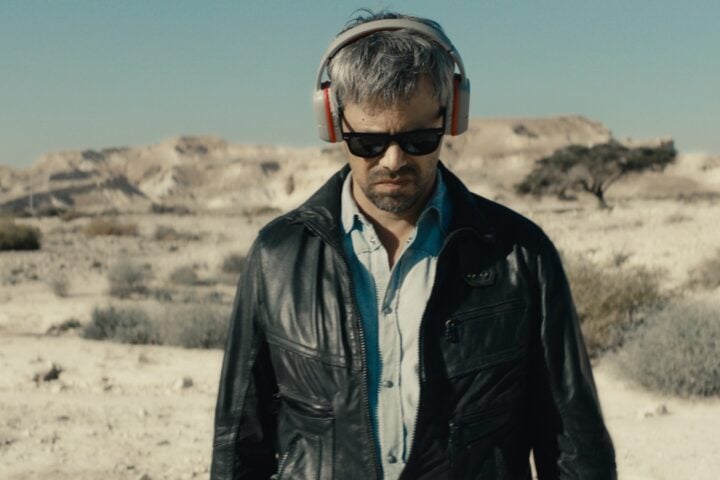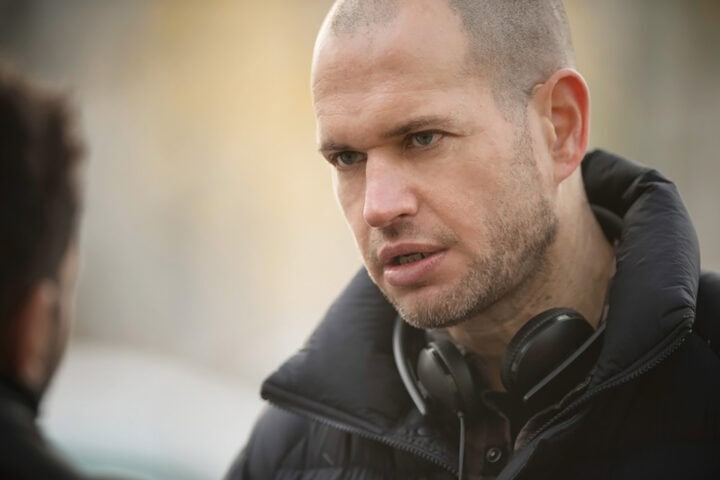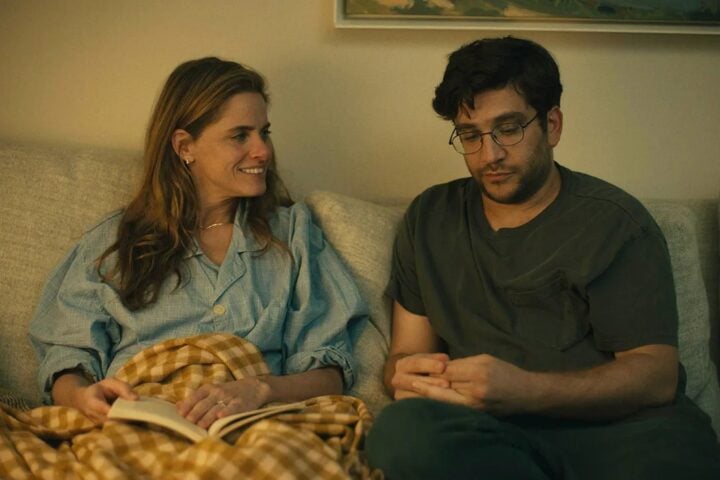
Taking on the nauseous cultural landscape of post-October 7 Israel amid the backdrop of atrocities in Gaza, writer-director Nadav Lapid’s fearless, scattershot Yes locates a dire spiritual crisis facing the nation of his birth. Grounded in unresolved contradictions from the time of the country’s founding, this crisis has turned the dream of national liberation that once spoke to millions of Jews into a nightmarish vessel for idolatry of the murderous military-industrial state, perverting the spiritual values of Judaism along the way.
The Star of David in its myriad forms haunts the dissociative conscience of the irreligious Y (Ariel Bronz) as he sleepwalks through his comfortably bourgeois life as a Tel-Avivi jazz pianist during the spring of 2024. Framed reverently in the window of a dusty old synagogue, the arch symbol of Judaism recalls his morally uncompromising late mother, who despised the Israeli state’s treatment of Palestinians, and a sense of higher purpose he can no longer feel or see around him despite his countrymen’s nigh-hysterical protestations to the contrary.
Flown and draped across nearly every public space in the form of the Israeli flag, the Star of David becomes a numbing artifact of conformity. And emblazoned in neon on the wall of a Beverly Hills-style mansion, where a graying sea of statesmen, military officers, war profiteers, and ultra-Orthodox fundamentalists mingle in a grotesque flurry of drugs, sex, and deafening EDM beats, it takes on a more sacrilegious meaning entirely.
Like many films about spiritual crisis, Yes takes an exceptional interest in sensation (and desensitization) of the basest kind, awash as it is in images of skin, woozy handheld shots, erratic cuts, and harsh artificial lighting. The film is practically a paean to theatrical body language, and the soundtrack doesn’t let you miss the guttural sounds that spill out of the characters’ bodies.
Like many Israelis following the terror of 10/7 and the accelerating tidal wave of compulsory nationalist euphoria and fevered denialism that’s enveloped the country, Y has retreated into a kind of stupefied complacency. He struggles to drown out those deeper sensations which would otherwise render his “normal” life of blunt, exaggerated sensations wholly unlivable.
To preserve their loving home and the future of their infant son, Y and his beautiful wife, Yasmin (Efrat Dor), both figuratively and literally prostitute themselves to Israel’s reactionary high society. They sacrifice their dignity as they offer up their talents and bodies for the fetishistic use of the most privileged, whether by tonguing unusual orifices, snorting cocaine off the wrinkled asses of the powerful, or performing sweaty arrangements of the Teenage Mutant Ninja Turtles theme song as patriotic tributes to Israel’s military brass.
Yes is an ironic echo of Arthur Schnitzler’s Dream Story, the basis for Stanley Kubrick’s Eyes Wide Shut, about a middle-class Jewish couple dispossessing themselves of sexual agency for the gratification of the antisemitic ruling class of 1920s Vienna. A century later, Lapid dryly suggests, Jews in Israel now have the privilege of degrading themselves thusly for fellow Jews.

Unlike the elites he services and the ordinary Israelis he encounters still reeling from the horror of 10/7, the cowardly Y is fully cognizant of both the Israeli state’s crimes and their moral gravity when he agrees to arrange the music for a nakedly genocidal new Zionist anthem. Opening his smartphone to daily stories of Gazans wiped out by the dozens in bombed residential buildings, schools and hospitals, Y’s everyday surroundings are briefly drowned out by the sounds of their distressed and dying screams—the only direct Palestinian presence in the film—before he declares to no one that he will choose to believe the IDF’s claims of taking every measure to minimize civilian casualties, and goes on about his day.
As he drives freely past apartheid walls and checkpoints in the West Bank on the way to a business engagement at an illegal settlement, he internally registers his disgust before blasting his favorite music to comfort himself. But of course, Y’s halfhearted denial—of Israel’s crimes and his own agency—can only go so far before his relationships and sanity begin to crumble.
Lapid’s film is intentionally exhausting, a meandering, maximalist grab bag of self-aware solipsism and dystopian excess whose noisy vulgarity brings its unseen horrors into starker relief than the film it’s likeliest to be compared to: Jonathan Glazer’s stately The Zone of Interest. But while it will no doubt be read and celebrated (or condemned) as an article of Jewish self-flagellation, its best qualities go beyond its tortured indictments of Israeli society and the defeated Israeli left, and into its evocation of a distinctly 2020s brainrot inseparable from livestreamed, meme-ified authoritarianism and atrocity around the globe.
Yes melds unhinged reality and absurdist mockery in the age of cyber-fascism, a graveyard of irony and sincerity alike, where all of history is happening at once as both tragedy and farce and all sensation is hysterical and numbing. Lapid’s film is one with its protagonist, whom it views with equal parts pity and contempt: unfocused, overstimulated, and perpetually queasy, drowning in hollow hedonism, childish cruelty, and asphyxiating guilt.
Yes is unstable in form, pacing, style and tone, chronicling the cramped headspace of a bystander too paralyzed by contradictory perspectives to act. The film, with its swarm of appropriated texts and orphaned signifiers, evokes the unique despair of a multimedia-addled psyche in a time of dog-eat-dog nationalism and capitalism, and synthetic vulgarization of all life. It diagnoses a widespread and contagious illness of the spirit that should scare anyone who would comfortably look down on its Israeli antihero from afar.
Since 2001, we've brought you uncompromising, candid takes on the world of film, music, television, video games, theater, and more. Independently owned and operated publications like Slant have been hit hard in recent years, but we’re committed to keeping our content free and accessible—meaning no paywalls or fees.
If you like what we do, please consider subscribing to our Patreon or making a donation.