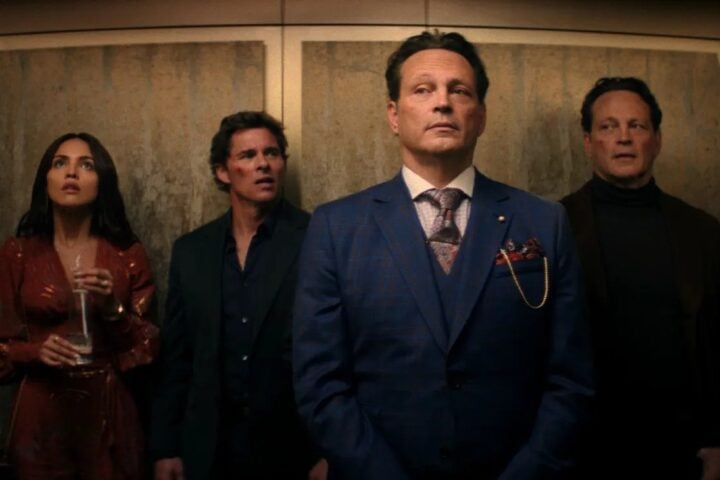
Nadav Lapid’s Yes, a satirical depiction of Israeli life in the wake of October 7, is impossible to pin down in a single description. But at the close of my interview with Lapid, an aphorism from 20th-century Indian philosopher Jiddu Krishnamurti came to mind: “It is no measure of health to be well adjusted to a profoundly sick society.”
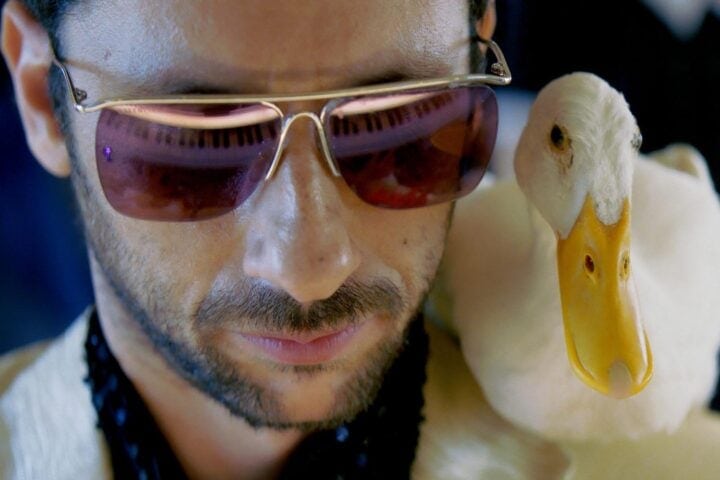
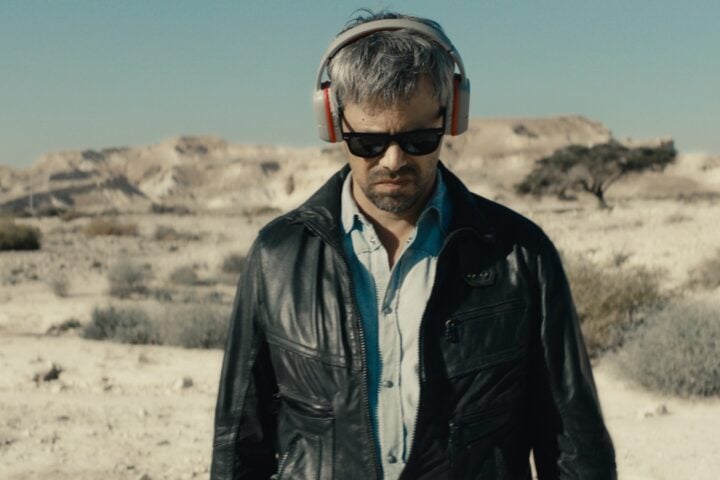
The concept of Yes predates Hamas’s terrorist attack on Israel and the country’s subsequent retaliatory campaign of civilian carnage in Gaza. Yet Lapid had no hesitation in steering his film into the headwinds of current events. The travails of the hedonistic Y (Ariel Bronz), a struggling artist who accepts a commission to compose a new Zionist national anthem for Israel, seamlessly lend themselves to adaptation from timeliness to timelessness.
Lapid’s scabrous, slippery film is a masterclass in evading expectations for what a project so reactionary should do or be. Yes never looks to directly point the finger at Israel’s government or citizens, even as Lapid’s own feelings about the fraught nature of nationalism and patriotism begin to emerge. He avoids pathologizing or preaching as the film begins to embody the chaos and corruption swirling around Y. The filmmaker is comfortable making the audience uncomfortable to sit with the contradictions he exposes.
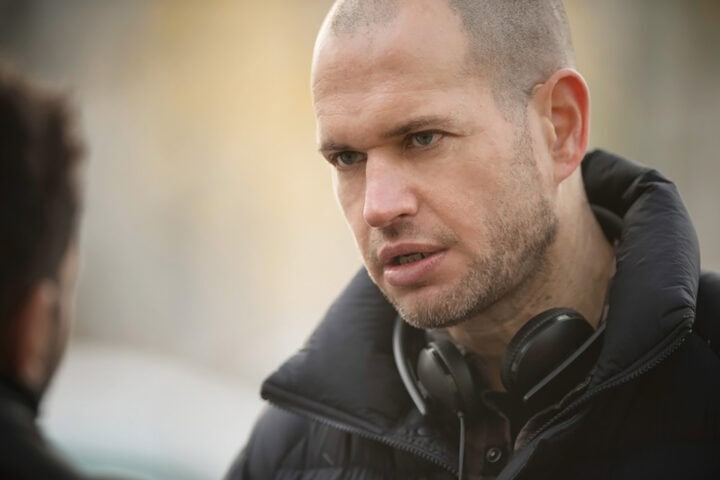
I spoke with Lapid ahead of the stateside release of Yes about his ambitions for the film, how his main character defies cinematic archetypes of morally conflicted protagonists, and why shooting while the carnage in Gaza unfolded was the only way to capture the intensity of the moment.
You’ve brought up the distinction between talking about the horror and madness of October 7 and putting it on the screen, and you were aiming to depict it rather than discuss it in Yes. There’s a slippery distinction between those two things.
You’re moving between the danger of becoming didactic and the danger of falling into a kind of moral relativism. I felt the breath of both demons, you know? The didactic demon may be the most common disease of cinema nowadays, especially political cinema. I feel that a huge percentage of the films that I see are good but [have] pretty evident ideas. On the other hand, I think, is this danger of a film that doesn’t just recreate obscenity but is an obscene film. I feel escaping or avoiding the danger of didacticism isn’t a very complicated obstacle. I think that I have a certain lack of consciousness. It’s not that I’m trying to do something that is strange or a little bit detached or different. To me, it looks very classical.
When I finished the script of this movie, for instance, I was convinced that I had just written a romantic comedy following a three-part structure of paradise, hell, and limbo. But the movie is not classical. You take the main character, for instance, and I think that the movie could have been a remake of Mephisto. That’s totally okay, but this might have been a didactic thing. I think that there’s something inherently punk inside Ariel Bronz, the main actor. Even when he’s submissive, you cannot reduce him only to this. He’s not like Bertolucci’s conformist. Even when he’s a submissive bootlicker, he’s submissive in his way. The strategy of the movie is pushing things to extremes in a way that goes beyond the explanation and the intention. When you can understand very well the intentions, and they’re not defied by a sensation, that’s the moment when art becomes didactic. But the movie is pushed beyond those intentions.
And what about avoiding relativism?
There’s something not totally clear about it because it’s not promoting one political idea or conclusion. At the very end, does Y understand that he was wrong? You don’t know. You can’t tell. Okay, he decides to commit suicide, but he tries to commit suicide in a certain way: not totally, not entirely. It’s a movie with no clear conclusions, or maybe with many conclusions.
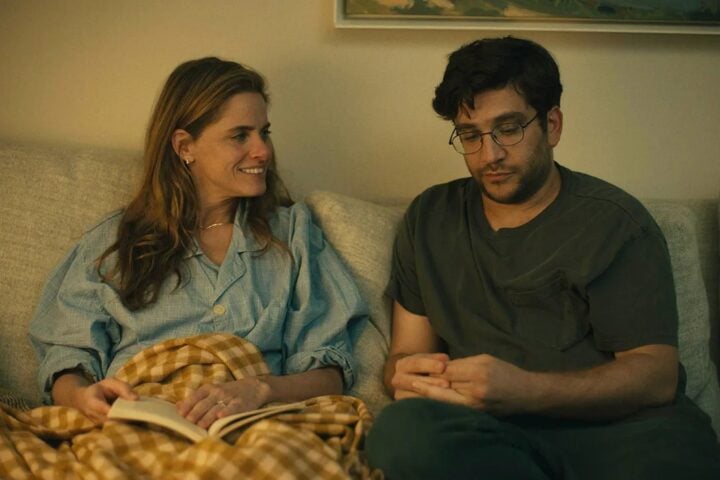
Think about the scene where Yasmin [played by Efrat Dor] is cutting cucumbers, and suddenly, she gets these text messages with the horrifying sound of the carnage in Gaza. It could have been a very explicit, talkative scene. But what happens next? First of all, the [volume] level of the messages is going beyond [reality]. But what’s happened next is that Y is putting on one song [a dance remix of Las Ketchup’s “Aserejé”], and she’s putting a German punk metal song on. They start to throw their baby, which becomes a puppet. Then, they have a clash, and they kiss while bumping into the door. It becomes a lot of things. You cannot reduce the scene only to “let’s talk about the blindness of these nice Israelis living in Tel Aviv,” although this exists inside.
Not falling into relativism in the movie is avoided by the feeling that the camera is agitated. If the same film would have been shot with a very cold style, like all these movies that show atrocities with an objective camera and very clean framing, it would have fallen into a kind of relativism. But you feel that the camera is agitated about what’s happening, even if it doesn’t have a clear conclusion about what should be done. It doesn’t live in peace.
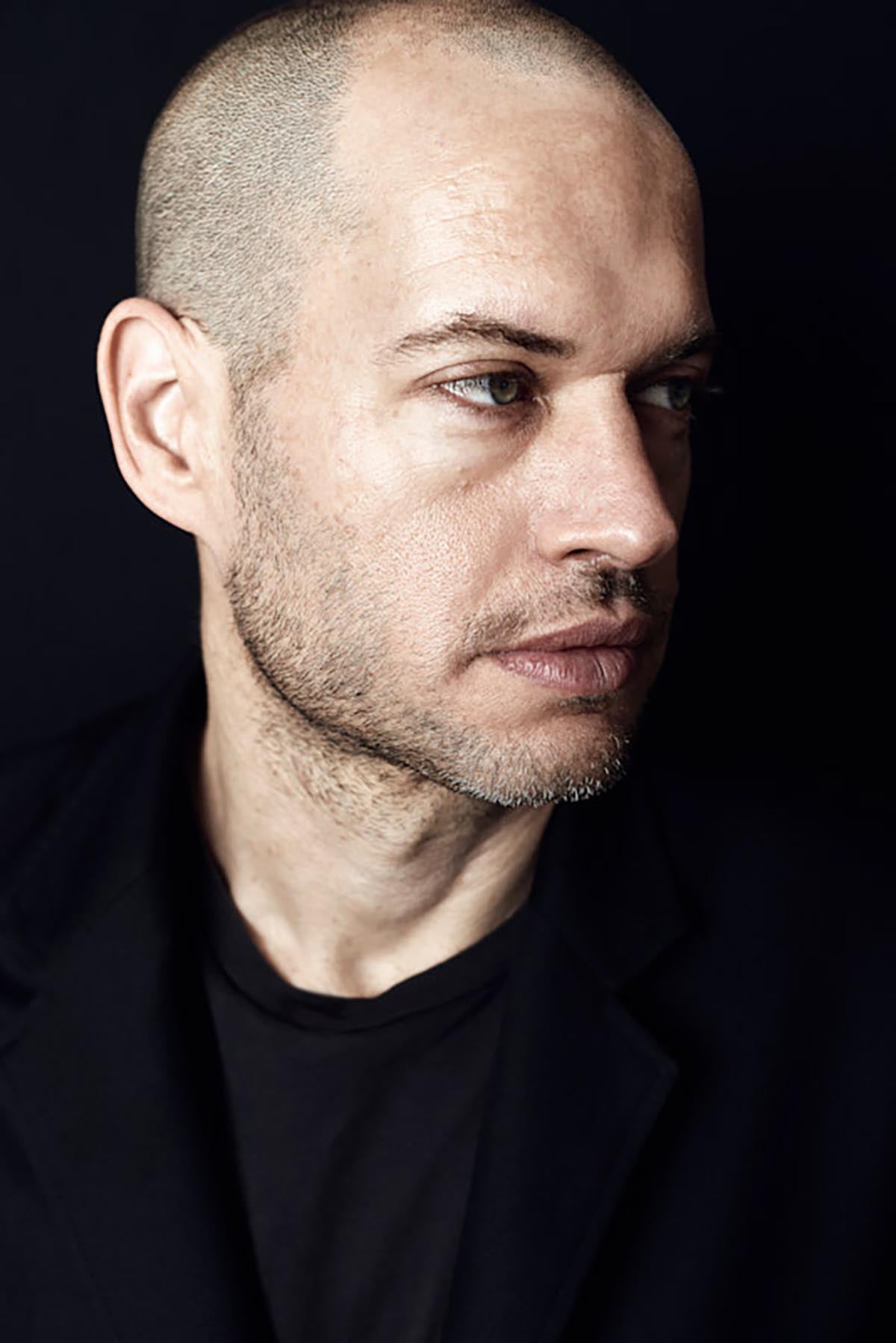
Those moments of push notifications about Gaza, which introduce the idea that our phones serve as a portal into all the tragedies of the world, are so striking. How did you find the audiovisual language to express these interruptions of everyday life?
There are two scenes when the phone becomes an agent of truth. Your phone forces you to see. I think we all learn how to live with the suffering of others, but the phone obliges you to repress things in a much more active way. It’s a permanent danger, forcing you to stay in contact with the external world. The phone is a party pooper, but the party is a decadent one. It’s a party where you dance on dead bodies, and the phone reminds you of the texture of the floor you’re dancing on. I think that Yes is a lot of things, but on top of everything, it’s a film about this actual moment in time. We live in two places at the same time in this techno-ideological moment: in the physical one and in the technological one. It’s a collision between these two dimensions.
I’m always fascinated by films that shoot as fast-evolving situations unfold, as you did by making Yes in the immediate aftermath of the October 7 attack. What were your considerations in making such a present-tense film, rather than waiting to go into production with the benefit of hindsight and retrospection?
Of course, tactically, it wasn’t a clever thing to do. But the movie was contaminated by this reality all the time, in the same way that the movie tries to tell that everything is contaminated. I know that when you shoot in the middle of the tempest, you don’t have any perspective. You cannot keep the right or the wrong distance. But you have the capacity and possibility, I think, to witness and to touch a moment that will never come back. It’s a unique, singular moment to see what I think you can feel in the movie. This agitated, morbid, vivacity of a state executing a horror is something you know that you cannot recreate. Maybe there will be another 50,000 movies about this, but I think none of them will be able to recreate these vibrations.
I really appreciate Jonathan Glazer’s The Zone of Interest, but imagine if it had been shot in the 1940s at the moment where you don’t need to artificially recreate the smoke in order not to see it…or to rebuild Auschwitz. Of course, it would have been different. All of us would have died to see a Fritz Lang movie from 1943, which would be a real Zone of Interest, you know, and not an artistic exercise that you do [looking] backwards.
You’ve cited George Grosz’s Pillars of Society as a source of inspiration for Yes because the figures in that painting are “grotesque” and “exaggerated,” in your words. How do you and your actors find the balance of capturing this heightened reality without losing touch with the characters as flesh-and-blood people?
These are maybe the biggest questions. You want every shot to be an idea of cinema, but also an idea of life. Of course, you don’t want to shoot only ideas. One thing that can be helpful is a very strong physicality. There’s something very visceral about the fact that, at the end of the movie, you know how almost all the body parts of the main actors. You saw their ears, you saw their nose, so it turns them into very concrete creatures.
Of course, in the editing, [we were] reinforcing contradictions between scenes. Each scene will slap in from the previous one. Very often in totally conceptual movies, there’s a kind of tranquility. For me, that’s boring. The visceral chaos in the movie all the time subverts this tranquility. Even if there’s a concept, you’re not sure what it is. At the end, it’s trying to grasp this huge experience. Life sometimes can look totally caricatural and grotesque, and, in another moment, touching and simple. People talk a lot about the first part of the movie. Let’s say that if the movie had been only its first part, it would have lacked a lot of ingredients of humanity.
The film circles such a timeless question that even extends beyond artists of whether it’s possible to create anything ethical or good in a system that feels irredeemably toxic. Did making Yes change the way you feel about the struggle your protagonist faces?
I agree that it goes beyond the artist’s experience. Artists in the movie are a code to someone who maybe, in a way, tries to keep an individual hierarchy in life that is not totally following the same system [of society]. There are these artists—usually, I can’t stand them—or some Israeli directors who do whatever it means [to make] a left-wing movie in Israel. They say, “Ah, look, we are the proof that it’s not an apartheid country because look at our movies!” I think that Yes doesn’t have this ambition. In a way, it’s a sick film. It’s not a healthy film. It’s a chaotic film. It’s a polluted film. For me, maybe the success of the film is that it doesn’t preserve itself from the toxicity of the world. It’s not sterile. Because if the movie would have been, in this sense, a success, the success would have been its own failure.
Since 2001, we've brought you uncompromising, candid takes on the world of film, music, television, video games, theater, and more. Independently owned and operated publications like Slant have been hit hard in recent years, but we’re committed to keeping our content free and accessible—meaning no paywalls or fees.
If you like what we do, please consider subscribing to our Patreon or making a donation.