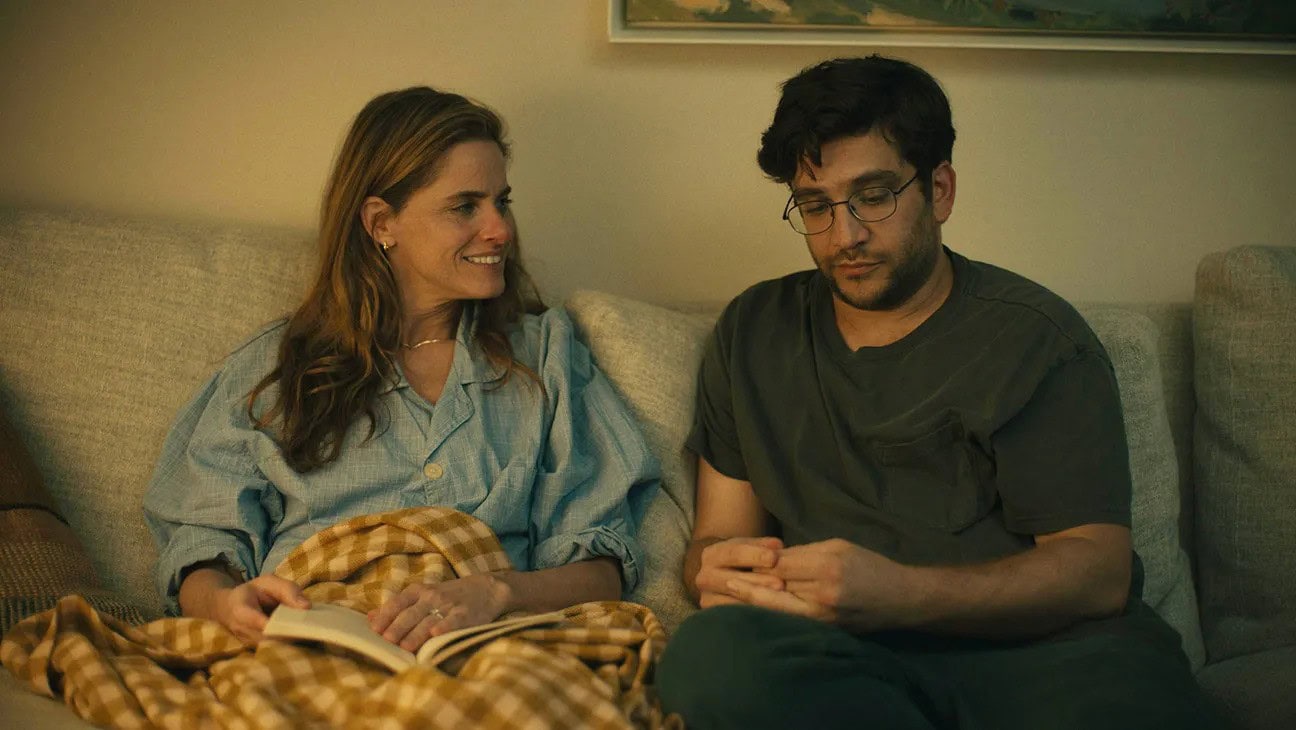
Writer-director Matthew Shear’s Fantasy Life is an initially familiar-feeling rom-com about urbane yet nerve-rattled characters that eventually, but just barely, transcends expectations. A law school dropout who appears constantly shell-shocked by the concussions of everyday life, Sam (Shear) is first seen getting fired from his impossibly bleak office job before having a panic attack at a bookstore. With seemingly few prospects, he takes on a job as a manny for the children of a wealthy couple, Dianne (Amanda Peet) and David (Alessandro Nivola). Sam almost immediately falls headlong for Dianne, an ex-actor suffering from different but similarly debilitating and career-stifling mental health issues.
This setup suggests that Fantasy Life will track its shy and stunted failure-to-launch main character’s growth after he’s exposed to different circumstances. Instead, Shear uses Sam’s burgeoning relationship with Dianne as an entry point to exploring Peet’s privileged character, which turns out to be a fundamentally more interesting path to follow.
Set over one year, Fantasy Life dispenses quickly with the fish-out-of-water comedy about Sam clumsily adjusting to a job he’s wildly unsuited for. One sequence efficiently shows his bumbling attempts to connect with the couple’s three young girls while also being cowed by the brash David, a dilettante musician at a crossroads. The film hits its modest stride once Sam starts connecting with Dianne, whose smothering depression and acrimonious marriage puts her in need of a friend or, Sam hopes, something more. David disappearing on an overseas tour produces a dramatically convenient opportunity for Sam to get closer to Dianne.
Peet’s precise, grounded performance finds layers of shading in what could have been a dull and simplistic role. The actor communicates a kind of depression that’s almost closer to nonstop grief and threads a sharp bleakness into Dianne’s self-aware anxiety about whether somebody with her privilege (family money, beautiful home) has the right to complain about feeling too old for the industry. Dianne sees Sam as an escape hatch of sorts, preferring to watch Battlestar Galactica with him and lightly flirt rather than facing her demons.
As a filmmaker, Shear gives Peet the spotlight here, with a few showstopper scenes that let her show a wider range, from achingly vulnerable to blazingly vengeful, than the flinty and stoic style she’s more known for. And as a writer and actor, Shear avoids the temptation to present his character as a loveable charmer who a beautiful older woman couldn’t help but fall for (see Cooper Raiff’s Cha Cha Real Smooth for a particularly egregious example of that trend).
Still, Shear’s decentering of Sam in the story makes his character difficult to read or latch onto, with only occasional hints of his life outside Dianne’s family, which leads to the film being almost as reticent about the character as Sam is to talk about himself. Fortunately, Shear seems to have a good sense of his effective but relatively narrow comedic scope as a character actor, using a stoned puppy-dog demeanor to convey Sam’s baffled helplessness in the world and utter misunderstanding of the time bomb his attraction to Dianne will set off in the family.
Though relatively little in Fantasy Life qualifies as laugh-out-loud hilarious, it keeps up a steady pace of subtle and sometimes quite dark humor while building to a satisfyingly spirited blowout at a family gathering on Martha’s Vineyard where secrets are revealed and grievances aired. Moody and borderline depressed, with a touch of sweetness, the film can be a little schematic in the way it frames each of the major characters as essentially useful tools for the others’ increased self-awareness. But Shear takes his characters’ challenges seriously without making them the sum total of their lives. Nothing here saves them, but nothing dooms them either.
Since 2001, we've brought you uncompromising, candid takes on the world of film, music, television, video games, theater, and more. Independently owned and operated publications like Slant have been hit hard in recent years, but we’re committed to keeping our content free and accessible—meaning no paywalls or fees.
If you like what we do, please consider subscribing to our Patreon or making a donation.