
Because it has dancing, queer-coded firemen, a lot of people have taken to comparing João Pedro Rodrigues’s Will-o’-the-Wisp to Julia Ducournau’s Titane, but in practice a perhaps more useful namecheck, if not necessarily deep critical comparison, would be Radu Jude’s Bad Luck Banging or Loony Porn. Rodrigues has already proven no stranger to the cinematic equivalent of trying out new fetish gear, quite literally in 2000’s O Fantasma. But this is may be the first time his selection from the drawer of slicked toys doesn’t include a pocket protector. Which is to say, Will-o’-the-Wisp is, in its 67-minute runtime, a breeze—and not even just compared to his next most recent feature, the densely allusive The Ornithologist.
Which isn’t to say that it’s remotely straightforward. The film begins in 2069, as a dying man is laid out like a display while a child plays with a toy fire truck. No sooner do you have your bearings than Rodrigues rewinds the clock back to the early aughts, flashing back to the moments when the dying man, Alfredo (Mauro Costa), first gets his activist sea legs, much to the chagrin of his clueless, aristocratic Portuguese family. His activism is established right off as being hopelessly intertwined with his maladroit sexuality; during a musical ode to the splendor of the pines, and their being “tumescent with sap,” Alfredo bashfully hides the erection he’s getting. He then attempts to transmute that fetish into action (in all senses of the word) by getting a job as a firefighter, in order to halt the spread of climate change-induced wildfires.
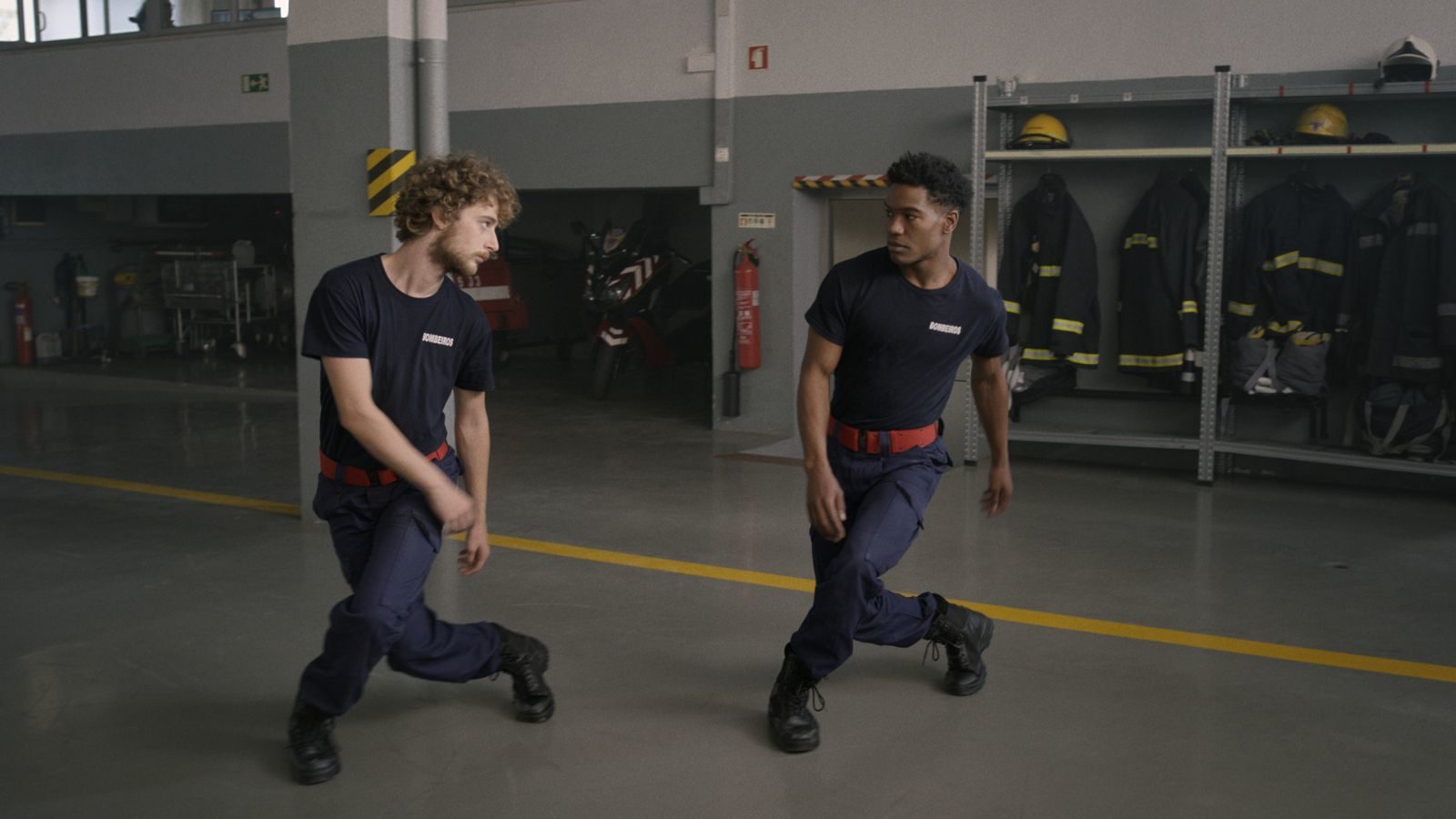
Speaking of wild, the sexual heat of the firehouse is on full display from the moment Alfredo arrives to find crews performing field exercises, all under the watchful eye of the station’s salty fire chief, Comandante (Cláudia Jardim, splendidly ripped from out of an alternate-universe John Waters film). She sets up her new charge to train with Afonso (André Cabral), and the sexual tension between the two—one a wispy descendent of white colonialists, the other a strapping Black member of the working class—is immediately apparent.
Despite framing the film, which he co-wrote with João Rui Guerra da Mata and Paulo Lopes Graça, around the race and class differences represented by Alfredo and Afonso (there’s even a number set to the Portuguese song “Black on White”), Rodrigues never drops the tone of frivolity, and despite the implicitly apocalyptic undertones of its century-hopping framing device, the stakes are relaxed. Will-o’-the-Wisp is Rodrigues’s Pierre et Gilles film: baroque, unabashedly sexual, light as a feather. Here, even the cocks being stroked are tres plastique.
For the first time in his career, Rodrigues seems to be going for consistent, sustained mirth. An early scene finds the station’s firemen quizzing Alfredo, supposedly a student of art history, on the various nude tableaux that they intend to reenact for the firehouse’s forthcoming erotic charity calendar. Alfredo is ultimately unable to identify the various, overtly sexualized parodies (such as Carvaggio’s Fireman’s Head and Francis Bacon’s Mr Fireman, Send Me a Dream), only being familiar with the racist artifacts of colonial repute. (In the wraparound segments, Alfredo is laid out in front of José Conrado Roza’s Wedding Masquerade, which has been passed down in his family through generations, presumably since its 18th-century commissioning.)
Despite the philosophical implications of the sexy charade game, the meat of the scene is in the gentle-spirited naïveté exhibited by both Alfredo and the muscle-bound firefighters striking curious poses while wearing jockstraps. Will-o’-the-Wisp may be knowingly naïf, but in its final moments it still shares common bond with Rodrigues’s best work in that it never undersells the importance of brains being the most important sex organ.
Since 2001, we've brought you uncompromising, candid takes on the world of film, music, television, video games, theater, and more. Independently owned and operated publications like Slant have been hit hard in recent years, but we’re committed to keeping our content free and accessible—meaning no paywalls or fees.
If you like what we do, please consider subscribing to our Patreon or making a donation.