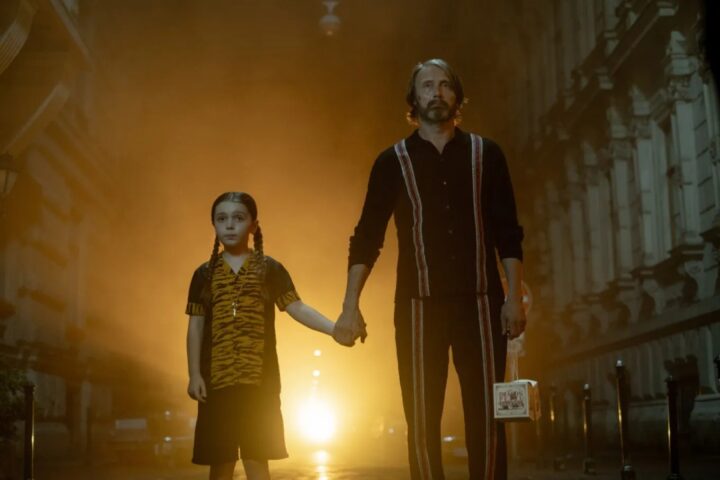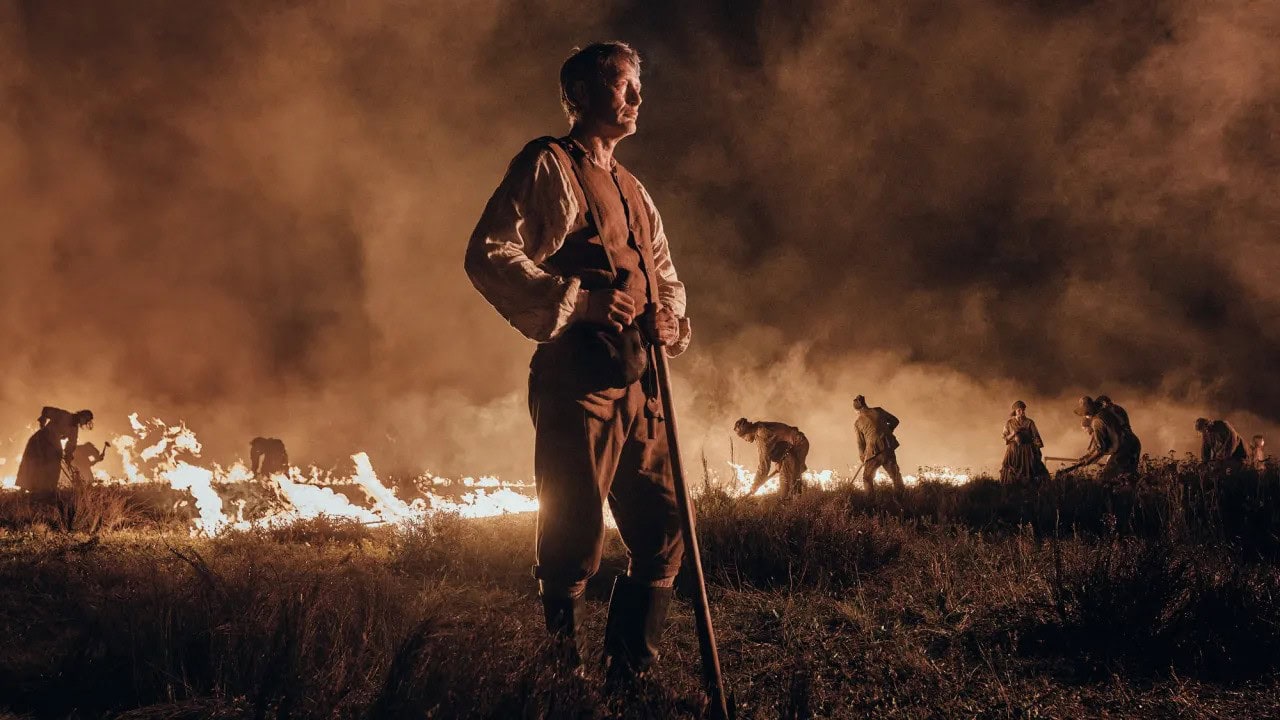
Glowering from atop his mountainous cheekbones, Mads Mikkelsen cuts a hard, intimidating figure in the The Promised Land. Directed by Nikolaj Arcel from a screenplay co-written by the prolific Anders Thomas Jensen, the film casts Mikkelsen as real-life 18-century war veteran Ludvig Kahlen, a proud man of humble origins who hopes to establish the first viable homestead in Denmark’s Jutland heath. Many others have tried to cultivate the barren lowland in the name of the king, but none have succeeded. “The world’s asshole,” one man calls this no man’s land roamed by outlaws and outcasts. One look into Kahlen’s eyes is to know that he’ll succeed at transforming the heath into farmable land.
In large part for the way it paints morality in black and white, The Promised Land is an old-fashioned western, and what it lacks in nuance it more than makes up for in showmanship. Kahlen’s aspirations are self-serving, as he asks for a noble title and an estate with servants should he succeed. He doesn’t believe himself to be like the people he encounters on the heath, but he’s not far removed from them in the eyes of the king’s advisers, men in powdered wigs whose pets eat better than the peasantry. The illegitimate son of a plantation owner and a maid (the film’s Danish title translates to The Bastard), Kahlen only receives funding for his efforts after stating that this meager army captain’s pension is enough to set his plans into motion.
Kahlen’s sheer determination alone is enough to make you root for him. And while he does little to earn our sympathies at the outset, it soon becomes clear that he’s a saint compared to the wanton cruelty of the upper class. He secures the help of a desperate runaway servant, Johannes (Morten Hee Andersen), and his wife, Ann Barbara (Amanda Collin), but refuses to pay them. In exchange for their services, he offers them only food and shelter. But you sense that he’s truly concerned with protecting them from whatever cruelties sent them into hiding. And while he hits a young “darkling” Romani girl, Anmai Mus (Melina Hagberg), for pilfering his supplies, he stands up for her when she’s subjected to racism by a group of superstitious peasants.
The film never totally embraces the complexities that its characters suggest. Kahlen does the “right” thing when he doesn’t sell out Ann Barbara, but it seems less out of principle than an aversion to prostrating himself before men like Frederik De Schinkel (Simon Bennebjerg), a neighboring nobleman who’s determined to see Kahlen fail. De Schinkel, who added the “De” to this name to make it sound more aristocratic, goes out of his way to sabotage Kahlen’s efforts at every turn, from hiring away the man’s workers to setting violent outlaws on him, and the film delights in his cartoonish villainy. As for Kahlen, the script feels overly determined to make him into a more decent man than he probably was, never forcing him to reconcile his social aspirations with the cruelty of the men who hold very status he hopes to attain.
But even when it’s painting its story in broad strokes, The Promised Land plays expertly to audience emotion. There might not seem to be much excitement in watching a man try to grow potatoes on the Danish moor, but the film finds it, as in a scene where Kahlen bolts awake and, seeing the frost on the windows, runs out to the field to cover his crop in blankets.
Similarly, you not only feel early on that De Schinkel is due for his comeuppance, but you may find yourself hankering for it. He behaves like a teasing bully, and he continues to behave as such even when revealing the depths of his depravity, as in a torture scene that spares us the sight of boiling water being poured on a man but still churns the stomach due to the sound of the victim’s screams. In such moments, it feels as if The Promised Land is trying to make a meal out of what was likely a more mundane reality, but such embellishments are consistently vivid and revealing of human will. In short, this a film that not only deftly braids social drama with a tale of frontier survival, it does so in the most unsparing and consistently entertaining of ways.
Since 2001, we've brought you uncompromising, candid takes on the world of film, music, television, video games, theater, and more. Independently owned and operated publications like Slant have been hit hard in recent years, but we’re committed to keeping our content free and accessible—meaning no paywalls or fees.
If you like what we do, please consider subscribing to our Patreon or making a donation.