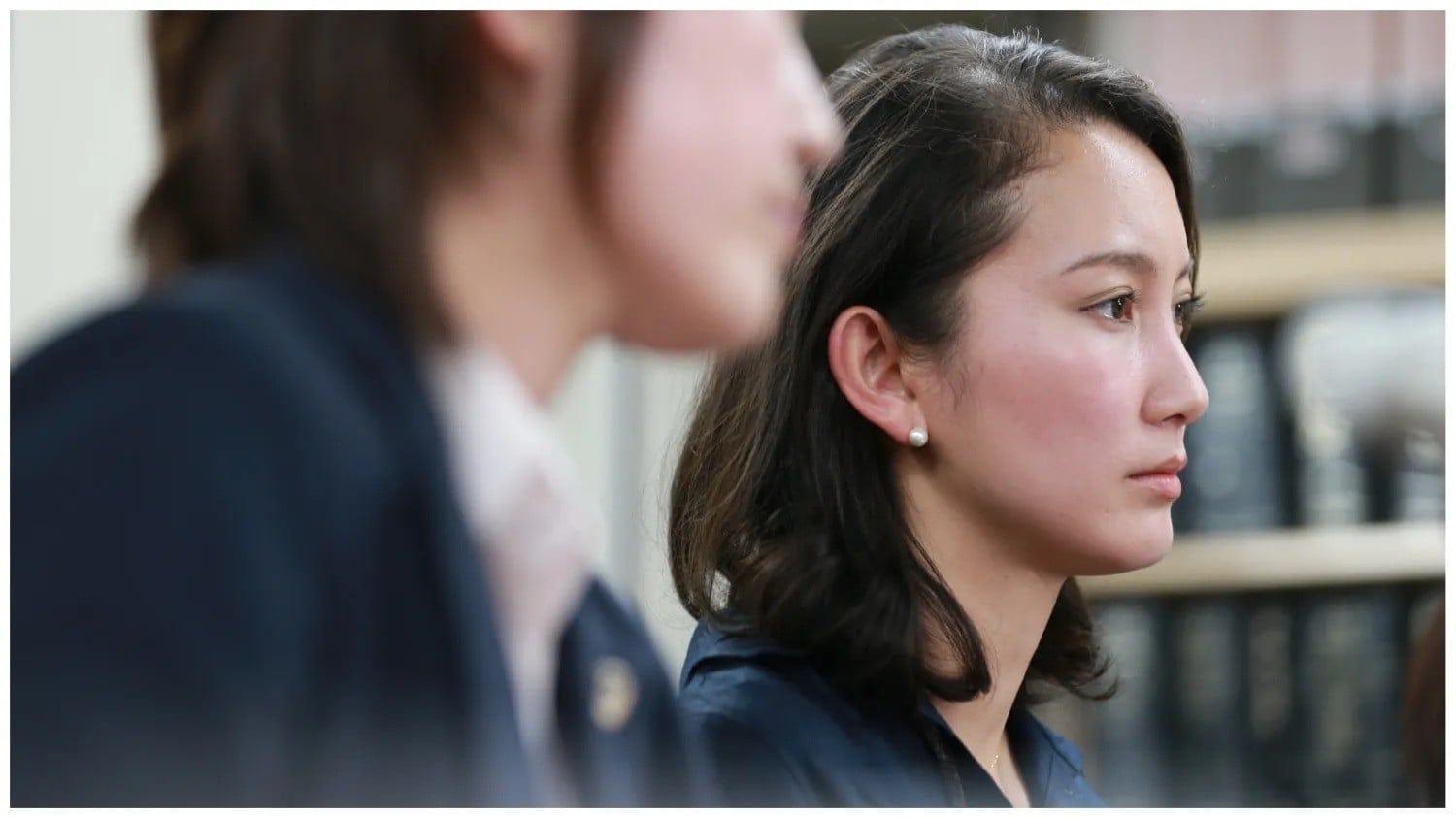
It can be hard for some to fully reckon with systemic issues like sexual abuse because of the sheer scale of them. Conversations about the legal issues that allow these crimes to go unpunished or the culture of misogyny that fosters them often lose sight of the actual experiences of the victims. Even that label, “victims,” has a way of reducing a person’s identity to nothing more than something that was done to them. With Black Box Diaries, journalist and filmmaker Itō Shiori details her own quest for justice from an intimate, personal perspective that ensures her humanity is always at the very center of the frame.
In 2015, Itō was raped by Yamaguchi Noriyuki, a prominent Japanese TV journalist and friend of Abe Shinzō, then prime minister of Japan. The film opens in eerie quiet as we watch the CCTV footage from the hotel where the assault took place and see Yamaguchi half-dragging Itō from a hired car and through the building. From here, we get an up-close look at Itō’s quest for justice over the following two years, told largely through videos recorded on her phone.
Through her early conversations with the police, Black Box Diaries reveals a justice system gallingly unequipped to prosecute those who commit sex crimes. After going to the police, Itō is informed that, under Japan’s present law, a mere lack of consent isn’t enough to constitute rape—that there must also be evidence of physical violence. Even though she has Yamaguchi’s DNA on her underwear, video footage of her being dragged from a car and an interview with the driver that confirms she had repeatedly asked to be taken home, the police advise Itō that her criminal case is a non-starter. They describe cases like hers as existing within a “black box,” rendering it untouchable to prosecutors and invisible to the world at large.
Itō remains undeterred. She publishes a tell-all book, Black Box, to make the matter public and pursues justice in the civil courts, to which Yamaguchi responds by filing a countersuit. Slowly, Itō recruits allies to help her navigate a system that’s almost perversely designed to silence women like her, including a sympathetic police officer, a group of fellow survivors, and a witness from the hotel. Even the most talented dramatic writers would struggle to conjure scenes more cathartic than the ones in which, after being shut down time and again by those who were supposed to help her, someone finally agrees to give Itō their support.
In between the segments recorded by Itō herself, archival footage of parliamentary meetings in Japan is used to show how her story grabbed the attention of the nation, sparking a #MeToo reckoning. Mostly, these clips show enraged young politicians raging on Itō’s behalf against Japan’s archaic sexual assault laws while their older colleagues listen on with a look of stony indifference or cite “parliamentary procedures” in order to shut them up. Like the rest of Black Box Diaries, these scenes tend to leave the audience on a razor’s edge between hope and despair—encouraged on the one hand by the passion with which justice is being demanded and, on the other, depressed by the widespread indifference with which these demands are met.
Black Box Diaries relates a dark and heavy story, buoyed only by Itō’s almost effervescent screen presence. She manages to remain unfailingly calm, even when dealing with the umpteenth authority figure to inform her that, no, there’s nothing they can do for her. And there’s a sunny, gregarious quality to her that shines brightest during the private moments with her friends—undimmed even by the fact that they’re usually hanging out at somebody else’s house because mysterious cars with darkened windows have been staking out Itō’s home.
Perhaps the saddest and most infuriating thing about Black Box Diaries is its very existence. We’re accompanying Itō on an arduous journey that she shouldn’t have had to take, watching on with a level of intimacy that only serves to remind us how vulnerable she had to make herself in order to get some semblance of justice for herself. And yet, as this cinematic black box attests, that she went on this journey and sparked a movement toward legal and cultural change in her native Japan will hopefully mean that no one else will have to do the same.
Since 2001, we've brought you uncompromising, candid takes on the world of film, music, television, video games, theater, and more. Independently owned and operated publications like Slant have been hit hard in recent years, but we’re committed to keeping our content free and accessible—meaning no paywalls or fees.
If you like what we do, please consider subscribing to our Patreon or making a donation.