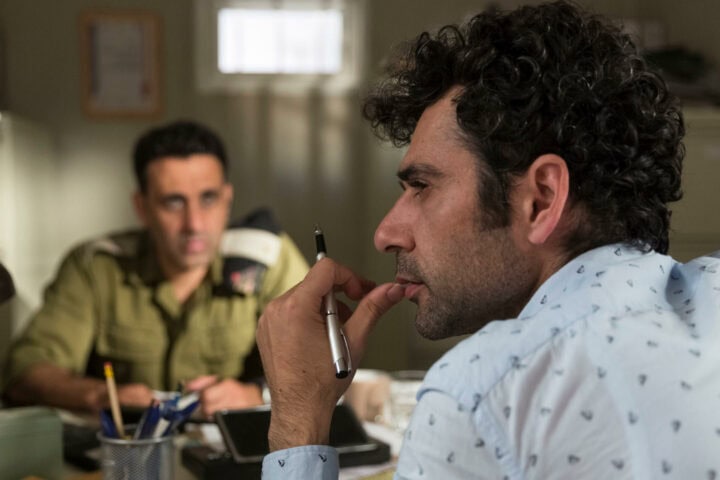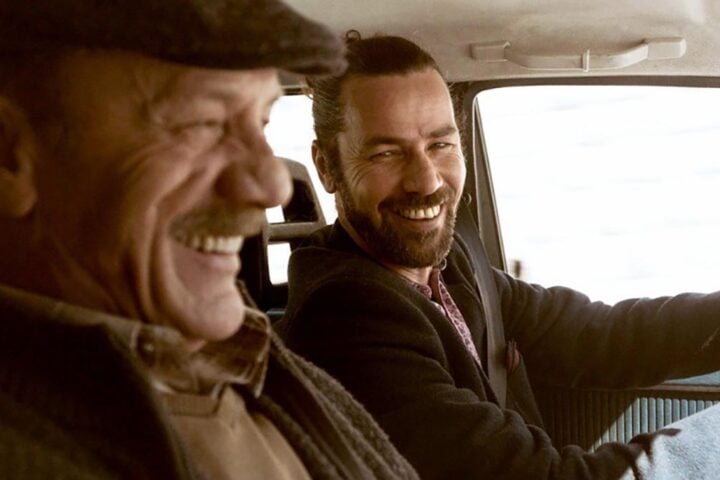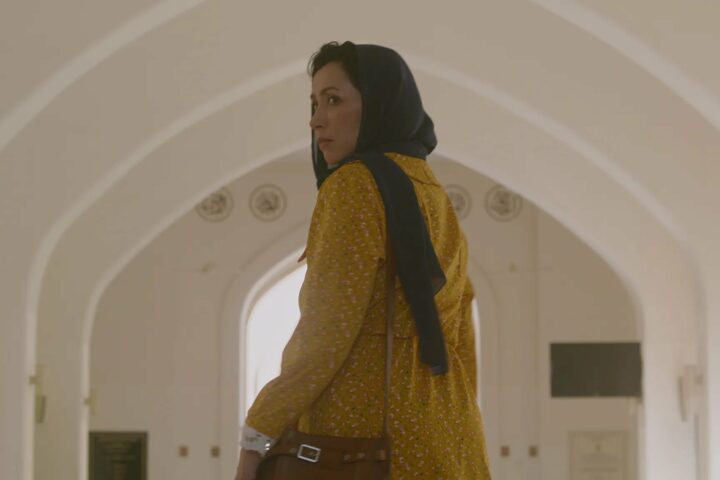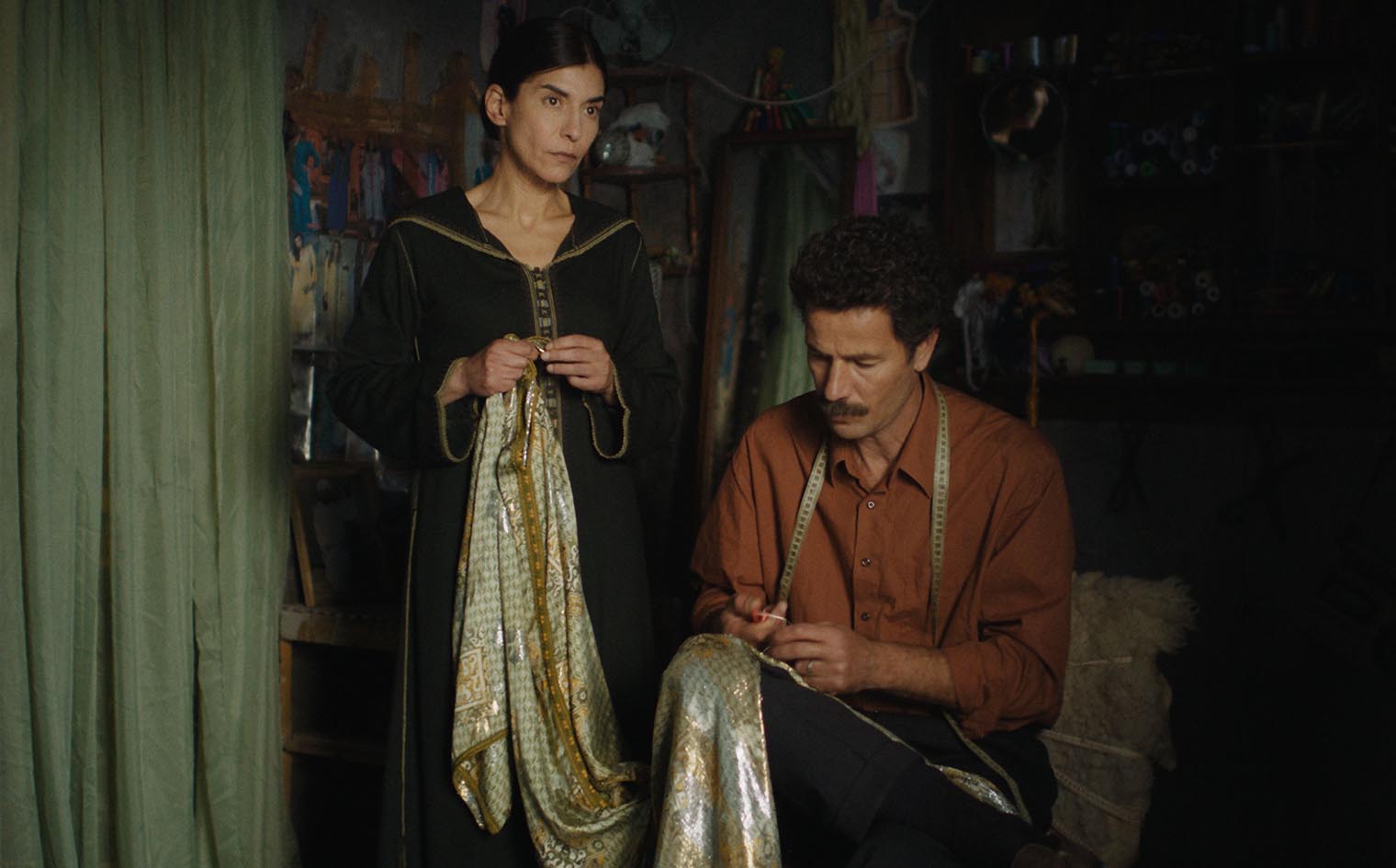
Director and co-writer Maryam Touzani laces The Blue Caftan with so many metaphors that it’s difficult to describe its plot or sequences without succumbing to analytical paralysis. Yet this is precisely what one should avoid when engaging with this incredibly delicate film. Touzani’s account of an unconventional love story—among a closeted Moroccan tailor, Halim (Saleh Bakri), his wife, Mina (Lubna Azabal), and their new apprentice, Youssef (Ayoub Missioui)—is best experienced by simply wallowing in the lushness of its fabrics, sartorial and symbolic alike, refusing the temptation to unspool its poetic parallels.
Halim and Mina run a caftan shop in the medina in Salé. Halim is a maalem, an expert seamster who works at his own pace. Which means he’s “not a machine,” as Mina tells one customer who’s eager to have her order completed. Halim refuses to use a sewing machine, granting his garments the kind of attention and labor that Renaissance painters bestowed on their artworks.
But in order not to completely alienate their clients, the orders need to be finished in some sort of timely fashion. Which is why Halim and Mina hire Youssef, who proves to be a dependable and gifted apprentice, and who becomes smitten with Halim and his delicate mode of instruction. This attraction seems to be mutual but not the willingness to act on it.
Salé was also the setting of Abdellah Taïa’s Salvation Army, a tale of queerness, misery, and emancipation through literature. In the Salé of The Blue Caftan, misery gives way to the art of cloaking the body with materials so sublime that one would feel compelled to think that there’s only room for fantasy in this world. Here, queerness remains as hidden as misery, but it’s also just as crucial to the inner workings of a traditional hetero-patriarchal society.

In The Blue Caftan, a local hammam functions as a place for cleansing and sociality in the front, and anonymous sexual encounters in the back. Twice in the film, Halim enters a stall to have sex with a man, and during the second encounter, the camera makes clear that the stranger is taking Halim from behind. In fact, much of the touching between characters in The Blue Caftan comes from behind, suggesting a slightly shameful avowal of an impulse, or a betrayal of the unspoken social contract to cover up the truths about the body—individual and social.
In a wrenching scene, Mina attempts to initiate sex with a half-asleep Halim, pulling off his shirt from behind before ardently caressing his chest. There’s also the moment where Youssef embraces Halim in a sudden declaration of love, which is met with Halim’s request that Youssef pick up a piece of fabric from the floor. Halim will eventually get around to returning the embrace in a sequence where Youssef walks out of the couple’s home in tears and Halim holds his pupil from behind so that he doesn’t collapse—or so that he falls into his arms if he does.
One of the most fascinating and daring aspects of The Blue Caftan is the role that Touzani gives to the figure of the heterosexual woman in the relationship between men who desire each other despite everything. Mina, who’s terminally ill, and whose pain is precisely located on her back, works at once as a repressive agent and a facilitator of Halim and Youssef’s desire. Throughout, her closeness to pain and death—her agony so intense that she takes morphine for it—seems to undo her buttons, her initial possessiveness giving in to a kind of queer hospitality.
One night, Mina decides on a whim to accompany Halim to a café full of men for the first time in many years, where she drinks, smokes, and shouts at the football match on the screen. She learns to admit her regrets and to say to Youssef that she’s sorry. Youssef ultimately becomes the trigger for an apprenticeship that all of these characters share. For all of the film’s allegorical lines having to do with dress-making, such as “if you cut too much, there’s no going back,” or “iron all you want, it won’t fall right,” it’s Mina’s piece of advice to Halim that most vividly and succinctly captures the core of this apprenticeship: to not be afraid to love.
Since 2001, we've brought you uncompromising, candid takes on the world of film, music, television, video games, theater, and more. Independently owned and operated publications like Slant have been hit hard in recent years, but we’re committed to keeping our content free and accessible—meaning no paywalls or fees.
If you like what we do, please consider subscribing to our Patreon or making a donation.