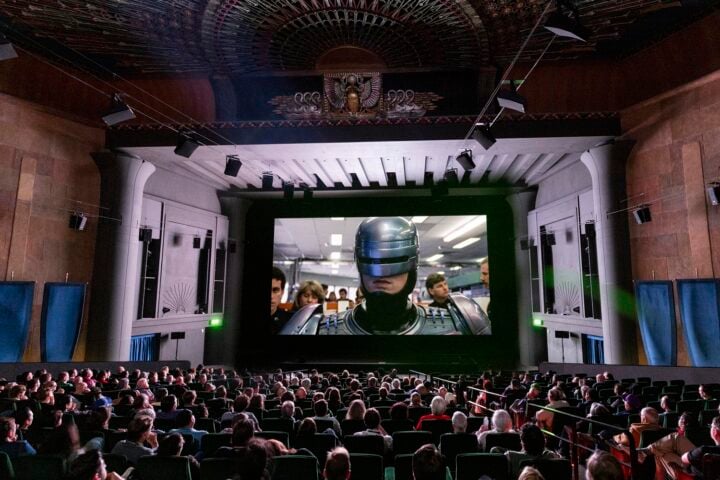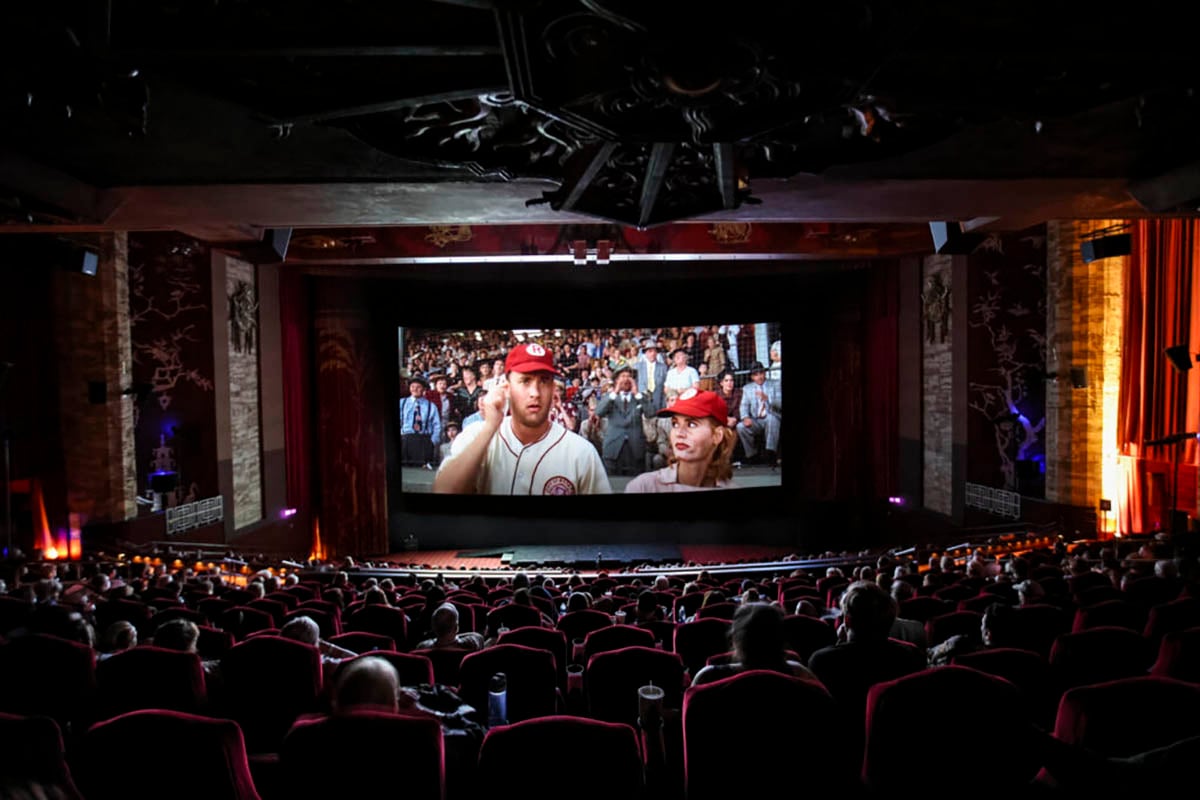
After a two-year hiatus due to the COVID-19 pandemic, the Turner Classic Movies Film Festival returned to Hollywood for four days last week, and guided by the theme of gathering, specifically “All Together Now: Back to the Big Screen.” It was a strange, initially tentative, but ultimately exhilarating homecoming.
It wasn’t just the proliferation of TCMFF-supplied N95 masks, required for all attendees inside the theaters and lobbies, which made initial festival participation and navigation seem slightly squirmy and unavoidably post-2020. Things felt askew right out of the gate on Thursday night, when attendees fumbled to discover the ins and outs of a new lineup location for Theater 4, the only auditorium in the festival’s TCL Chinese Multiplex hub that’s equipped to run 35mm, where many of the popular pre-Code titles, including 1932’s Jewel Robbery, starring William Powell and Kay Francis and directed by William Dieterle, were showcased.
Staffers seemed confused about who was supposed to line up where, and there was an unexpected early swarm of people who hoped to see Jewel Robbery, all of which led to passholders not being able to make it inside before the screening filled up. Developments like this, while discouraging in the moment, require clearheaded perspective, given the state of the world from which such movies and festivals like TCMFF are designed to allow us to momentarily escape, and were best not received as a portent of a disastrous festival to come. But this wasn’t the spirit in which many excluded passholders chose to take the news. (The fest eventually rescheduled Jewel Robbery as one of Sunday’s repeat performances, this time in a larger venue, so hopefully the Cranky Charlies and Charlottes managed to get in.)
My consolation prize after missing Jewel Robbery was another crime caper, Jules Dassin’s Topkapi. The uneven quality of the new restoration and, to my mind, the unevenness of the film itself, which takes a long, lumpy time to get to its deservedly celebrated (and much copied) heist sequence, constituted the festival’s only real disappointment and went a long way toward proving my apparent insusceptibility to the charms of Melina Mercouri.
The real world’s instability made itself known in a few festival selections that played on Friday. The midnight slot proved too late for me to consider contemplating the end of the world, Nuclear Explosion Division, courtesy of Steve De Jarnatt’s Miracle Mile. But Friday evening was well spent poolside at the Hollywood Roosevelt for an outdoor screening of Soylent Green. Set in 2022, which may at least partially account for its presence on the festival schedule this year, Richard Fleischer’s cult classic easily plays on its audience’s fears about climate change, overpopulation, and crises of agriculture and food supply chains, which was perhaps ironic at this screening given that the crowds were sipping overpriced cocktails under palms.
Indeed, given the festival’s history of showcasing far bubblier, party-ready fare at this venue, like Grease, Neptune’s Daughter, South Pacific, and, this year, Fast Times at Ridgemont High and Blue Hawaii, the sobering, downbeat Soylent Green seemed like an odd choice. It didn’t inspire a whole lot of lubricated hooting and hollering in the audience, though it may have driven some to one or two extra visits to that conveniently located outdoor bar.
That said, Soylent Green, a solid if not exceptionally inspired bit of adult-oriented sci-fi, played well to the crowd. The film marked the final big-screen appearance of Edward G. Robinson, so his character’s exit is a poignant one. Then there’s the gut-punch ending, about which TCM Senior Programming Director Scott McGee, while promoting the screening at an earlier event, had the best advice: “And if you make it over to the Soylent Green screening, please be respectful of those who haven’t seen it and may not be aware of the big twist at the end. Because, really, Soylent Green is [long pause]…People, it’s just really important not to ruin the surprise.” And the crowd roared with laughter. Now, that’s entertainment.
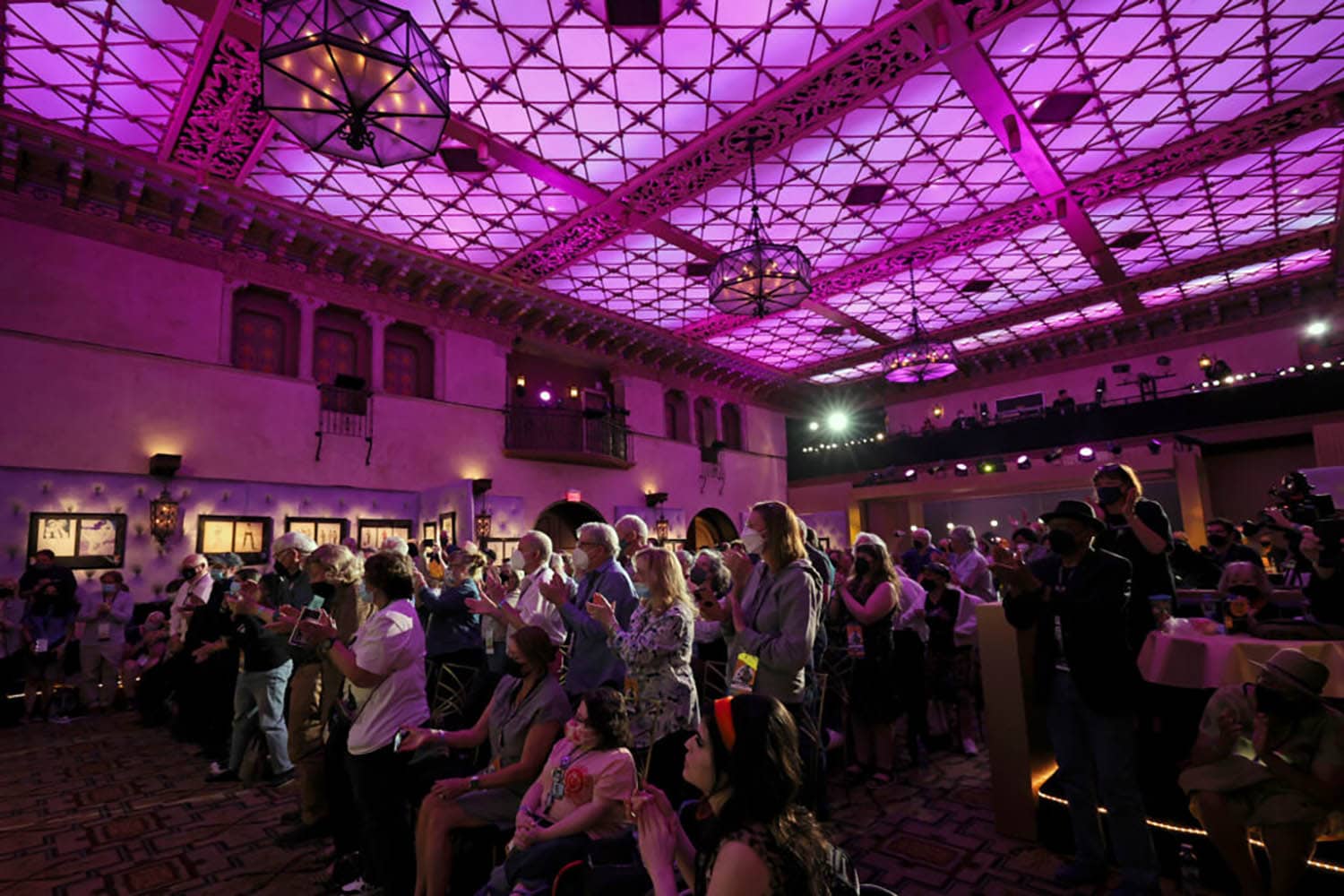
My own festival theme began to emerge, as it often does, as I navigated my way through my personalized schedule. This year’s unpremeditated through line? Female icons. And my first strong dose came courtesy of what was easily the biggest and happiest surprise of the festival: Joan Crawford in Queen Bee. Directed by Randal MacDougall, who also wrote the scripts for Mildred Pierce and Possessed, the film is a lurid melodrama, the story of a devious Southern matriarch who presides over and methodically undermines the fortunes of her fractured, wounded family. It’s a riot of nasty and nasty characters, and Crawford is in deliciously over-the-top top form throughout. Queen Bee sent me out of the theater Friday afternoon on a giddy high, only slightly worried that the festival’s peak might have already been scaled.
I needn’t have worried. Still in store were Ann Dvorak, Joan Blondell, and a young Bette Davis in the punchy, disturbing Three on a Match; Barbara Stanwyck’s blazing performance as a woman who’ll stop at nothing to get to the top in the notorious Baby Face; and a delightful conversation with Piper Laurie at the festival’s live appearance venue Club TCM. Regarding Baby Face, the print that was screened was the uncensored pre-release cut, which differs significantly from the version in circulation for almost 90 years, and was introduced by the incomparable Bruce Goldstein of New York’s Film Forum and Rialto Pictures. As for the Q&A that followed the Laurie chat, yes, someone in the audience asked her about having the phrase “dirty pillows” follow her throughout her career in the wake of her performance in Carrie, to which she threw back her head and let forth a hearty laugh worthy of Margaret White.
No disrespect to Joan, Joan, Ann, Bette, or Piper, but the most delightful and down and dirty of all was Divine as the harried materfamilias Francine Fishpaw, whose freaked-out family causes her life to go spiraling out of control in Polyester, John Waters’s riotous satire of suburban life. The film is famous for its use of Odorama, but the reprints of the scratch-and-sniff cards that were handed out at the screening were unfortunately faulty. Instead of matching the film’s visual cues, every scratch released only a ghastly synthetic petroleum-like smell. This might have been the only time in my life where I’ve felt vaguely disappointed to have been denied the chance to whiff skunk mist, farts, and dirty socks in close succession.
However, the most formidable and beloved female icon in attendance at the festival this year was, as it happened, saved for last: Pam Grier. TCM’s own Jacqueline Stewart was near tears just in her introduction to Grier prior the screening of Jack Hill’s Coffy, and when Grier entered the room to the accompaniment of the blaxploitation film’s theme song, Roy Ayers’s “Coffy Is the Color,” the crowd turned to putty in her hands. Right off the bat, Grier engaged her receptive audience and held court, with great stories of her early days behind a receptionist’s desk and on low-budget film crews, all leading up to the association with American International Pictures and Hill, with whom she forged her place in American film history as the movies’ first Black female action star, of the blaxploitation or any other era.
While this was the greatest dream come true that was ever conjured for me at TCMFF, that many attending the festival would hardly qualify Coffy as a classic points to the biggest challenge for TCMFF as it attempts to continue to attract audiences and maintain its charge as a shepherd of movie history. Most are aware of the economic situation that looms for festivals like this one, but I continue to worry about TCMFF’s gravitation toward more contemporary movies, ones far younger than Coffy, for which the word “classic” seems, at best, misapplied.
During my first festival in 2010, I didn’t see any movie made after 1967, and several of those that I did see were in the festival’s biggest venues. Yet this was the first time in 11 years of attending the festival that I wasn’t tempted by a single offering being showcased at the Grauman’s Chinese Theatre, among them A League of Their Own, Heaven Can Wait, and Annie. And screenings of fare like Fatal Attraction, Tootsie, and The Sunshine Boys in the biggest of the multiplex theaters did little, despite being adorned with special appearances by some of their stars, to draw me away from more adventurous or unknown works.
Still, it was an undeniably worthwhile festival experience this year, in part because nothing bore out the appropriateness of that “All Together Now: Back to the Big Screen” theme more vividly than getting to experience the festival with friends new and old. As we begin to slowly reclaim a world forever altered by COVID-19, these sorts of experiences will undoubtedly become ever more valuable, especially if they eventually become rarer. If attendees of TCMFF, and even the festival itself, seemed initially tentative about the fulfillment of that aforementioned theme, then by the weekend’s conclusion there was at least a sense of an understanding of just how “togetherness” might be accessed. Here’s hoping that TCMFF marches forward and continues to remind us of every reason why the movies are so essential.
The TCM Classic Film Festival ran from April 21—24.
Since 2001, we've brought you uncompromising, candid takes on the world of film, music, television, video games, theater, and more. Independently owned and operated publications like Slant have been hit hard in recent years, but we’re committed to keeping our content free and accessible—meaning no paywalls or fees.
If you like what we do, please consider subscribing to our Patreon or making a donation.