The official thematic umbrella for the 2026 Turner Classic Movies Film Festival, held since 2010 in the heart of Los Angeles, had a clear point: “The World Comes to Hollywood.” At a time when the immigrant experience has been framed in destructive and inhumane terms and actions, the intent of this year’s programming, as expressed on the festival’s website, was shaped to reclaim that experience in a more positive context of Hollywood history:
“Men and women of disparate talents and distinct styles journeyed from around the globe to America, already fluent in the same language of cinema as industry veterans, to create, collaborate, and in many instances, just to live another day. This was not an intrusion, but an infusion of fresh ideas and startling visions of what movies could be…”
The statement, part of a larger one positioning the festival as a celebration of these “gifted and vital artists, innovators and craftsmen,” is actually more or less business as usual for TCMFF. In fact, one would have to be spectacularly unobservant not to understand the sentiment as the basic impetus of the entire Turner Classic Movies enterprise from its beginnings.
But what made this year’s festival richer was the way in which, by inverting those expressed intentions, festivalgoers were invited to consider how the scheduled films illustrate classic Hollywood also reaching out to the world, how films from ages and movements past could reflect upon and continue to contextualize the world we live in today. In Jean-Luc Godard’s Band of Outsiders (featured at TCMFF in 2016), a high school English teacher (played by Danièle Girard) offers T.S. Eliot’s observation that “everything that is new is thereby automatically traditional,” spelling it out on the chalkboard: To be classic is to be modern. It’s a reversal that suits TCMFF well in general but never more aptly than this year.
Certainly, one could look at specific films, like 1956’s Anastasia, director Daniel Raim’s moving documentary The Ozu Diaries from this year, and even the big-scale 1962 adaptation of Mutiny on the Bounty as nods to a world beyond Hollywood, through which the theme of an industry enriched by a global influx of talent could be addressed. And the sorts of pleasures that have always been a hallmark of TCMFF were plentiful this year too.
Barbara Hershey appeared in person at screenings of Hannah and Her Sisters and A World Apart, and actor-songwriter Paul Williams was similarly feted with The Muppet Movie and Ishtar, both of which benefited from his musical contributions. (Many TCMFF attendees were compelled to wonder why Phantom of the Paradise was absent from the schedule.)
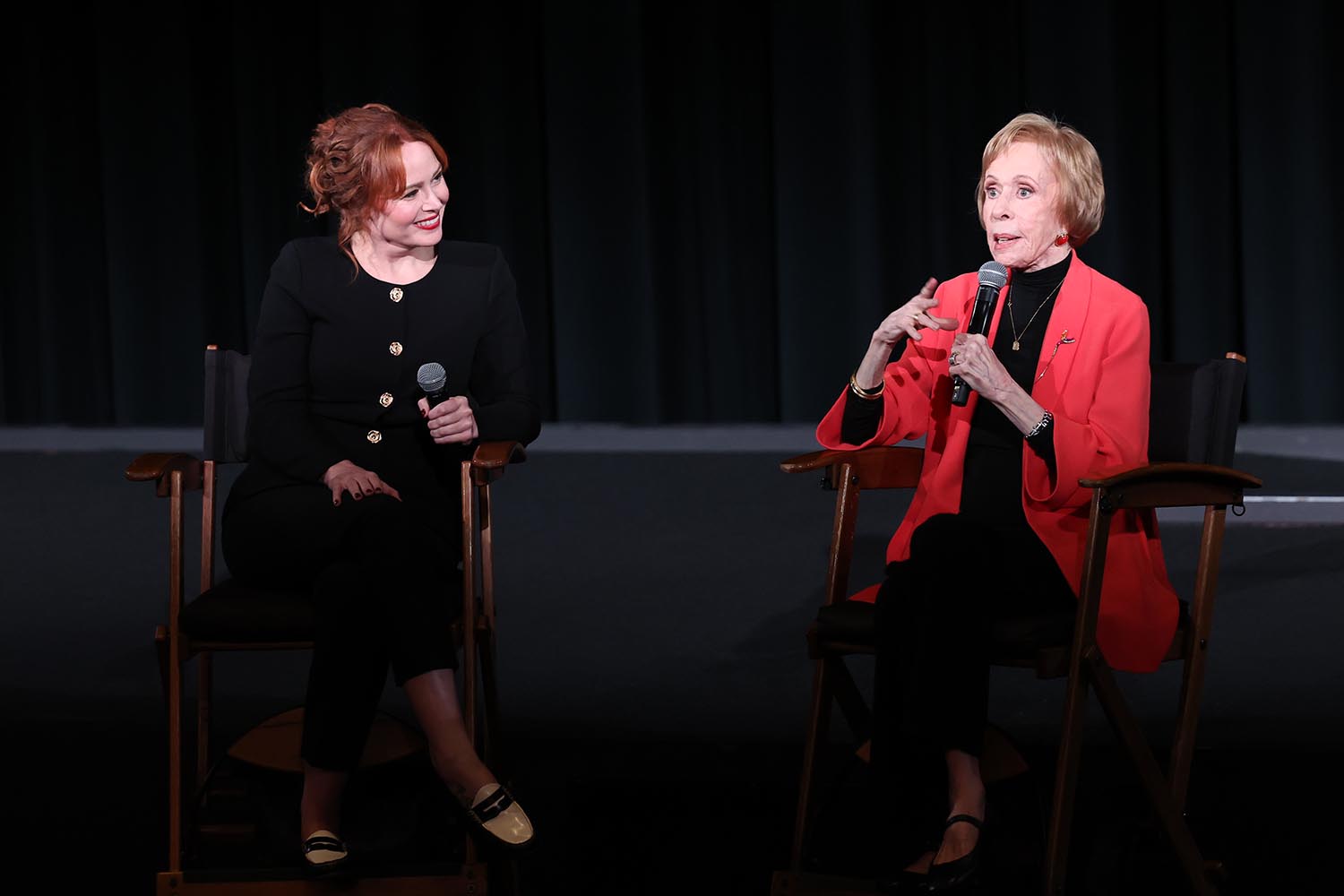
Appearances throughout the weekend included Carol Burnett, interviewed on stage at the festival’s hub, the Hollywood Roosevelt Hotel; Glenn Close, whose hand and footprints were enshrined in cement in front of the TCL Chinese Theatre; writer-director Charles Burnett, who was present for a screening of his 1983 film My Brother’s Wedding; and Brooke Adams, who introduced Terence Malick’s Days of Heaven. There was also an entertaining and informative showcase for The Towering Inferno hosted by sound designer Ben Burtt and visual effects artist Craig Barron—TCMFF perennials whose appearances at the festival have fast become must-see events—and even a 50th-year reunion of nine cast members from The Bad News Bears.
But in those instances where classic films from another era somehow commented on a world 50, 60, 70 years after they were made, TCMFF 2026 came alive in an unexpectedly powerful way. For instance, it’s not hard to initially understand how a movie like Robert Wise’s The Day the Earth Stood Still, a revered work of classic Hollywood science fiction rooted in fear of the postwar threat of atomic annihilation, might be relevant to modern audiences.
Michael Rennie’s Klaatu lands his spacecraft on the Washington Mall and demands an audience with the entirety of the leaders of the world in order to deliver a dire message, threatening global destruction if mankind’s aggressive development of atomic technology is allowed to continue and likewise threaten the existence of other interstellar civilizations like his own. The politicians and military officials offer up the usual resistance, not only to the presence of an unexpected alien visitor, but also to Klaatu’s expectation that cooperation between world powers could ever be coordinated to heed his warning. Viewers in 2026 are left to imagine how such a visitation, and such an ultimatum, might be greeted by the current “secretary of war” operating out of the White House, not with sober consideration but instead as an invitation to belligerent conflict.
Even Klaatu’s message itself, however, feels different in the disorienting geopolitical turbulence and destabilized diplomacy of our own times. What had always seemed, in eras ranging from Kennedy to Reagan to Obama, as a call for mankind to reconsider their trajectory of destruction, now feels different, queasily familiar. As Klaatu departs under a threat that Earthly civilization will cease to exist if its programs of nuclear aggression aren’t scaled down and eliminated, echoes of chosen conflicts destabilizing our global ecosystem color the alien’s ultimatum with an unexpected shade of red, and the ending of the film now reads with an unmistakable, though ostensibly well-intended, tinge of unwelcome aggression, if not outright fascism.
Another sci-fi classic from 1951 that screened this year at TCMFF, The Thing from Another World, directed by Christian Nyby with heavy influence from producer Howard Hawks, couldn’t escape similar recontextualization. The film sets up a conflict between science-based and military responses to a familiar invasion scenario, both sides of which now feel different, less assured after years of destabilization of trust in scientific method and aggressive political-paramilitary aggression against “the other” indulged by the current American government.
The world comes to Hollywood, alright, and in Nyby and Hawks’s version of John W. Campbell’s short story “Who Goes There?” an aggressive denizen of “another world” is understandably resisted. The upbeat finish of the movie is satisfying, but the viewer is left to consider the possibility that the scientific side of the equation may have gone misrepresented in the zeal to eliminate a perceived threat whose destruction does nothing to advance scientific understanding or assuage defensive worries over possible further encounters.
Finally, moving from the realm of socially relevant science fiction to factual American political history, TCMFF’s 50th anniversary presentation of Alan Pakula’s All the President’s Men would on its own have been a must-see. But the presence of former attorney and White House counsel John Dean, who was instrumental in blowing the whistle on the “cancer” he once described eating away at the Richard Nixon presidency in 1972, as guest speaker at the festival vaulted the presentation into one of the top two or three experiences I’ve ever had at TCMFF.
In anticipation of seeing the film again, a woman seated next to me expressed the very strange sensation of feeling almost nostalgic for an era of political paranoia and journalistic integrity. But if nostalgia for a time that ushered in awareness of the orchestration of political assassinations, coups and bombings in other countries is most certainly misplaced, with our current situation for comparison it may be at least understandable.
All the President’s Men was, of course, the beneficiary of historical hindsight in its laying out of the beginnings of just how a particular White House of cards was brought down. And Dean himself pointed out in the post-film discussion that funding of the Watergate burglars didn’t come directly from the White House, but that the escalating cover-up of that burglary did.
Dean helped contextualized the film’s account of “perceived history,” one not without inevitable, if slight, inaccuracies, and he re-emphasized the ultimate legal and historical outcome of the Nixon era, even expressing optimism that a similar outcome might await lawyers currently working within the Department of Justice whose illegal behavior he and others have been monitoring. Viewers could hardly be faulted, then, for looking back comparatively favorably on a time when governmental checks and balances were both still somewhat of a given.
All the President’s Men remains a vital representation of, and even an essential part of, the history it so vividly depicts. If it were up to me, the person at TCMFF who helped coordinate Dean’s appearance, allowing us 50 years later to reflect on the film within the context of the dumbfounding events that have unfolded in Washington over the past decade, would deserve their own Presidential Medal of Freedom, if such a prize could be said to have any remaining meaning. The gratitude of those who experienced the screening will, I suppose, have to do.
This festival’s desire to engage with the idea of the world coming to Hollywood, and conversely the films that turn and examine that world in sometimes unexpected ways, felt like a revitalizing impulse this year. May the future of the TCM Classic Film Festival continue to be as resonant.
The TCM Classic Film Festival ran from April 30—May 3.