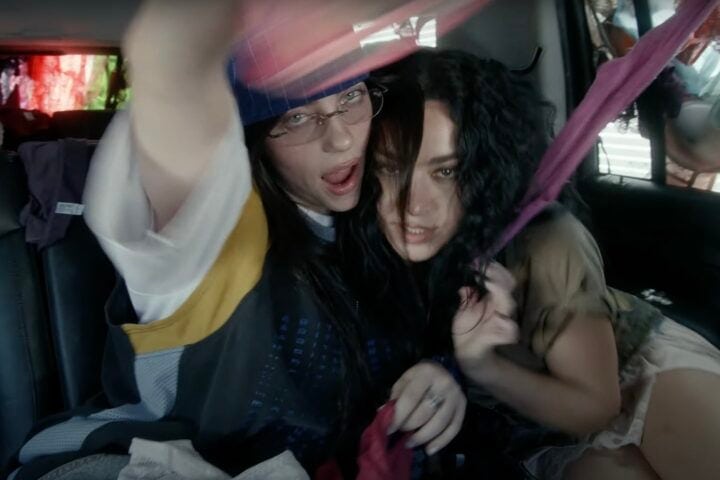
Billie Eilish and James Cameron’s Billie Eilish – Hit Me Hard and Soft: The Tour (Live in 3D) is hardly the first concert film to revel in 3D razzle dazzle, but it must surely be the first to be made in a time when young audiences feel compelled to document their experiences at live performances on their cellphones.
Seldom does an audience member in the film’s extensive crowd footage put down their phone to actually watch and be present with Eilish. The feverishness makes sense though, as the 24-year-old alt-pop singer-songwriter has the keen ability, through her somewhat coquettish and wily smirks and skill at transforming her aura of not wanting to be seen into an invitation into her world (in music and on stage), to articulate her generation’s anxieties and fears. She does what all great artists do and makes her audience feel seen, only she’s doing it in a cultural landscape that exaggerates the intimacy between artist and spectator, or even between everyone to everyone else, and yet in a technological setting that deepens our sense of isolation.
There’s something compelling about the challenge of using 3D to enhance and juxtapose the literal and emotional proximity between Eilish and her fans, during a time when social media follows appear to collapse the distance between artists and audiences. And that we often see Eilish’s image throughout the concert fragmented and proliferated across a sea of phone screens offers an even more playful possibility of using 3D to augment that feeling of a mediated experience, with at least three planes of sight: fan’s head in foreground, Eilish on a phone in middle ground, and Eilish in background, out of focus.
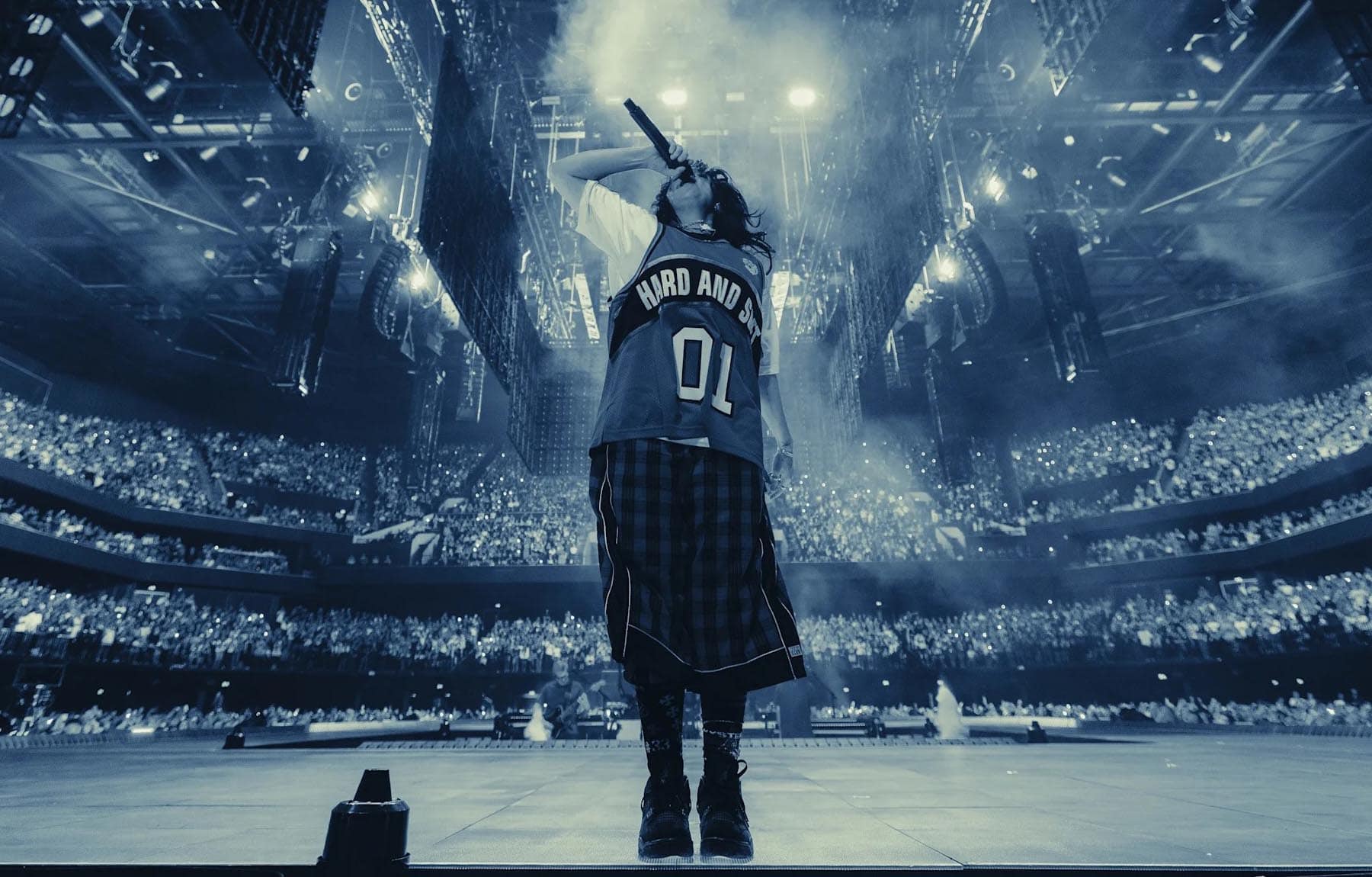
But just because Cameron’s name is on the film doesn’t mean he necessarily incorporated the same obsessive desire to create some quasi-verisimilitude with regard to depth and spatial mapping—of being in the frame—as he’s done with his Avatar movies or his Titanic 3D re-release. Rather, the image is barely as good, as poppy and exciting, as a 3D lenticular trading card one might find in a cereal box. And given that the show, like most of Eilish’s tours, relies on the singer being the focal point on the stage—rectangular, with a cube that sometimes triples as cage, platform, and additional screen for the visuals/live feed—the mediocrity of the 3D effects makes the film feel like a dime a dozen as far as concert docs go.
Eilish puts on a solid show: energetic, focused, and minimalist. It’s really just her, that rectangular stage, and the cube, unburdened by dancers, elaborate sets, or other physical spectacle. She says during one of the film’s many brief EPK-ready interviews that her objective is to create the ultimate sensory experience, with each song assigned color-specific lighting. But the film doesn’t totally succeed in capturing the show’s scope or thematic through line.
In a few songs, the lights around the perimeter of the stage are tilted straight up, creating a geometric border around Eilish. It feels like a clever and subtle complement to her bedroom pop, set to thumping, rubbery basslines, alternately hip-hop- and industrial-influenced. She creates a room with the lights, empty save for her roaring emotion. She’s inviting you in. Would that the film’s tech elements had similarly given you a door to enter through.
Since 2001, we've brought you uncompromising, candid takes on the world of film, music, television, video games, theater, and more. Independently owned and operated publications like Slant have been hit hard in recent years, but we’re committed to keeping our content free and accessible—meaning no paywalls or fees.
If you like what we do, please consider subscribing to our Patreon or making a donation.