Among the individuals who’ve attempted to assassinate an American president, perhaps none is as unexpected as Sara Jane Moore. Moore’s unsuccessful attempt on the life of Gerald Ford in San Francisco in 1975 peeled back the then-45-year-old suburbanite mother’s veneer of normalcy to reveal a complex web of conflicting personal and political associations, one that Robinson Devor’s documentary Suburban Fury does its best to untangle.
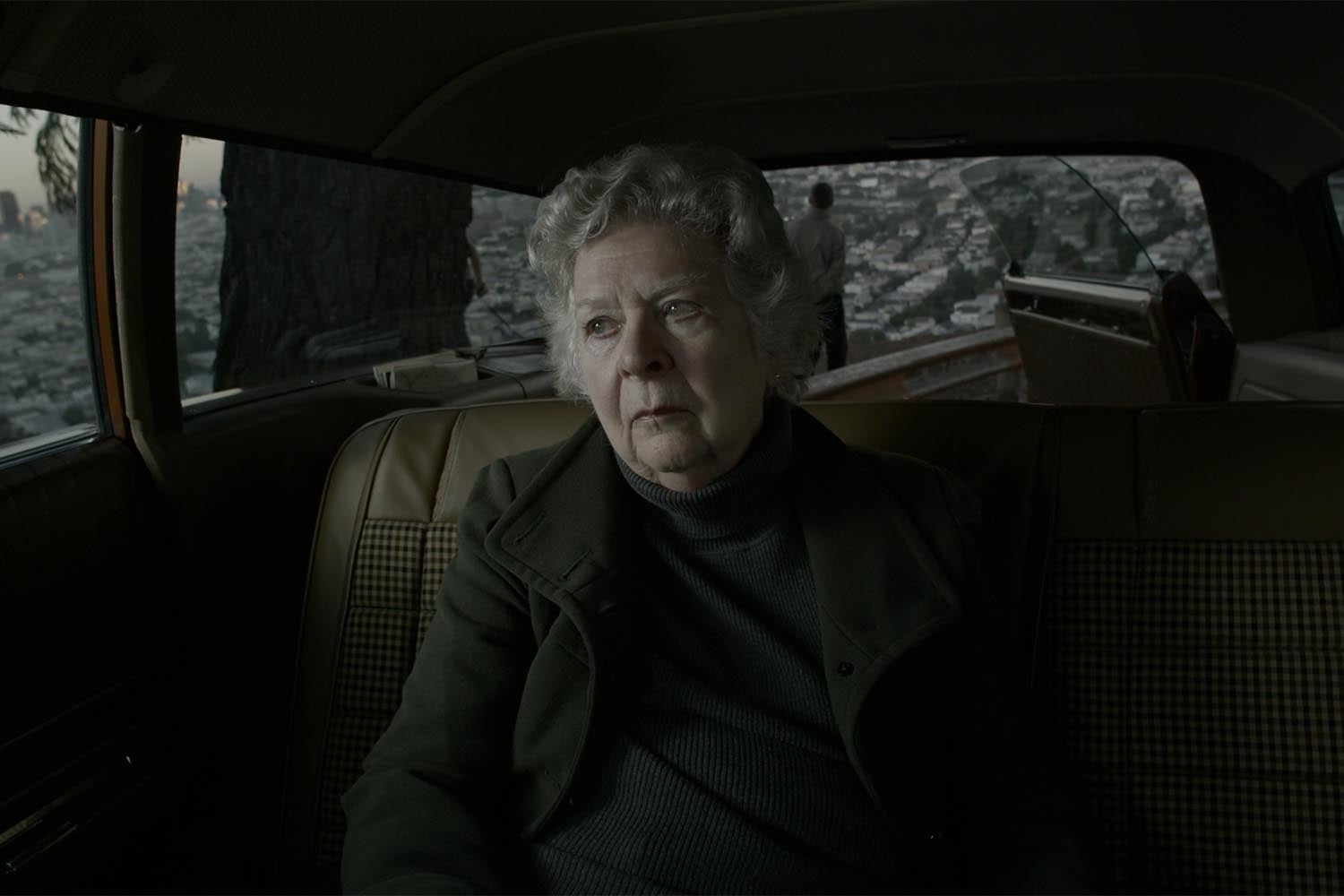
The film opens with a title card stating that Moore was, at her request, the only person interviewed by Devor. What follows is a subjective account of the years leading up to Moore’s fateful act, built entirely around the on-screen recollections of the now-94-year-old parolee. In giving control of the narrative over to Moore, Devor and co-writer Charles Mudede have crafted something a historical corrective for a misunderstood and quickly villainized figure, albeit one that arguably raises more questions than it answers about her true motivations.
The sequence of events that led to Moore’s radicalization generally begins with the 1974 kidnapping of Patty Hearst by the Symbionese Liberation Army. When Hearst’s father, with whom Moore was acquainted as a woman about town in San Francisco, set up the People In Need (P.I.N.) organization in response to the S.L.A.’s demands that the wealthy family provide food to the poor as ransom, Moore was eager to come aboard as a bookkeeper and PR person. Sympathetic to the S.L.A.’s ends but appalled by their means, Moore was soon enlisted as an F.B.I. informant, traveling to various meetings of San Francisco-area radical leftist groups and reporting back on their activities. The only voice competing with Moore’s in the narration is that of her handler “Bertram Worthington,” a figure whose fictional dialogue was also based entirely on Moore’s recollections (and is voiced by Devor himself).
In the interest of creating a fuller picture of Moore, Devor utilizes deep archival resources to reach back to well before this moment. After a stint in the Women’s Army Corps, Moore flirted with an acting career in the ’50s (including a stint at the Actors’ Studio under the tutelage of Lee Strasberg) and went through four marriages that produced five children, only the youngest of whom she raised herself after entrusting the others to her parents. (Devor has noted that, true to her work with P.I.N., Moore had a publicist’s instinct for sticking only to the immediately relevant details of the assassination attempt, and was wary to open up about her personal life.)
It’s an understandable stance for someone whose private life became fodder for public dissection, yet a limiting one for a film about how personal motives can dictate political action. It’s clear that, to some extent, Moore’s dissatisfaction with her cozy upper-middle-class life informed her sympathy for leftist causes; she notes that her third marriage was “mostly a physical thing,” while her fourth was to a man who disapproved of her holding a job. The film never quite pulls on these threads hard enough, but then again, Devor is less interested in reconciling Moore’s contradictory allegiances than in exposing how they were formed.
Indeed, Moore’s story remains relevant today less for any parallels to recent assassination attempts than for the way that it shines a light on a burgeoning clandestine domestic intelligence apparatus. At a time when the Pentagon maintains a massive undercover online intelligence force without oversight, and when events like the January 6th riots and the Gretchen Whitmer kidnapping plot have been revealed to be largely the work of government informants, cases like Moore’s feel like the laying of a sinister groundwork. Suburban Fury casts Moore neither as an unwitting victim of manipulation by her handler nor as a devious traitor to the leftist cause, but rather as someone whose unnatural capacity for processing cognitive dissonance made her a perfect source of inside information.
The most striking example comes with the case of Wilbert “Popeye” Jackson, a formerly incarcerated prison reform activist who Moore alleges traded information on the S.L.A. for access to his son. A close associate of Moore’s toward the end of his life, Jackson was murdered in April of 1975, possibly as revenge for his collaboration with the government. Moore actively attempts to downplay the importance of her informing in this section, insisting that everything in her reports was essentially public knowledge anyway. In his clearest challenge to Moore’s account, Devor cites sources claiming that Moore was in fact an enthusiastic informant who consistently went above and beyond her handler’s expectations.
This changed with Jackson’s murder, and with Moore’s disillusionment with the smear tactics of the FBI’s COINTELPRO program. Again, though, true motives remain murky: At the time, Moore claimed that her act was an attempt at revenge for the American state-sponsored murders of figures like Salvador Allende, Patrice Lumumba, and Fred Hampton, but it’s her personal feeling of betrayal at the hands of the FBI that registers most strongly. If the film’s somewhat opaque psychology is fitting of Moore’s unresolved contradictions, it also runs the risk of creating an incomplete portrait, one with few recourses to its narrator’s lack of reliability.
Devor stages the interviews with Moore in key real-life locations from the story, often placing Secret Service figures in the background as ominous reminders of ubiquitous state power. The approach recalls the “landscape theory” put into practice by radical filmmakers like Adachi Masao in 1960s Japan—the idea that these locations can carry the memory of the violence they bore witness to. Suburban Fury doesn’t approach the level of provocation of something like Revolution+1, Adachi’s chilling fictionalized portrait of Abe Shinzo’s assassin and frontal attack on the Japanese state. If Adachi’s film locates brutal truths in its fictional bent, Devor’s meticulous recounting of Moore’s actions only deepens their mystery.
Since 2001, we've brought you uncompromising, candid takes on the world of film, music, television, video games, theater, and more. Independently owned and operated publications like Slant have been hit hard in recent years, but we’re committed to keeping our content free and accessible—meaning no paywalls or fees.
If you like what we do, please consider subscribing to our Patreon or making a donation.