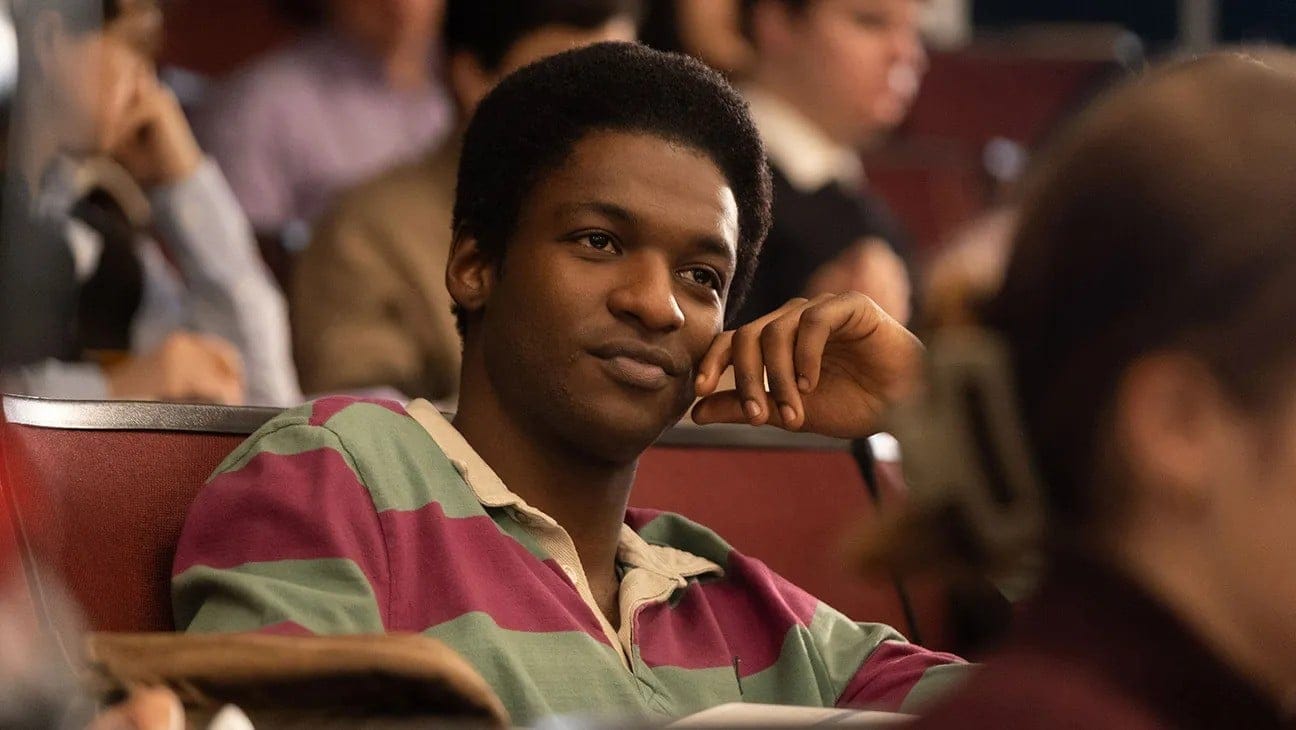
Not long into Chiwetel Ejiofor’s Rob Peace, the eponymous character (Chance K. Smith) is sent to private school in a pre-emptive effort by his mother (Mary J. Blige) to keep him from the fate that often strands people of color in urban environments like Newark. Rob stands in front of the foreboding red bricks of his new school, as his new headmaster, Fr. Edwin Leahy (Michael Kelly), asks a group of Black teenagers, “What’s the most important thing you will learn here?” A few of the boys answer, but only Rob gets it right: brotherhood.
It’s the school’s most crucial lesson, etched on a plaque that you see the second you walk through the doors: “Whatever hurts my brother hurts me.” It’s chanted during morning convocation, where every student in the school gathers to take attendance, pray, and share the news as a community. And I know this because I went to that very same school.
Robert Peace was a year ahead of me at St. Benedict’s Preparatory School, a private, Catholic and (at the time) boys-only school run by Benedictine monks sitting at a strange perch overlooking Market Street in Newark. Born and raised in East Orange—another thing we had in common—Rob was the platonic ideal of the man the school looked to create, given time and commitment. He was able to straddle the lines of still being from North Jersey and being an intensely smart, driven kid who bought wholeheartedly into the philosophies of brotherhood, community, education, and faith that the school instills in its students. While he embraced the school, and the brotherhood he fostered around him, it was always clear that he was headed out of the city, into the Ivy League, and that he was smart and spiritually strong enough to get there.
I can’t say the same about myself back then. I was a nerdy, angsty, alternative-rock kid who was built like a football player, and who, rather than ever try out for football or water polo, wanted to watch wrestling, play Mortal Kombat, and listen to Nine Inch Nails. I appreciated the school and my time there only in retrospect, when it became clearer what kind of world Benedict’s was preparing its students for. That is, the fates it tried to equip us to avoid. And in Rob Peace’s case, that fate was being shot to death over a drug deal a little over a decade after he graduated.
It’s rare to see the less inherently cinematic sections of Newark and East Orange portrayed on screen, playing themselves for better and worse. Ejiofor’s direction frequently keeps things close and intimate, so that being this close to the stoops, the gutted Section 8 mansions-turned-apartments, and cracked roads of the place makes life in the Jersey depicted in the film feel as insurmountable as it often is for the folks who live there. And you don’t get a larger sense of the world in this film until Rob is a grown man (now played by Jay Will) and is headed off to Yale.

Beyond the potential oblivion that so many people living in his hometown struggle to wrest themselves from, Rob’s life had a much heavier albatross in the form of his father, Skeet (Ejiofor), who was convicted of murdering two women and sentenced to life in prison when Rob was seven. Rob’s ceaseless faith in his father’s innocence leads him to his academic career in biology, and to a side hustle selling weed to Yalies to pay for his father’s legal fees.
Throughout, the film mediates its story through a hell of a code-switch. Its entire narrative, like Will’s performance, modulates wildly depending on which path Rob is choosing to walk down at any given moment, from investigating ways to exonerate his father, to his fascination with science, to using both those skills to set himself up as the premiere weed connection on campus.
The main issue is that Rob Peace is a film unsure of how much time to spend showing the various facets of Rob’s life, and despite all of them being fascinating, funny, and subtly enthralling, each of them suffers in some fashion along the way. Rob’s relationship with his closest friends in particular feels like it’s on fast forward after we get to the point that he’s started dealing and his friends come along for the truncated ride. Rob’s girlfriend, Naya (Camila Cabello), is equally underserved, mostly there to reiterate his potential.
The things that elevate Rob Peace are those that elevated Rob’s life overall. The film’s narration—a framing device centered around Rob’s posthumous letter to a grad school he’d never get to attend—is heavy-handed. But hearing a young Black man tie his upbringing and environment to the study of microbiology and the lessons learned from Benedict’s to the need to bring the rich and poor together on Yale’s campus is beautiful and rarely heard in world cinema. These stretches may be inconsistent, but they carry Rob Peace beyond being just another message film. They, more than anything, exhibit the wasted potential of Rob Peace as a human being.
Late in Ejiofor’s film, we see a small aspect of this story I had no idea about: Rob actually returned to Benedict’s in the mid-2000s to teach biology and coach water polo. He and his friends used the money from Yale to buy up real estate in East Orange, while Fr. Edwin Leahy encouraged him to go to grad school and continue down the path of becoming a microbiologist. The entirety of Rob’s world had been telling him to get out of East Orange toward the end of his life, even though he had never had more power to bring his knowledge back to his community.
That’s a contradiction that haunts so many of us who grow up in these places—the innate knowledge that you should try your damndest to uplift those you leave behind. The tragedy of Rob Peace’s life, and the bleak climax of the film based on it, may be an all-too-common one, but that doesn’t mean it’s worth mourning less, or that his failures don’t feel sad and familiar. The things that hurt my brother, as it turns out, still have the ability to hurt me.
Since 2001, we've brought you uncompromising, candid takes on the world of film, music, television, video games, theater, and more. Independently owned and operated publications like Slant have been hit hard in recent years, but we’re committed to keeping our content free and accessible—meaning no paywalls or fees.
If you like what we do, please consider subscribing to our Patreon or making a donation.