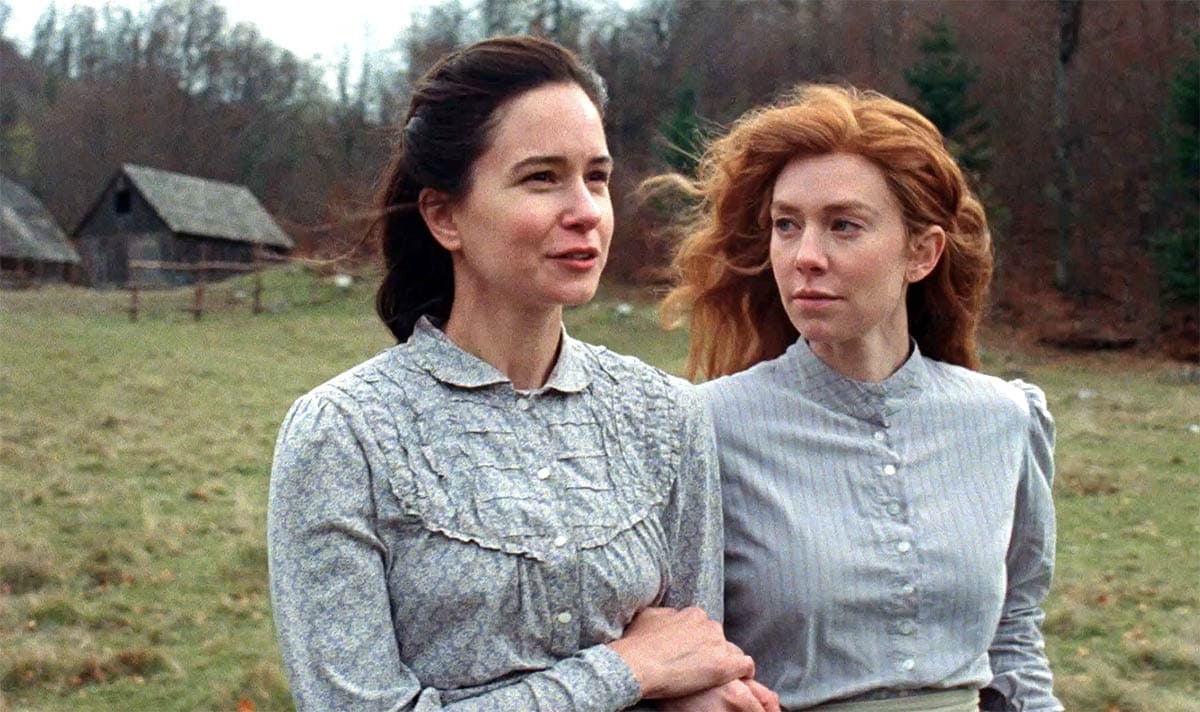
Mona Fastvold’s The World to Come is an emotionally stormy romance in which true happiness feels as fleeting as the suddenly changing weather. Set on a farm on a rocky wooded hillside in upstate New York in the 1850s, the film starts as many stories about an affair do: inside the prison of an unhappy marriage. Abigail (Katherine Waterston) is the reserved wife of Dyer (Casey Affleck), whose vocal reticence and emotional flatness make her seem almost manic by comparison. Even when it becomes clear that Abigail’s heart has been stolen away by the couple’s neighbor, Tallie (Vanessa Kirby), Dyer registers as much perturbation as a horse with a few flies on its back.
Structured as a series of diary entries narrated by Abigail, the film opens with her describing in measured, somewhat hypnotic tones her observations of the January weather as we see the two go about their labor and nearly silent coexistence. Although the screenplay (adapted by Ron Hansen and Jim Shepard from the latter’s acclaimed short story) generally hews to a less-is-more philosophy, it introduces an unnecessary piece of plot baggage by sourcing Abigail and Dyer’s martial disquiet to flashback memories of a dead child, recently lost to sickness. Given the sharp disconnect between Dyer’s submerged personality and Abigail’s desire for something more than their mere survival (and no sense that he was any more emotive before the tragedy), it’s hard to imagine her as a contented spouse while their daughter was living. His grumbling over her wasting paper and ink recording anything but facts about money received or debts incurred has already caused her to internally agitate over the idea that on their death there would be nothing left, “no record of our emotions or fears.”
The most successful aspect of The World to Come is just how sudden and inescapable the spark is between Abigail and Tallie. When Abigail first spots the red-haired Tallie riding by in the wagon driven by her husband, Finney (Christopher Abbott)—who’s talkier than Dyer but no less emotionally detached—their eyes lock with a goosebump-raising intensity and nearly carnal frankness that renders their ending up in bed together a foregone conclusion.
Once the women find excuses to start spending time together, their flirtation is well-calibrated. As the two chat over tea and chores, Tallie’s nearly unblinking attentiveness helps Abigail to overcome her shyness. “I find that everything I wish to tell her loses its eloquence in her presence,” she writes in her diary. As the two find more points at which their spirits are wanting to merge, the story becomes not just a romance but a liberation narrative in which they realize just how little they have been raised to expect out of life.
Before long, the political tracks with the romantic as Abigail starts to overtly yearn for a life more expansive than the one her family imagined or Dyer has laid out for her. This sense of wide-open possibilities enriches the film’s middle stretch, and in spite of the distinctly anachronistic tone of Kirby’s performance (the actress catches the eye, but her affect and accent feel better suited for a fashion runway than a pre-Civil War frontier setting).
After Abigail and Tallie finally work up the nerve to consummate their love, Fastvold presents what follows as a series of montages showing the two as a kind of couple, hiking and chatting and blissfully ignorant of the world around them. It’s a disappointing shift that fails to replace the fervency of those earlier bonding conversations with anything of matching intensity. With the exception of a couple scenes, the women also seem strangely unconcerned about their love being discovered. It’s a refreshing, if somewhat unrealistic, direction for the filmmakers to go in, allowing the characters to at least briefly live as an openly loving couple without the narrative being hijacked by societal prejudice. For the most part, their clothed but no less impassioned encounters are put right out in the open for their husbands to witness.
The film’s romance comes alive through some well-wrought dialogue that rarely ventures into faux-period eloquence, but there are a few moments here where the scripting stumbles over itself. Writing of a cold January morning, Abigail notes with groaningly obvious subtext that there was “ice in our bedroom.” Despite being structured around Abigail’s narration, a couple of scenes are inexplicably seen from Tallie’s perspective. After Abigail mentions to Dyer that she would like to have an atlas, he gifts her instead a box of raisins for her birthday. That same symbolic atlas comes back not only when Tallie gifts it to Abigail but also as the crux of the film’s last-act tragedy. Though the writers can be forgiven for trying to give their frequently gloomy story a more upbeat conclusion, the too-clever maneuver they use to tie things off is ultimately more distracting than a straightforward downer might have been.
It may not be fair to lump The World to Come in—as others surely will—with two recent romances about 19th-century women falling in love in isolated surroundings: Céline Sciamma’s Portrait of a Lady on Fire and Francis Lee’s Ammonite. But it’s instructive to note that those films maintain a far stronger sense of time and place. There’s a foreignness to their settings and their characters’ behaviors that never let us forget that we’re peering into a different world, where people have radically different viewpoints. By contrast, The World to Come’s presents a period setting that too often feels as if it’s a product of the present day.
Since 2001, we've brought you uncompromising, candid takes on the world of film, music, television, video games, theater, and more. Independently owned and operated publications like Slant have been hit hard in recent years, but we’re committed to keeping our content free and accessible—meaning no paywalls or fees.
If you like what we do, please consider subscribing to our Patreon or making a donation.