John Lee Hancock’s The Little Things blends two modes of the serial killer film, both of which have been shepherded by David Fincher. In the first, trendy in the mid-to-late 1990s in the wake of Jonathan Demme’s The Silence of the Lambs and especially Fincher’s Se7en, movie stars chase enigmatic and powerful killers who suggest rock stars. In the second mode, embodied by Fincher’s Zodiac and trendy again due to the popularity of true-crime shows, the killer is an elusive phantom who unmoors the dogged obsessives looking to catch him implicitly as an indication that society is rational and therefore controllable. The first mode often suggests youthful rebellion, while the second plumbs vulnerable adults’ existential search for meaning and safety. Inconsistently embracing both of these essentially opposing perspectives, The Little Things seeks to have its cake and eat it too, functioning as a nightmarish midlife crisis thriller with a cartoon demon at its center.
The Little Things follows two police officers as they futilely track a killer of prostitutes in Los Angeles in 1990, though Hancock, ever thorough, shoehorns in an only-in-the-movies mastermind into the proceedings. Joe Deacon (Denzel Washington) works with a sheriff’s department outside L.A. and, in the tradition of many of the actor’s heroes, radiates an intelligence and intensity that’re pointedly meant to inspire curiosity as to why he hasn’t gone further with his career. Joe is purposefully slumming, perhaps in retreat from a mysterious tragedy, though he unofficially partners with Jim Baxter (Rami Malek), a detective working murders that might connect to a previous cold case. Soon, Joe’s shedding his sheriff’s duds for chic apparel worthy of Washington’s star power and going rogue to flush out answers.
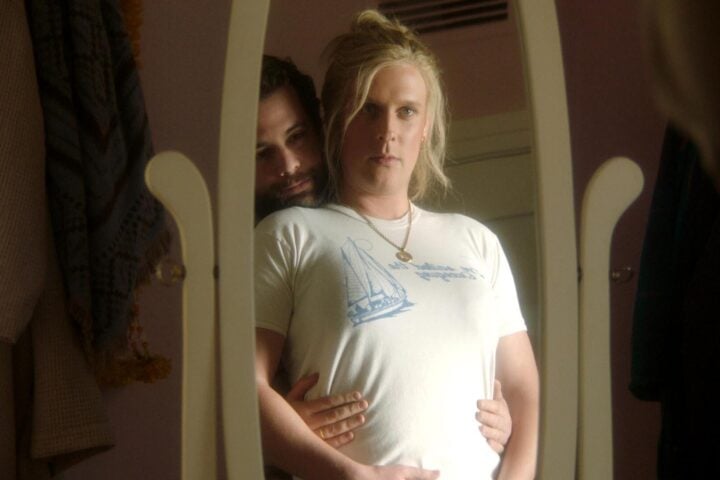
Joe’s discarding of his uniform is weirdly disappointing, underscoring the paucity of the film’s imagination. It would be more novel, and exciting, if Joe were an everyman rather than one of Washington’s prototypical bad asses. And The Little Things would be scarier if the suspect who Joe and Jim come to harass, Albert, were also more ordinary, rather than some weirdo straight out of central casting who’s here played to the inevitably fey hilt by Jared Leto. Still, Leto’s performance may grow on you, as the actor perversely, amusingly understands Albert to be playing a stereotype. A true-crime obsessive, Albert is a dweeb who fashions himself as a Machiavellian villain, and Joe and Jim are desperate enough to fall for his shtick.
If Hancock had further mined the suggestion that we’re all playing roles fostered for us by society, especially by pop culture, The Little Things could have packed an unusual metatextual punch. As it is, the film mostly functions as a Fincher tribute reel: The opening sequence, with a vintage vehicle stalking someone while a golden oldie plays on the soundtrack, recalls Zodiac, while the climax, set in a desert under the harsh sunlight as someone springs a trap, is reminiscent of Se7en’s final sequence nearly to the point of plagiarism. The Little Things’s best scene, in which Joe plays hide and seek on the highway with Albert, even alludes to one of Zodiac’s own influences, Peter Yates’s 1968 action thriller Bullitt.
Though it feels impersonal, The Little Things nevertheless has an obsessive pull. The film’s images have a haunting noir sheen, rich in darkness and empty L.A. vistas, and it was astute of Hancock to pair Washington and Malek, who play workaholic detectives in starkly different registers. Malek gives Jim a combustible fragility that brings the film’s potentially rote investigation scenes to life, plumbing the psychic toll they take on a character who could’ve been a cipher. Such energy keeps Washington, who can steamroll over most performers, on his toes, coaxing out a nurturing instinct that gives Joe an unexpectedly wounded texture. At the center of this diverting formula exercise is a compelling pair then, and Hancock has the taste to allow his actors to riff, informing The Little Things with an irresolute humanity that’s redolent of yet another superior Fincher-affiliated production, Netflix’s Mindhunter.
Since 2001, we've brought you uncompromising, candid takes on the world of film, music, television, video games, theater, and more. Independently owned and operated publications like Slant have been hit hard in recent years, but we’re committed to keeping our content free and accessible—meaning no paywalls or fees.
If you like what we do, please consider subscribing to our Patreon or making a donation.