
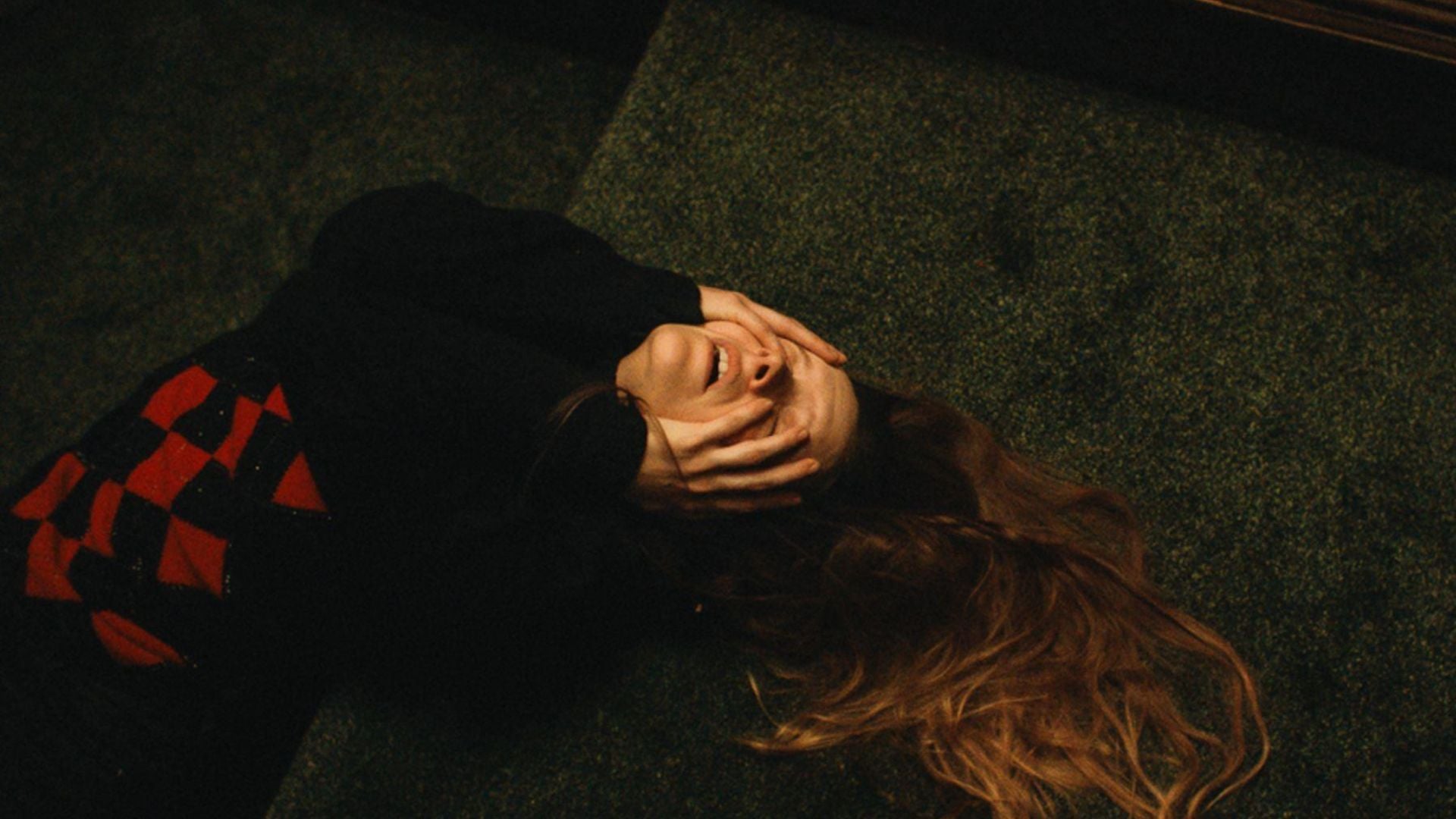
Writer-director Rose Glass’s Saint Maud stretches a short film’s worth of material to feature length, papering over the resulting sketchiness with a stifling, studied atmosphere. At its best, the horror film can serve as a gloriously disreputable refute to polite society, to the sort of euphemistic evasions offered up by “respectable” productions. By contrast, Glass utilizes a provocative scenario for a vague and deadly serious art exercise.
Maud (Morfydd Clark) is an in-home nurse living in a small British seaside town who believes that she’s meant to enlighten her new patient, Amanda (Jennifer Ehle), before the ailing, wheelchair-bound woman succumbs to stage-four lymphoma. A devout Roman Catholic, Maud is a pious loner, intent on denying and punishing herself for mysterious reasons, who serves as a stark contrast to Amanda, a former dancer who’s accustomed to a hedonistic artist’s lifestyle, including booze, smoking, and liaisons with younger women. The film’s early passages, establishing this relationship, are its most promising, suggesting a dark psychological comedy of manners in which a libertine is pitted against a prig in a confined setting.
There’s obviously something wrong with Maud, who’s seemingly in a trance when the film opens with her in a hospital room that’s menacingly and ludicrously lit like a Saw torture chamber. She suggests a bomb waiting to go off, a fanatic who thinks God is speaking directly to her. In the tradition of films as diverse as Roman Polanski’s Repulsion, Brian De Palma’s Carrie, Martin Scorsese’s Taxi Driver (which Glass visually quotes at one point), and Lucky McKee’s May, Saint Maud roots itself in a fragile, self-absorbed psyche and inspires morbid curiosity as to just how bad the fallout is going to be when internal violence bursts out.
In its references to William Blake’s ecstatic, disturbing religious paintings, we sense that Saint Maud has similar ambitions to those other films, which are tonally varied, surprising, and formally rapturous, mixing violence and beauty in fashions that are truly unnerving. But it isn’t long before Glass’s film turns into a single-minded dirge. Everything there is to know about Saint Maud is knowable within the first 15 minutes, from the actions Maud will inevitably take to the accomplished yet unvaried visual scheme, which suggests a series of gothic watercolor paintings. Maude is never defined as anyone other than a crazy bible-thumper who’s destined to unleash some Old Testament-style destruction.
There’s one moment late in Glass’s film, when Amanda tells Maud how ludicrous her religion is, that’s joltingly funny, in part because Amanda is allowed to voice the irritation that many viewers may also feel from being stuck with the invalid’s cipher of a caregiver. In this scene, Glass captures the resentment that atheists often feel toward the religious for their judgment and hypocrisy. But the filmmaker otherwise has little interest in the emotional contours of fanaticism, as well as the tensions between devout and atheist beliefs.
Throughout, Maud speaks in clichés and contorts herself into poses familiar from so many films about demonic possession. Is Maud speaking to God, the devil, or is she just mad? The answer is tipped off early, leaving many halfhearted scenes that tease a nonexistent mystery. And while Clark has an intense screen presence, her monotonal performance embodies the film’s pervading obviousness. The actress’s relentlessness becomes a form of editorializing, a failure of imagination and empathy; the film would be harder to shake if we were allowed to occasionally understand Maud’s point of view, rather than pitying her as a freak.
Piper Laurie accomplished such a task in Carrie, as her character’s religious zealotry was monstrous yet magnetic, even sensual. If Laurie’s Margaret White were a preacher, people would follow her. Maud, on the other hand, is a bore who gratifies atheists’ condescension of the religious. Which is to say that, in its own way, Saint Maud preaches to the choir.
Since 2001, we've brought you uncompromising, candid takes on the world of film, music, television, video games, theater, and more. Independently owned and operated publications like Slant have been hit hard in recent years, but we’re committed to keeping our content free and accessible—meaning no paywalls or fees.
If you like what we do, please consider subscribing to our Patreon or making a donation.



I agree. An utterly tedious film.