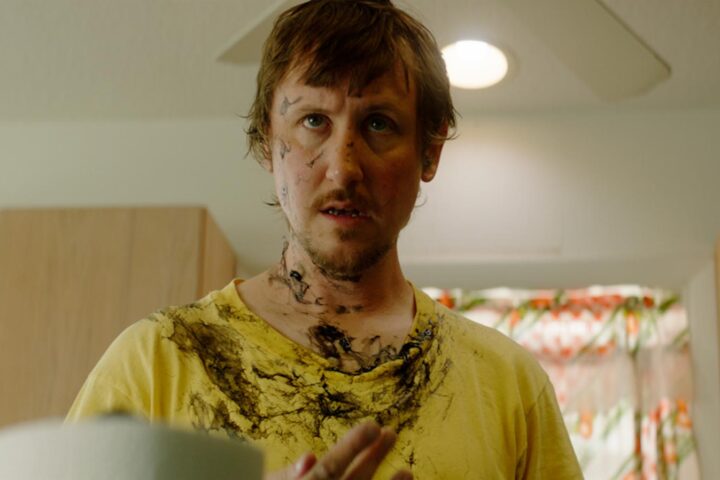
William Shakespeare’s Hamlet endures as one of the Bard’s most malleable works. As in Kurosawa Akira’s The Bad Sleep Well and Michael Almereyda’s Hamlet, Aneil Karia’s adaptation is set in a modern city, with the myriad misdeeds and rampant corruption of modern capitalism and the business world filling in for the original play’s perilous royal intrigue. But it also concerns itself far less with the massive, shady real estate dealings of Hamlet’s father (Avijit Dutt) and uncle, Claudius (Art Malik), than with Hamlet’s (Riz Ahmed) interior struggles upon learning that his father was murdered by Claudius.
Karia’s Hamlet, which is nearly defined by its handheld camerawork and the medium close-ups on Ahmed’s face, is one of the more intimate adaptations of Shakespeare’s play to date. Ahmed’s line readings, while primarily in Shakespearean verse, are extremely naturalistic, with the actor fiercely attuned to Hamlet’s feelings of disillusionment and anger, as well as his thirst for vengeance. Ahmed’s raw vocal delivery, often trembly to the point of making the words difficult to decipher, underlines his character’s vulnerabilities as they’re shepherded to the surface.
Set in London’s South Asian community, the film also makes the most of its milieu. Many of the costumes and scenes, such as the extended wedding sequence, add original visual flourishes that help to defamiliarize the familiar. The play that Hamlet puts on for his mother, Gertrude (Sheeba Chaddha), and Claudius unfolds as a traditional Indian dance number, feverishly capturing the feelings of guilt, rage, betrayal, and fear that are stirred up across the scene. Even Hamlet’s heightened deference to his mother and uncle, after already suspecting them of killing his father, is poignantly reflective of South Asian parent-child relations.
While Karia’s intense focus on Hamlet and his immediate surroundings feels fresh and revealing, the film tends to give a short shrift to other characters. Both Gertrude and Claudius are too thinly sketched, so the tensions between them and Hamlet don’t carry quite the same weight as they do in other adaptations. Meanwhile, Laertes (Joe Alwyn) and Polonius’s (Timothy Spall) relationships to Hamlet and Claudius are barely explored, so it’s no surprise that the formers’ deceptions late in the film aren’t especially stinging.
Also as a result, the film’s critique of crony capitalist real estate moguls isn’t terribly revealing; a few brief scenes of the tent city that was formed after Hamlet’s father and uncle’s shady dealings forced low-income residents out of their neighborhood is a fascinating but undernourished subplot. But if many ancillary characters are murky, Karia and screenwriter Michael Lesslie’s deep, thoughtful examination of Hamlet’s psychological and emotional ebbs and flows, and Ahmed’s grounded and organic portrayal of them, is enough to prove that, in the right hands, Hamlet remains a diamond capable of revealing new facets each time it’s held in the light.
Since 2001, we've brought you uncompromising, candid takes on the world of film, music, television, video games, theater, and more. Independently owned and operated publications like Slant have been hit hard in recent years, but we’re committed to keeping our content free and accessible—meaning no paywalls or fees.
If you like what we do, please consider subscribing to our Patreon or making a donation.