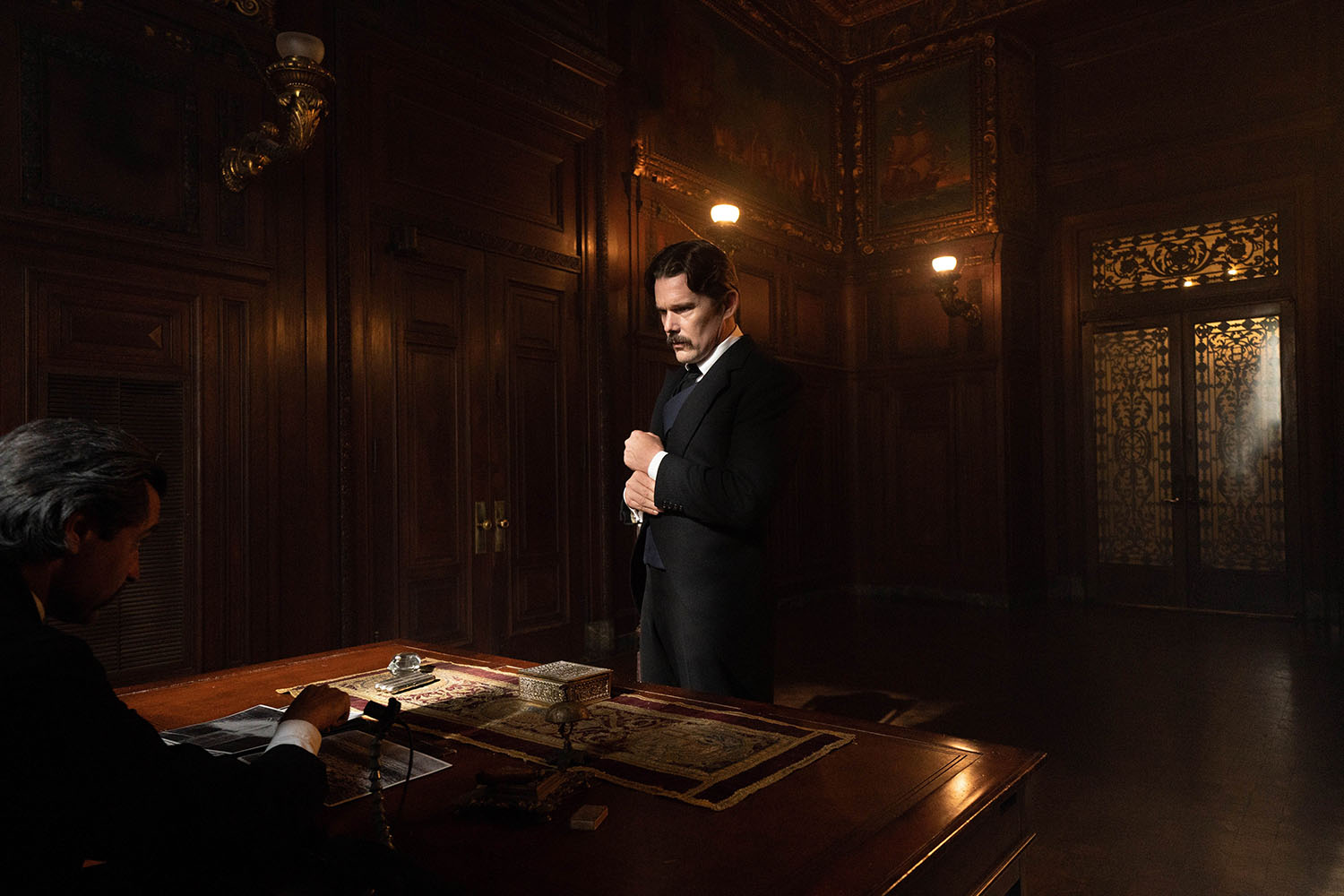
Biographies are often weighed down by obligation. Regardless of medium, one often has to wade through many pages or minutes of exposition—usually pertaining to genealogy and frustrations and failures—in order to get to the “why” of our interest in a person’s life. Several recent biopics have shaken up this formula, most notably Josephine Decker’s Shirley, which utilized elements of author Shirley Jackson’s life as the foundation for a furious psychological roundelay that feels intensely of the moment. With Tesla, writer-director Michael Almereyda similarly combats the numbing aura of retrospection that can plague the biopic, filtering the professional life of Nikola Tesla (Ethan Hawke) through a series of postmodern conceits that intensify the mystery of the inventor and futurist.
Retrospection is a bane of the biography, giving the impression that its subject’s narrative is set in stone, in the process shortchanging the chaos and immediacy of life. By contrast, Tesla is concerned with what specifically drew Almereyda to Tesla, namely what the filmmaker doesn’t know about his subject. These concerns conjoin into a governing idea: the media’s legacy of insidiously shaping our knowledge. Tesla is hosted by Anne Morgan (Eve Hewson), daughter of wealthy industrialist J.P. Morgan (Donnie Keshawarz), and she underlines the difference between the perceived facts and legends of Tesla’s life, as well as the flights of fancy that Almereyda indulges for dramatic effect. Most evocatively, she compares Google entries about Tesla and a few of the major players in Tesla’s life, particularly his brief employer and rival, Thomas Edison (Kyle MacLachlan), who has twice as many searches as Tesla.
Of course, Edison is a legend taught in schools everywhere, while Tesla is a cult figure, even though the latter pioneered the channeling of alternating current, or AC, while Edison was devoted to direct current, or DC. Anne observes to the audience that only a handful of pictures of Tesla exist online, which are often Photoshopped to suggest differing shots. Such a sleight of hand implies a breadth that doesn’t exist, nurturing our already inherent tendencies to consume bits of information quickly, lazily filling in gaps of knowledge with presumption.
Similarly, traditional biopics patly reduce a life to a formulaic three-act structure, imparting an impression that we know the story and that the story is inspiring without complication. The online series Drunk History, which Almereyda claims as a source of inspiration, and Jake Kasdan’s Walk Hard: The Dewey Cox Story mercilessly parody this proclivity of biographers. Hollywood’s able to make lives as diverse as those of Ray Charles and Johnny Cash appear similar through highly manipulative and highly pleasurable formula.
With Anne’s self-conscious hosting, with jarring breaks in “period” detail, with stylized blow-ups and backdrops that alert us to Tesla’s identity as a simulation, mixing elements of truth with mythology, Almereyda reinvigorates the biopic. It’s freeing to see a film like this concerned with gaps in knowledge, which allows for existential role-play that’s more dramatic, chaotic, and very much in the moment, than the canned homilies that often lard more typical scenes in the genre. (Paul Schrader’s more radical and austere Mishima: A Life in Four Chapters also appears to have been an influence on Almereyda.)

In one of Tesla’s most moving sequences, Almereyda utilizes several alienating devices at once. After Tesla illuminates the World’s Fair in Chicago with AC current in 1893, working for another industrialist, George Westinghouse (Jim Gaffigan), Edison invites him to lunch. Edison apologizes for not believing in Tesla before and offers him a blank check for a future project, while giving him a preview of his Kinetoscope, the peepshow precursor to cinema. This kind of scene, in which a hero’s daring is gratified, is traditional to the biopic. Then Anne tells us this encounter never happened, and Edison steps to the bar to grab a Coca-Cola, light a cigar, and check his iPhone. The puncturing of this scene’s reality is more than a clever stunt; it’s heartbreaking, expressing and denying our own yearning for closure, via narratives, as well as the need for security, to dream and innovate, which Tesla never quite continuously found.
A profound sense of restlessness and loneliness haunts Almereyda’s film. Tesla’s illumination of the World’s Fair is visualized by a beautiful, fleeting blown-up still that probably reflects the tight resources of the film’s production while suggesting the small comfort the glory might’ve provided the inventor, who was always pushing forward to the next idea. Tesla is first seen entering the doorway of a prosperous courtyard, perhaps in an echo of the final shot of John Ford’s The Searchers, and we see that he and the other partygoers are on roller skates, which he struggles with, drifting by musicians and acquaintances without much connection. Tesla is full of such metaphors, which are somehow cheekily obvious and haunting at the same time.
The framing device involving Anne gives Almereyda license to skip around in time, structuring the film primarily as a series of dialogues between Tesla and various captains of industry who could help him in his endeavors, and who often either discourage him, abandon him, or rip him off. This structure lends itself to a parable of the relationship between capitalism, innovation, and art-making, with Tesla as a creative who’s too obsessive to “play the game” as Edison does. Edison, Westinghouse, and Morgan help to forge what would become the modern idea of America, while Tesla dreams of wireless transmissions of electricity through the Earth—a notion that would be more prescient than anyone at the time could possibly fathom.
Almereyda doesn’t fuss over the capitalist theme by allowing his characters to make comfortable political points. Edison, Westinghouse, and Morgan aren’t villainous Big Daddy stereotypes, but individualized men, hounded by loss, who channel their anguish into vast seizures of power. They see in Tesla the brilliant drifter they might have themselves become if they had less control over their demons. Edison is particularly fascinating, as MacLachlan imbues him with a kind of poignant smugness; the character is never more vulnerable or funny than when lashing out passive-aggressively at Tesla, especially when he deliberately misremembers a perceived debt. Strikingly, Edison is also accorded the film’s most romantic scene, in which he offers to teach Morse code to his future second wife, Mina (Hannah Gross), tapping her hand while claiming that they can communicate without speaking. (Tesla, the dreamer, is incapable of such intimacy, and Hawke plays him without sentimentality.)
The film’s reference to modern technology gratifies Tesla’s dreams, while suggesting that the timeline here might be a multidimensional slipstream. Doesn’t wireless place us in less fantastical version of such a slipstream, as we consume information from various periods, mashing stimulation together in a frenzied torrent that leaves us feeling somewhat placeless? Almereyda suggests that these men felt that feeling ahead of their times, especially Tesla, and he dramatizes this grappling via scenes of insular, poetic, handwringing intensity, which cinematographer Sean Price Williams shrouds in soft, earthy light that often obscures the men’s faces, suggesting that we only know them via hearsay, and that they can’t fully see themselves. One moment, in which the actress Sarah Bernhardt (Rebecca Dayan) is bathed in heavenly AC light, is the closest this film comes to offering Tesla a love duet. It’s a moment in which the man’s brilliance actually, for once, brings him closer to someone.
Since 2001, we've brought you uncompromising, candid takes on the world of film, music, television, video games, theater, and more. Independently owned and operated publications like Slant have been hit hard in recent years, but we’re committed to keeping our content free and accessible—meaning no paywalls or fees.
If you like what we do, please consider subscribing to our Patreon or making a donation.