Henry Joost and Ariel Schulman’s superhero film Project Power lives in its fusing of realism and fantasy. Though its social commentary isn’t nearly as tone deaf as that of David Ayer’s Bright, the film is an equally clunky and disjointed affair, haphazardly alternating between scenes depicting a young girl’s struggle to achieve her dream of becoming a rapper, a former military officer looking for his missing child, and the intrigue tied to controversial military testing and a new War on Drugs. A few dashes of superhero action, hamstrung by slapdash CGI work, render most sequences visually incoherent, while the excessive amount of references to the film being set in New Orleans mostly succeeds at making the “Boston Strong” rallying cry seem understated by comparison.
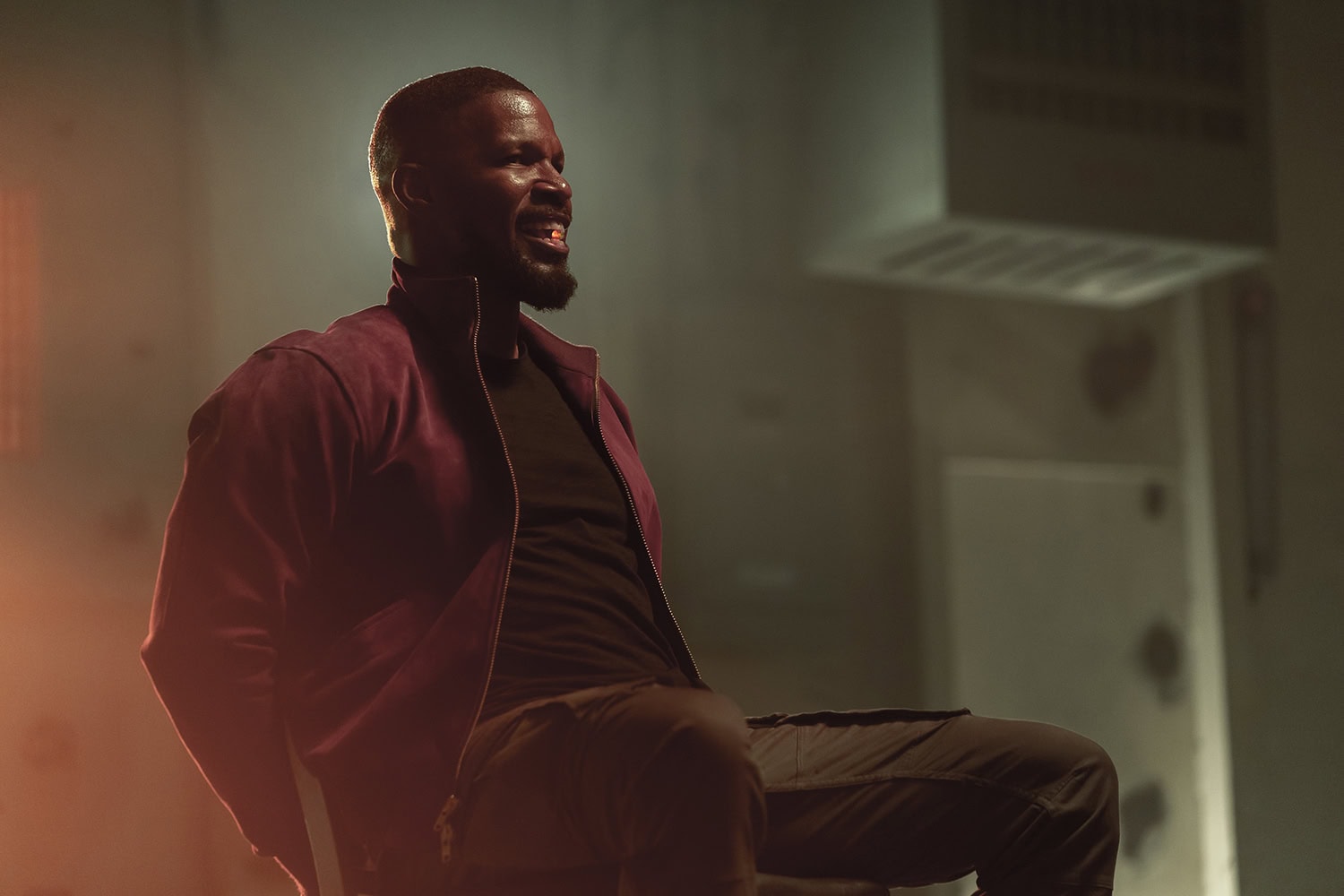
At the center of the film’s high-concept premise is a street drug called Power that gives anyone who takes it superhuman powers for five minutes. At the start of Project Power, the drug has already fallen into the hands of dealers throughout New Orleans, and the nefarious deeds committed by those who’ve ingested it are being combated by a trio of living, breathing clichés, each provided with their own trite, threadbare character arc. Joseph Gordon-Levitt plays Frank, a local cop who goes rogue, leveling the playing field by dosing up on Power with the help of a low-level dealer, Robin (Dominique Fishback), who’s only in the game to help pay for her mom’s exorbitant medical bills. An ex-soldier, Art (Jaime Foxx), is also in the mix, hunting down the head distributors of Power, who are holding his daughter (Kyanna Simpson) captive and using her mysteriously special DNA as the source for the experimental drug.
At one point, Project Power starts to open up interesting lines of inquiry when it conflates the expansion of the drug’s presence in inner cities with that of crack cocaine in the 1980s. But that potential is squandered almost as soon as it’s revealed that the only two people who’ve died from overdoses on Power are white. Indeed, Project Power evinces no interest in the drug’s war on black bodies, as communities of color are treated like wallpaper throughout the film: Just about the only feel we get for life in such communities are in glimpses of Saints or Pelicans sports gear and the occasional “Who Dat” group chant.
While the film judiciously places the blame for the chaos wrought by Power at the feet of the wealthy and influential, its portrait of corruption is as unimaginative as the name of its main villain, Biggie (Rodrigo Santoro). And in limiting its scope of who’s actually involved in the testing and distribution of the drug to only Biggie and Gardner (Amy Landecker), a suit who may or may not have government ties, the film refuses to implicate any particular institution, leaving its critique on the War on Drugs, at best, murky and toothless. Ultimately, Project Power is simply too weighed down by an abundance of narrative threads and abrupt tonal changes. In aiming to have a little something for seemingly every demographic, the film becomes an unwieldy array of muddled ideas that never gel together into a cohesive whole.
Since 2001, we've brought you uncompromising, candid takes on the world of film, music, television, video games, theater, and more. Independently owned and operated publications like Slant have been hit hard in recent years, but we’re committed to keeping our content free and accessible—meaning no paywalls or fees.
If you like what we do, please consider subscribing to our Patreon or making a donation.