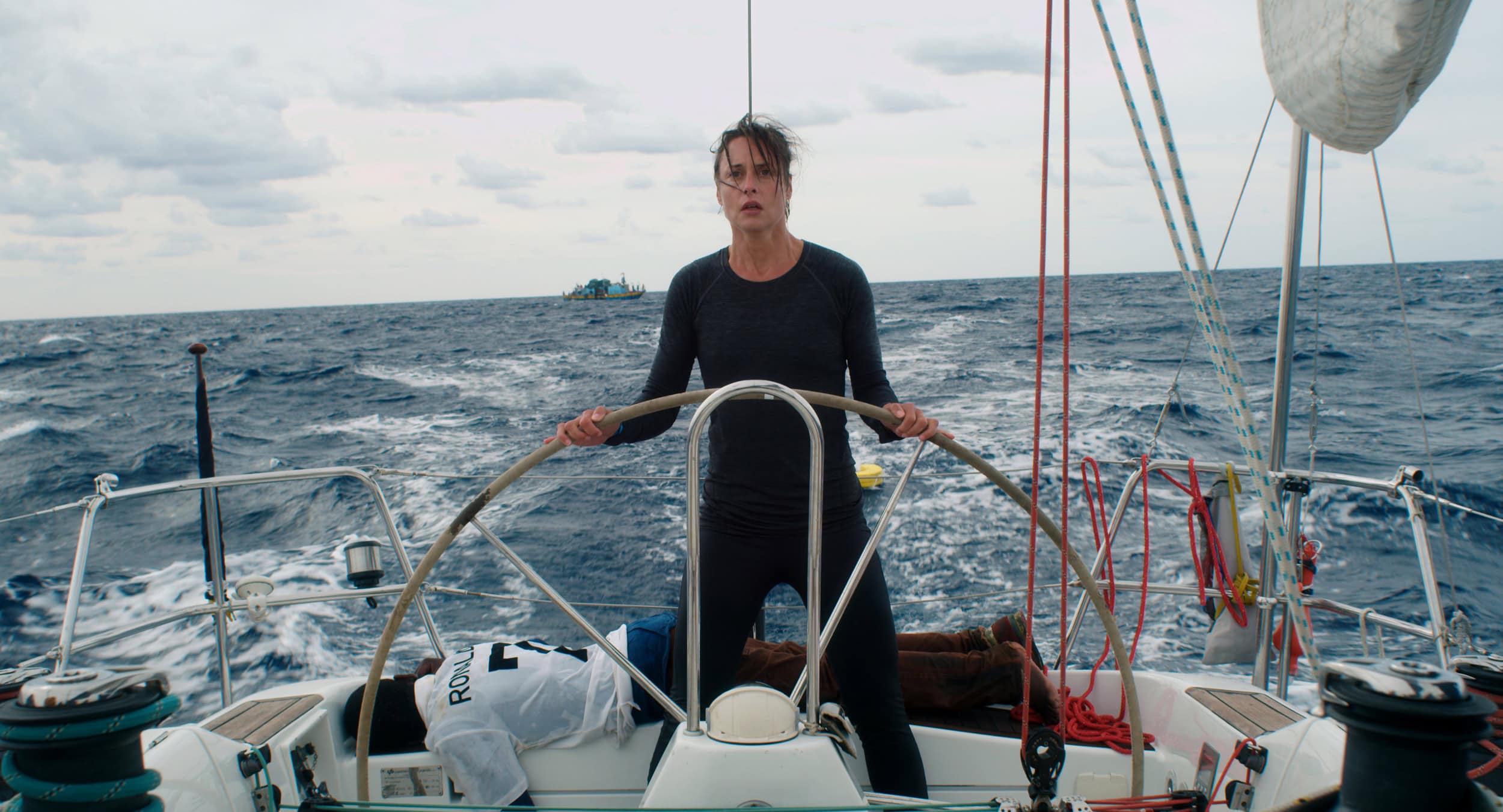
Set almost entirely in the middle of the Atlantic Ocean, Wolfgang Fischer’s Styx is a microcosmic parable of the global refugee crisis. This chamber drama’s protagonist, Rike (Susanne Wolff), is an avatar of hand-wringing European liberalism, a seemingly strong-willed and good-hearted German doctor who reveals a tragic indecisiveness when, during a solo yachting excursion, she encounters a boatful of stranded African migrants in desperate need of help. The problem for Rike is simply that, upon radioing in the incident, she’s instructed not to get involved and to entrust the situation to the proper authorities.
In its way, Styx is as penetrating an indictment of the bureaucratic obstacles placed in front of refugees as Guido Hendrikx’s Stranger in Paradise, which explicitly depicted the absurdities of the interview process for refugees seeking asylum in Europe. Rike clearly wants to assist the refugees she encounters, to provide them with bottled water, medical care, and maybe even sanctuary on her yacht, and yet, like the subject of a Milgram experiment, she allows her natural empathy to be overridden by a cruel and perplexing official command.
Rike does eventually get the opportunity to help at least one refugee, a young boy, Kingsley (Gedion Oduor Wekesa), who floats over to her vessel in dire need of medical attention, which she duly provides. But once Kingsley recovers, he starts to push her to assist his fellow refugees, to which she responds with mealy-mouthed excuses that mirror so much of the feckless, equivocating rhetoric around the refugee crisis. When Kingsley implores her to bring all the migrants onto her yacht, she responds that her boat is too small. And when pushed, she admits, “I have no answers for you. I don’t know what to say. I don’t know what to do.”
That sense of helplessness is palpable in Styx, but Fischer approaches it from an unexpected angle. The film opens with elliptical, seemingly disconnected sequences composed of elegant, disarming vistas: macaques descending on Gibraltar, a high-speed car chase, vast expanses of open sea. Gradually, though, the film tightens its focus onto Rike’s ocean voyage to Ascension Island, a remote volcanic outpost in the South Atlantic which Charles Darwin helped to terraform into a botanical wonderland. And, for a while, the film seems to be settling into a spartan (wo)man-versus-nature adventure tale in the style of All Is Lost, and one that’s even more strikingly authentic in its depiction of ocean sailing than J.C. Chandor’s film.
However, where All Is Lost essentially obliterated the world beyond its white male hero, Styx broadens out from its bourgie protagonist to show how privileged she really is. Rike’s adventure, while not without its perils, is one of her own choosing, a relaxing vacation with maps, radio, GPS, and a stockpile of supplies at the ready in case danger comes her way. The refugees, meanwhile, have far more limited choices and none of Rike’s access to resources. Kingsley and his fellow migrants may be traveling as a group, but they’re far more alone in this world than Rike could ever be. Even in the middle of the ocean, miles away from human civilization, there’s no escape from racism, class hierarchies, and Western global hegemony.
Since 2001, we've brought you uncompromising, candid takes on the world of film, music, television, video games, theater, and more. Independently owned and operated publications like Slant have been hit hard in recent years, but we’re committed to keeping our content free and accessible—meaning no paywalls or fees.
If you like what we do, please consider subscribing to our Patreon or making a donation.