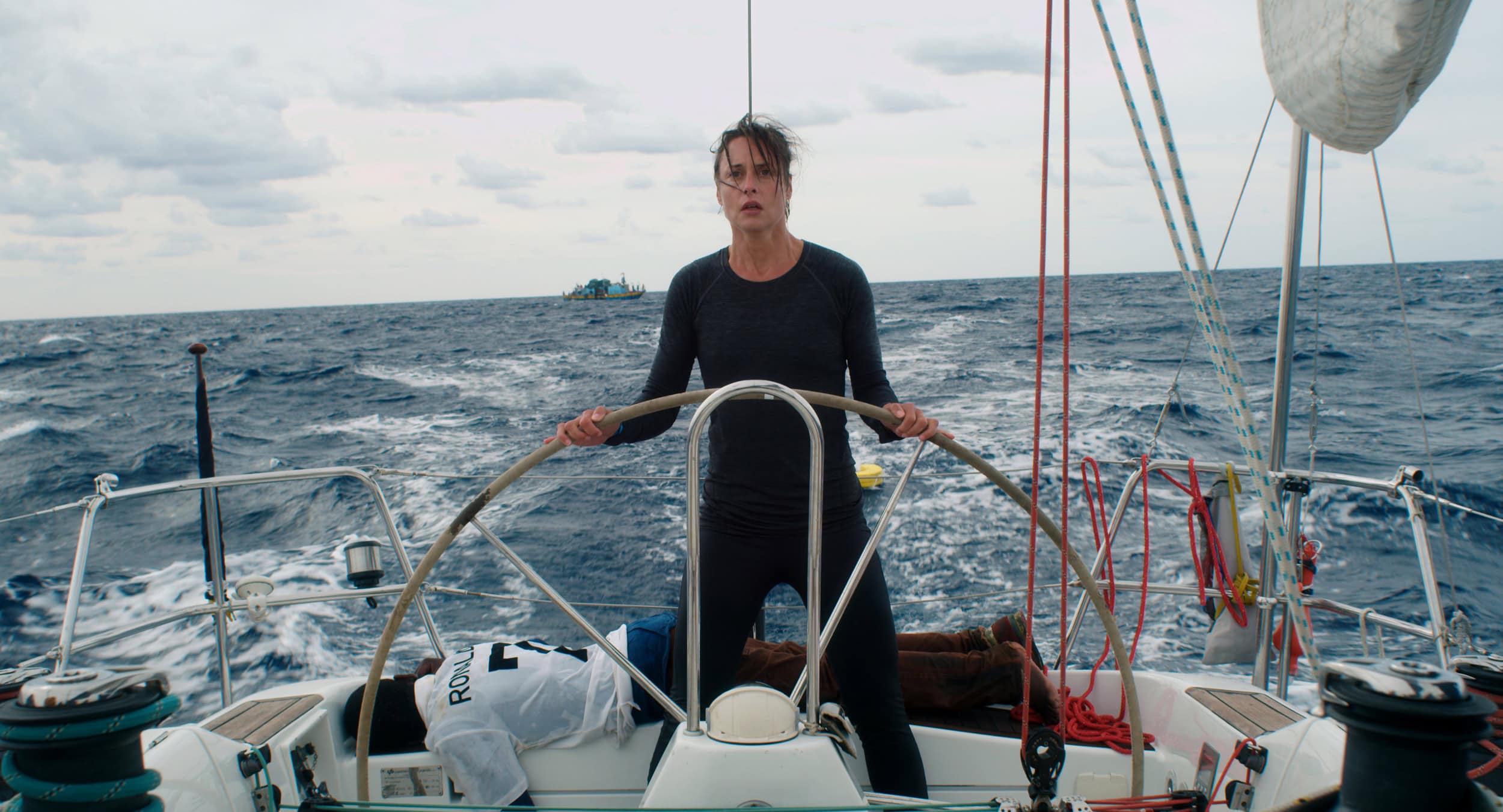
Director Benedikt Erlingsson’s Woman at War is a lot of things, probably too many things: ecological fable, ethical inquiry, action adventure, and more. But the film balances its various modes so carefully and efficiently that it achieves a graceful unity, if a strange one at that. It’s only appropriate, then, that Woman at War’s major theme, which emerges slowly throughout its running time, is synthesis itself.
To this end, the film centers around a personality split in two. Halla (Halldóra Geirharðsdóttir) is a middle-aged woman whose bourgeois exterior masks a secret: She’s the notorious ecoterrorist known as the Mountain Woman, who roams the countryside outside Reykjavik downing power lines with her bow and arrow. Her identical twin, Ása (also Geirharðsdóttir), is an aspiring sage, who wishes to perfect herself through meditation. Both see the world as out of joint; Halla wants to fix it, while Ása wants to fix herself. Right away, the film wants us to question whether these are goals that can be achieved in isolation from each other.
That’s a big enough question for any film, but there’s more to chew on here: Halla, who years ago put in an application to adopt a child, is notified that she’s been chosen to care for a Ukrainian girl, orphaned by war, and must decide in the next few days whether she will accept the child. Motherhood, though, isn’t compatible with an intensive campaign of industrial sabotage. Moreover, Ása, who had signed on as a kind of backup parent, is about to go on a retreat that will see her cut off from the world for two years. Thus, the sisters’ larger goals, their good writ large, must now be balanced against this chance to do good in the specific.
This piling on of moral complexity could have been daunting for the viewer, but Woman at War wryly and dreamily approaches the grandiose issues at its center. Halla is the film’s focal point, and at times the action feels so tightly tied to her concerns that it could be playing out inside her head—a dream in the literal sense. Her passion for nature is mirrored in the plotting. At one point, pursued by a helicopter after an act of sabotage, she happens upon the corpse of a sheep and hides inside it; at another, suffering from hypothermia, she’s cured by being laid in a hot spring. She wants to be one with the land, and Woman at War allows that urge to be fulfilled, both literally and with a tinge of the fantastic. In the same vein, Ása could even be read as a sort of figment—a la Tyler Durden in David Fincher’s Fight Club—embodying a moral stance that Halla finds attractive but is unable to accept.
Even Woman at War’s overall surfeit of ethical concerns could be seen as a reflection of Halla’s rebellion against convention and her desire to come to her own proper moral accounting. Still, the audience is never explicitly asked to question the film’s underlying reality; it’s just that this reality is woven through with Halla’s worries and fantasies, and perhaps even her own sense of self-importance (which Erlingsson is also careful to occasionally interrogate).
This is clearest in the case of the soundtrack. All of the film’s music is diegetic, performed by musicians whom only Halla can see and hear. At first, she’s accompanied by an Icelandic trio (drums, tuba, harmonium), to whom she occasionally issues cues. Later, when she begins to mull over the possibility of adoption, these are joined by a trio of Ukrainian folk singers. The score, then, serves to emphasize the quasi-magical interaction between Halla and the world of the film, that the world is responsive to her inner life, and that she, in turn, is unusually at home in and perceptive of the world. Having finally decided to go through with the adoption of the Ukrainian girl, Halla goes to catch a flight to Ukraine, and arriving at the airport, she sees the Icelandic trio’s drummer sitting by himself in the parking lot. She pauses, realizing the implication. What kind of scene requires only percussion? She’s been warned by the score before the score even plays. She won’t be getting on that plane.
In the end, some of the possibilities of synthesis that Woman at War examines are achieved. Halla and Ása find a way of jointly honoring both of their moral perspectives, albeit through sacrifice—and the Icelandic and Ukrainian trios sing a duet. But synthesis here isn’t a conclusion, nor a panacea. Iceland, portrayed as menaced by globalized capitalism, is in danger of being synthesized out of existence. This is a film too reserved and in subtle ways too self-questioning to offer answers, and it ends in ecological fashion, quiet and serene, avoiding the wasted narrative energy of resolution or catharsis.
Since 2001, we've brought you uncompromising, candid takes on the world of film, music, television, video games, theater, and more. Independently owned and operated publications like Slant have been hit hard in recent years, but we’re committed to keeping our content free and accessible—meaning no paywalls or fees.
If you like what we do, please consider subscribing to our Patreon or making a donation.