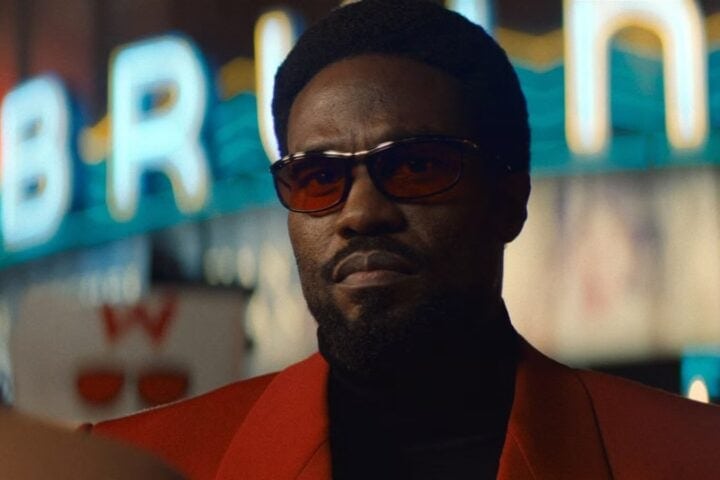
Heard early in Mary Harron’s new film, “Dalíland” refers to the entourage that surrounds legendary painter Salvador Dalí (Ben Kingsley) as he lives a life of sedentary comfort at New York’s St. Regis Hotel in the early 1970s. His best days as an artist behind him, Dalí himself is now the art, a series of poses and provocations that have attracted a small coterie of mostly aloof models, wannabe artists, and socialites, even a young Alice Cooper (Mark McKenna), who always looks vaguely put out to be one of the least outré people in this retinue.
Into this realm comes James (Christopher Briney), who works for the gallery that’s currently representing Dalí and awaiting new artwork to exhibit and sell. James sticks out like a sore thumb among these bohemians, his sheltered prudishness leaving him additionally prone to the lascivious attentions of both Dalí, who likens James’s androgynous beauty to the Christian martyr Saint Sebastian, and the painter’s wife and muse, Gala (Barbara Sukowa).
Gala enters the film like a force of nature, her openly amorous and defiant behavior a shot in the arm among the narcotized hangers-on who surround her husband. Instantly, her presence may cause you to question why James is at the center of Harron’s film. After all, few artist-muse relationships of the 20th century have been more scrutinized than the one between Salvador and Gala Dalí, chiefly because the latter bucked all usual expectations of the supplicant muse.
Even James can see from the outset that Gala is the machine that keeps Dalí going: handling his appointments, cajoling him to work, and regularly hitting up his gallerists for advances by countering their threats of nonpayment for works not remitted by demanding money so that he can work. And through it all, Sukowa captures the Russian-born Gala’s notoriously intimidating mien, with everyone from her husband to his backers cowering before her.

All of this is plainly visible in Dalíland, but it’s perplexingly seen through the camera obscura of James’s perspective. Rather than plunging us deep into Salvador and Gala’s mutually destructive and supportive codependency, the filmmakers situate us at the margins of it.
As written by John C. Walsh, the film treats us to facile insights that are revelations only to James, as in his confounded reaction to Gala’s open adultery and Dalí’s sexless voyeurism. Watching the young man struggle with the information that an artist whose work is as sexually obsessed as Dalí’s could himself be deeply repressed and virginal suggests that James made it all the way to adulthood and entered the realm of high art without ever hearing of Catholicism.
Harron’s own direction matches this removed point of view with drab, stately compositions of the parlors and galleries where the characters roam. Only the occasional, bracing moment of Dalí sitting down to paint, which she captures with sudden close-ups of paint tubes phallically spurting oils onto a palette, hints at the more vibrant path that the film might have taken.
The primary focus on James serves no other purpose than to reaffirm hollow platitudes about the sanctity and self-justifying beauty of art in the face of the naked materialism of everyone else who leeches off of Dalí. James remains doe-eyed in his naïveté until the very end, leaving Dalíland with no meaningful narrative of personal growth and rendering the sad final years of a mesmerizing artist with a self-negating blend of pity and worshipful devotion that does poor service to the enduring brilliance of Dalí’s best work and its emotional volatility.
Since 2001, we've brought you uncompromising, candid takes on the world of film, music, television, video games, theater, and more. Independently owned and operated publications like Slant have been hit hard in recent years, but we’re committed to keeping our content free and accessible—meaning no paywalls or fees.
If you like what we do, please consider subscribing to our Patreon or making a donation.