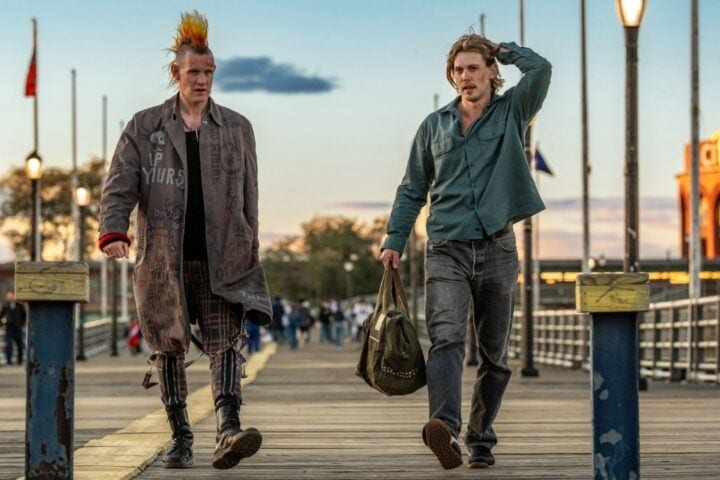
The life story of Robert Mapplethorpe is inextricably tied to the art that became his legacy. As a photographer, he worked primarily in black and white, his subjects often framed against empty backgrounds. The erotic images that he eventually became known for, often exploring BDSM iconography, are famous now for the controversy that they generated related to notions of obscenity and public funding for the arts.
Mapplethorpe, though, was also one of his generation’s most accomplished portraitists. His photograph of Patti Smith for the cover of her 1975 album Horses is perhaps the most recognizable of his work among the general public, but he also photographed figures as famous and far-ranging as Andy Warhol in the year before his death and a nude Arnold Schwarzenegger at the height of his bodybuilding career. And, of course, Robert Mapplethorpe himself. Mapplethorpe was a master of the visual autobiography, always staring directly into his own camera as if daring his eventual audience to look away even for a moment.
The relationship between art and its audience is based on the establishment of trust, and you can tell just by looking at a Mapplethorpe print that the artist whose eye brought the image to life was someone with keen instincts with regard to the careful collaboration between content and form, not to mention a deeply original point of view. But Ondi Timoner’s Mapplethorpe, a film that sets out to present a biographical account of the artist’s life from his young adulthood until his death in 1989 due to complications from AIDS, has absorbed none of its subject’s singular precision and focus. The film’s flatness and its relentlessly obvious narrative choices consistently undermine its potential to communicate anything more than the specifics of a timeline, and the constant reminders of Mapplethorpe’s genius at portraiture—his work is liberally represented throughout—do the comparatively bland film no favors at all.
Beginning with scenes that are air-lifted directly from Just Kids, Patti Smith’s acclaimed memoir of her and Mapplethorpe’s origin story as young lovers and budding artists experimenting and collaborating in relative obscurity, the film trudges through the already well-trod elements of Mapplethorpe’s biography as if responding to a particularly uninspired prompt, checking the boxes without elevating the form. But Matt Smith plays the artist with an involvedness that belies the banality of much of the dialogue that he’s been made to speak, capturing in the film’s stronger moments Mapplethorpe’s internal struggles both with his sexuality and with the direction of his increasingly complex artistic practices.
A beautiful scene early in the film depicts Mapplethorpe flirting concurrently with both the next phase of his sex life and the next phase of his work, impulsively tying up a future male lover in a bondage pose and snapping those first few photographs before succumbing to the other man’s embrace. Smith’s performance in the scene is at once seductive and aloof, full of both the nervous excitement of unfamiliar desire as well as the potential for violence in what is one of the film’s most raw expressions of the artist’s inner turmoil.
But it often seems like Smith has wandered from the set of Mapplethorpe and stumbled into a generic made-for-television depiction of an artist’s coming of age in New York City in the latter part of the 20th century, lazily rendered and lacking specificity. At the beginning of what is essentially the third act of the film, a title card indicates that the year is now 1981 just as Bronski Beat’s “Smalltown Boy”—which wasn’t released until 1984—begins to play. And that’s just one of several distracting details poised to throw discerning viewers.
Never mind that the biographical elements are essentially accurate; it’s the way that they’re so predictably strung together that begins to grate. The chronological events of a human life feel random without the connective tissue, the beating heart that brings us back again and again to the pleasures of narrative as art—stakes and tension, an intricate sense of causality and surprise, a sense of purpose. Look at the way Julian Schnabel’s At Eternity’s Gate incorporates Vincent van Gogh’s particular artistic aesthetic into the film’s cinematography as it brings to life an entirely interior world by embracing the quotidian, the everyday life of its subject. The content of Schnabel’s film directly influences its form.
In Mapplethorpe, the ultimate purpose of the film seems to be the reductive portrayal of the artist as yet another tormented queer destroyed by his tendencies toward vice. The cliché of tedious representations of rampant drug use and illicit sex that inevitably lead to an early death of AIDS is on full display here, similar to the way that Freddie Mercury’s extravagant descent into depravity is represented in Bryan Singer’s Bohemian Rhapsody, excessively played out (in a cringingly fallacious timeline) only for the audience to applaud his redemptive return to the stage by the film’s conclusion. And even Smith, in an otherwise loving portrayal of his subject, slips in Mapplethorpe’s last act into a theatrical and affected performance of vanity that shuts out the audience completely, the pathos of his younger Mapplethorpe replaced with a self-absorption that feels easy and unexplored.
Since 2001, we've brought you uncompromising, candid takes on the world of film, music, television, video games, theater, and more. Independently owned and operated publications like Slant have been hit hard in recent years, but we’re committed to keeping our content free and accessible—meaning no paywalls or fees.
If you like what we do, please consider subscribing to our Patreon or making a donation.