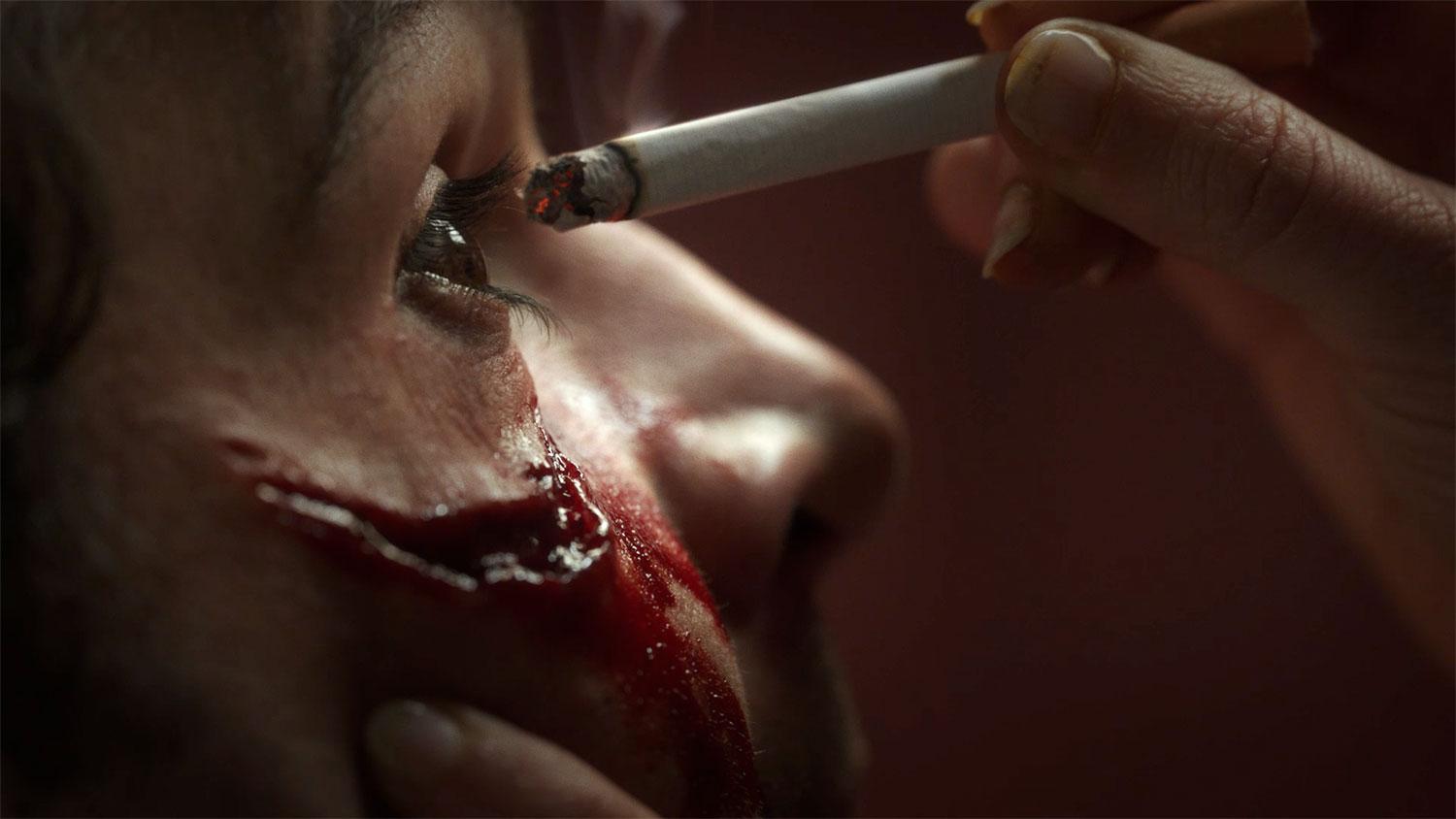
Like Takashi Miike’s Audition, Nicolas Pesce’s Piercing is based on a novel by Ryū Murakami and follows a man who lures a woman into his orbit under false pretenses, only to find that he’s more than met his match. Stylistically, however, the films are quite different. Audition is a slow burn in the key of Alfred Hitchcock’s Psycho, as both gradually morph from domestic dramas into ferociously subjective horror films. On the other hand, Piercing is a blow-out from the start, particularly emulating Italian gialli.
Some of Pesce’s homages are subtle, such as the emphases on brightly colored rotary phones that will be familiar to fans of Dario Argento’s cinema, while other references are bolder, like the use of miniatures to create a deliberately fantastical cityscape, and the sampling, on the soundtrack, of the scores of Deep Red and Tenebre. Which is to say that Piercing is as deliberate and self-conscious as Pesce’s prior The Eyes of My Mother, but the former’s aesthetic is warmer and more playful, allowing the characters to come to life.
Piercing opens with a startlingly off-putting image, as Reed (Christopher Abbott) holds an icepick up close to his baby son’s face. Reed is wrestling with a blossoming madness, and is planning on going into the city so he can murder a prostitute. In the film’s most unsettling scenes, Pesce lingers on Reed as the man chloroforms himself and pantomimes various methods of stabbing and beheading victims, which are accompanied by lurid gurgling sounds on the soundtrack that suggest the materiality of Reed’s fantasies, spurring his need to realize them. These sequences, however, are also darkly comic, as Pesce and Abbott understand the ludicrousness of Reed’s play-acting, which also embodies a pitiful man’s need to assert a power that evaporates in the presence of other people.
Reed settles on Jackie (Mia Wasikowska) as his first murder victim, but she’s as unhinged as he is, as well as more formidable. Piercing is essentially a chamber drama between these characters, set in a hotel room and later in Jackie’s apartment. And both of these habitats are also highly stylized, suggesting the dark and womb-like domiciles of many David Lynch productions. As in Audition, violence here is a metaphor for finding someone who can understand and share your special kind of eccentricity, and Abbott and Wasikowska give that potentially stale concept a sense of sexual combustion. Pesce allows the actors to establish a vivid physical rapport, lingering on touches that could signify violence, love, or both. With her insinuating voice, short blond hair, and leather undergarments, Jackie is simultaneously a den mother and a dominatrix, which is precisely what the neurotic Reed wants.
This film is a significant leap forward for Pesce after The Eyes of My Mother, which was calcified by its fealty to other horror films, with actors who appeared to be trapped in amber. If Piercing is mildly disappointing, it’s because it doesn’t go far enough. The film ends with two masochists on the verge of plunging into the deep recesses of their obsessions, perhaps upsetting the apple cart of Pesce’s beautiful and still somewhat precious slasher-movie compositions. Piercing confidently prepares us for a frenzy that never quite materializes.
Since 2001, we've brought you uncompromising, candid takes on the world of film, music, television, video games, theater, and more. Independently owned and operated publications like Slant have been hit hard in recent years, but we’re committed to keeping our content free and accessible—meaning no paywalls or fees.
If you like what we do, please consider subscribing to our Patreon or making a donation.