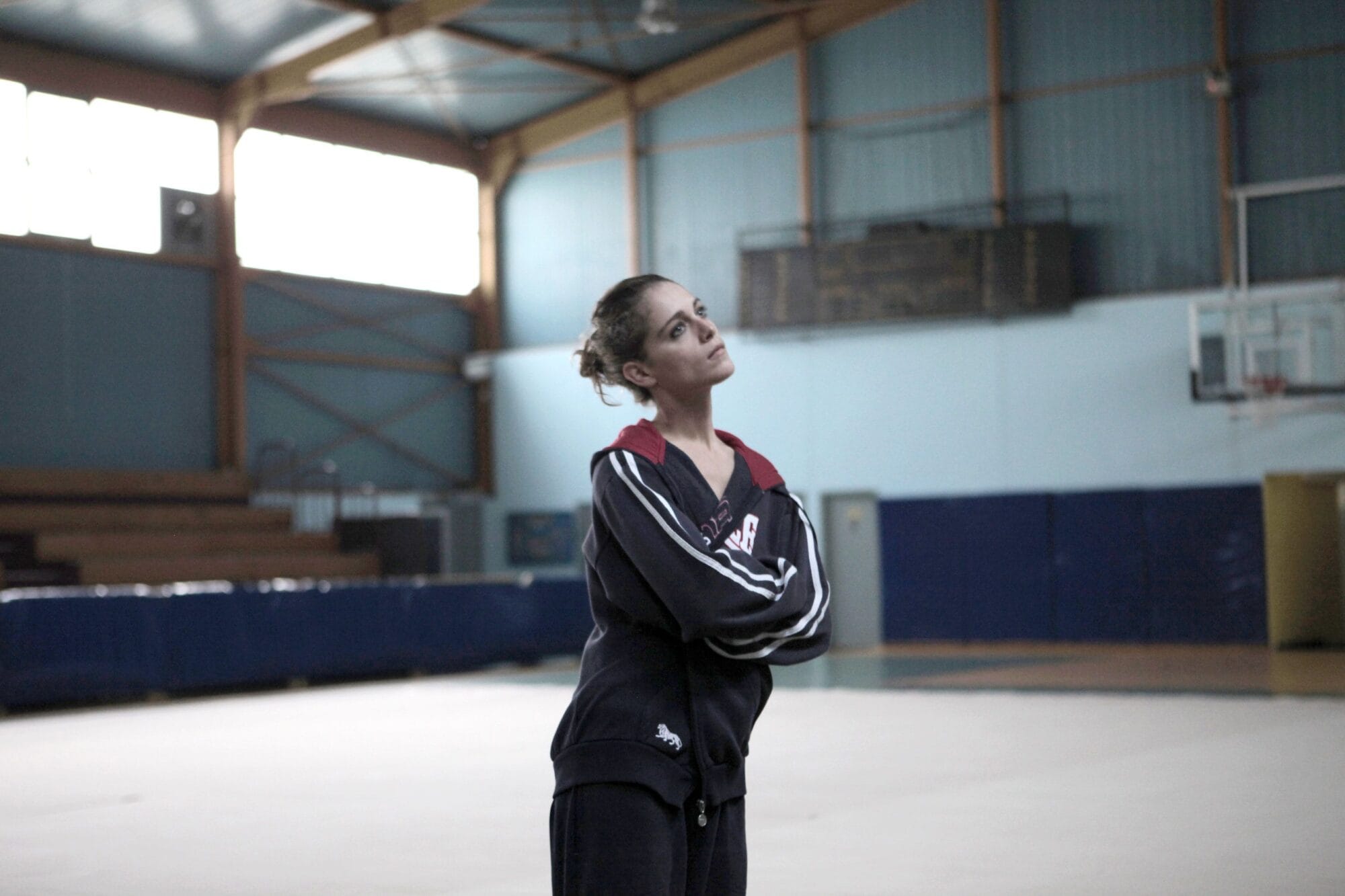
Operating from a premise strikingly similar to Chad Hartigan’s Little Fish, Christos Nikou’s Apples envisions a pandemic of amnesia, in which people stricken with a mysterious disease suddenly lose all memory of their former lives, right down to their names. For Aris (Aris Servetalis)—a man who seems to be sleepwalking through life when the disease hits him during a late-night bus ride—practically the only thing he’s able to recall about himself is that he likes eating apples. His roommate at the neurological hospital to which he’s taken, on the other hand, isn’t so lucky. When asked whether he eats the fruit, the old man responds matter-of-factly, “I don’t remember if I like them.”
Unlike most films about amnesia, Apples is less concerned with how people retrieve lost memories or reconnect with their previous sense of self than it is with how a brand new identity is created. Since no one claims Aris at the neurological hospital, he enrolls himself in an experimental program called New Identity that helps people to forge new lives. Under the guidance of a pair of parent-like doctors (Anna Kalaitzidou and Argiris Bakirtzis), Aris is put up in a modest, slightly sterile apartment and directed to carry out a series of tasks, each one to be documented with a Polaroid camera. These assignments span from relatively simple chores in the early stages (like riding a bike) to more socially complex undertakings later on (like having a drunken one-night stand) and essentially recreate, in highly compressed form, the trajectory of a person’s life from childhood to adolescence to adulthood.
Nikou and Stavros Raptis’s allegory-infused screenplay evokes the high-concept, quasi-surrealist work of fellow Greek filmmaker Yorgos Lanthimos, for whom Nikou served as assistant director on Dogtooth. But where Lanthimos approaches his weirdo premises with cynical black humor and a clinical distance, Nikou opts instead for a tone of droll melancholy that’s closer in spirit to Aki Kaurismäki’s work than it is to, say, The Lobster. Shot in a constrictive 4:3 aspect ratio, the film is neatly composed, with a bleached color palette that echoes Aris’s orderly, anhedonic existence without feeling overly stifling. Nikou makes room for a few refreshingly loose-limbed moments, such as a scene in which Aris dances wildly at a bar, that suggest a submerged vitality hiding behind the man’s stony façade.
Those brief moments aside, though, Aris is too hazily sketched for his efforts to build a new life to leave much of an impact. Midway through the film, the man strikes up a tentative courtship with Anna (Sofia Georgovassili), a fellow participant in the New Identity program who’s progressed a bit further in the process than him. But their relationship plays out in only the broadest of strokes, starting with a generic meet-cute at a horror movie followed by a series of scenes of the two helping each other with their assignments. Aris and Anna’s moments together are amiable enough, and a sequence in which they drive out to the country ends with a funny little twist, but all in all, their would-be romance lacks texture or dynamism.
That’s because, ultimately, Anna is little more than a plot device, a tool through which the audience will come to understand something about Aris that’s hinted at from the very start of Apples: that his amnesia may be only a front, an excuse to run from a terrible loss that disrupted his sense of self more than any mysterious affliction ever could. The filmmakers smartly avoid revealing the truth behind Aris’s mental state in one big grandiose twist, allowing our suspicions to build over the course of the film, until the reveal, once it finally comes, feels almost inevitable while still providing a satisfying sense of closure.
And yet, that feeling of satisfaction is precisely the problem with the film. Nikou has fully worked out his central allegory, even tying everything together with a symbolic closing scene in which Aris eats an apple, a metaphor for the past life to which he’s finally ready to return. But the ostensible emotional core of the film is left frustratingly one-dimensional. Because we get to know so little about Aris, and because he’s played with such deadpan aloofness by Servetalis, the character’s supposedly crushing sense of grief registers mostly as an idea. Apples may be cleverly constructed, but for a film about the interplay of memory, identity, and grief, its rendering of all three of those things remains disappointingly vague.
Since 2001, we've brought you uncompromising, candid takes on the world of film, music, television, video games, theater, and more. Independently owned and operated publications like Slant have been hit hard in recent years, but we’re committed to keeping our content free and accessible—meaning no paywalls or fees.
If you like what we do, please consider subscribing to our Patreon or making a donation.