Cinema has long been obsessed with memory, perhaps because of the fundamental disparity between the permanence of the filmic medium and the transience of our remembrance. A film crystallizes a moment in time, allowing us to revisit a scene over and over again, while memory is fleeting, fragile, and manipulable. All of which poses a tantalizing challenge to cinematic poets of memory: How to express the muddy jumble of images and impressions that we call memory in a materialist medium like film?
Director Chad Hartigan and screenwriter Mattson Tomlin take up that question in Little Fish, which asks whether it’s possible to forget that you love someone. Working in a lyrical, soft sci-fi mode that brings to mind Je T’aime, Je T’aime and Eternal Sunshine of the Spotless Mind, the film imagines a global pandemic in which a disease known as Neuroinflammatory Affliction (NIA) is causing those suffering from it to lose their memories. For some, their recall slips away gradually, while others find their memories snuffed out in an instant, like the airline pilot who suddenly forgets how to fly, resulting in the crash of his plane.
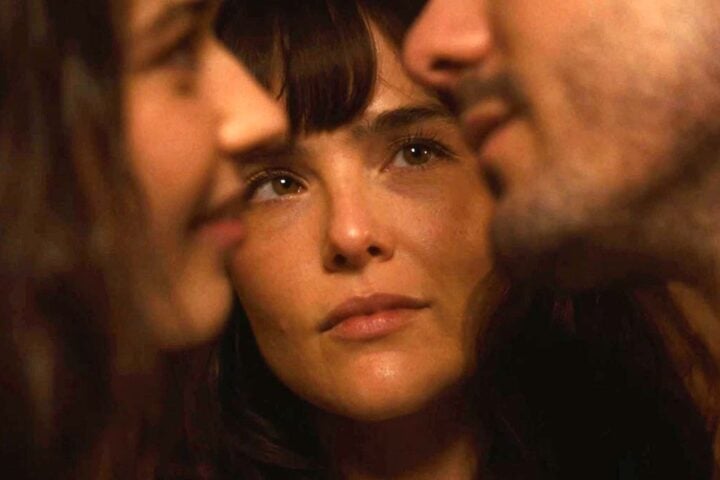
For newlyweds Emma (Olivia Cooke) and Jude (Jack O’Connell), the disease is a slow-rolling tragedy in which Jude at first has trouble with small details, as in the nuances of an argument they just had. He increasingly struggles to remember the big, emotionally important things that define a person’s identity, like the name of his dog or the details of his wedding day until, one day, he struggles even to recognize his own wife. Emma does her best to keep his memories alive, quizzing him on the past and seeking out potential cures. But the erosion of Jude’s deepest memories continues unabated, causing Emma, in voiceover, to ask herself, “How do you build a future when you keep having to rebuild the past?”
That question lingers over practically every frame of Little Fish, underlining a profound truth that our relationship with another person is, at its core, a collection of shared memories. The film is prone to indie-movie clichés, distilling Jude and Emma’s relationship into a lot of sweeping montages of too-cute romantic moments—a marriage proposal in a pet shop, a first kiss in line for the bathroom—all set to Keegan DeWitt’s swelling score. But Hartigan is able to undercut any potential schmaltziness with the subtle suggestion that these beautiful, relationship-defining moments are ultimately constructed by our own minds. As the film rolls on, some of the details of these memories begin to shift—like the color of a toy army man’s parachute—reminding us that such instances don’t exist in some hermetically sealed chamber; they’re subject to the ever-shifting lens of each individual’s own personal memory.
If the film’s intimate focus on Jude and Emma could’ve made Little Fish feel emotionally claustrophobic, the backdrop of a global pandemic opens the story up, allowing their relationship to become a microcosm of a universal condition. And while the film was completed prior to the Covid-19 pandemic, the parallels with the current state of our lives are eerie: the ubiquity of protective masks, the inability to see family members, the hope surrounding possible cures, and the inequitable distribution of treatment.
Throughout Little Fish, we catch glimpses of the little ways that communities respond to the NIA epidemic—such as a tattoo shop that offers 80% off “memory tattoos”—as well as the distrust and resentment it can produce, as we see in scenes of the public resentful that they haven’t received a cure. But more than anything, the film depicts a pandemic as a crisis of disconnection, uniting us in a common tragedy while simultaneously wrenching us apart from each other. As Emma muses, in a query that encapsulates the devastating stultification of our time, “When your disaster is everyone’s disaster, how do you grieve?”
Since 2001, we've brought you uncompromising, candid takes on the world of film, music, television, video games, theater, and more. Independently owned and operated publications like Slant have been hit hard in recent years, but we’re committed to keeping our content free and accessible—meaning no paywalls or fees.
If you like what we do, please consider subscribing to our Patreon or making a donation.