As in his earlier Winter Brothers, Hlynur Pálmason’s sophomore feature, A White, White Day, tackles the subject of masculinity in crisis. Both films center on a bottled-up male protagonist in a small community and chart the process of their volcanic emotions gradually bursting to the surface, leaving few unscathed in their wake. Pálmason’s strategy is two-fold: In some cases, he chooses to reflect his protagonists’ latent anxiety in the environment, as when a seemingly benign daytime television show in the background of a shot in A White, White Day turns excessively morbid as the camera dollies into the TV set, and in other cases he treats his settings as placid surfaces waiting to be disrupted by hysterical outbursts. To this end, both films feature lengthy scenes where the camera coldly documents the main character inciting cartoonish brawls with other men—bare-assed Eastern Promises style in the earlier film, and piercing the afternoon calm of a police office in this one.
Belligerent masculinity as a coping mechanism against repressed grief or alienation isn’t exactly untrodden thematic ground, and while Winter Brothers’s distinguishing mark was the stylistic dexterity it brought to dramatizing this familiar subject, A White, White Day doesn’t quite manage to overcome its familiarity. Part of the difference in effect has to do with the fact that Pálmason’s debut feature, recorded on degraded 16mm, intriguingly suggested Red Desert as filmed by Paul Thomas Anderson, while his new film, shot in clean widescreen images flanked by portentous negative space, looks more or less like any number of Tarkovsky-influenced Euro art films from the past decade. Nonetheless, Pálmason still brings a smattering of eccentric ideas to the table, including the decision to withhold any character introductions until after a wordless five-minute prelude that comprises both a lengthy tracking shot of a car through a foggy Icelandic landscape and a scenic study of a building over the course of various seasons—something of a James Benning film in miniature.
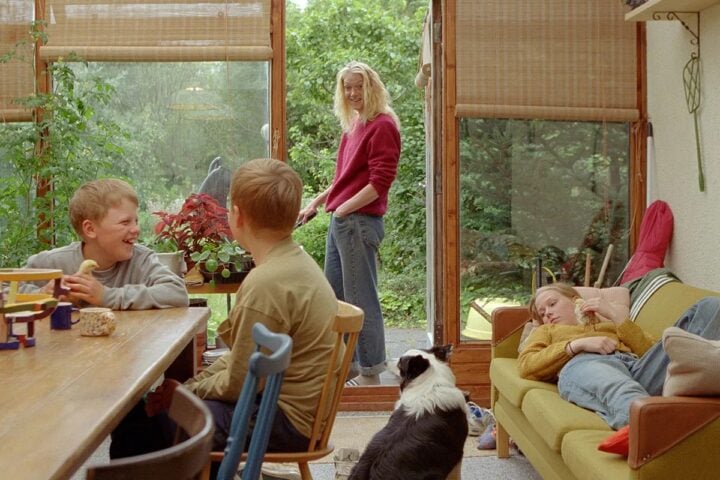
That building, initially appearing to be some kind of remote manufacturing outpost, ends up being the renovation project of Ingimundur (Ingvar Eggert Sigurðsson), an off-duty cop quietly reeling from the recent death of his wife. He’s restoring the property to be a home for his daughter, Olgeir (Hilmir Snær Guðnason), and nine-year-old granddaughter, Salka (Ída Mekkín Hlynsdóttir), for whom he acts as a tender guardian when Olgeir is busy at work. The provisional nature of this home offers a tidy analogy for the man’s liminal emotional space, caught between choked-up normalcy and unraveling devastation, and when a horse slips in through an unfinished French door in an early Steadicam sequence shot, it could either be the spirit of his late wife or a clunky metaphor for that animalistic state into which he will soon devolve. In any case, it’s fairly evident early on that Pálmason is aiming for a grand pitch to his intimate tragedy—a notion only augmented by the majestic alpine landscape.
The relationship between Salka and Ingimundur is the film’s richest and most compellingly acted vein, and particularly so when Grandpa’s underlying darkness starts to assert itself in oblique ways, such as a scene in which the reading of a bedtime story turns unexpectedly macabre. A White, White Day’s ultimate narrative trajectory would seem to imply that Pálmason understands this to be strong material, and yet much of the film is instead dedicated to a subplot regarding Ingimundur’s discovery of an affair his wife had with a man (Björn Ingi Hilmarsson) in town whom he tracks down and begins to stalk. This narrative thread effectively links Ingimundur’s grief to a feeling of suspended virility, and provides a man-to-man conflict that will presumably bring catharsis. This nemesis is characterized only to the extent that he’s glimpsed from a distance by Ingimundur, who goes so far as to join a soccer league to compete against him, and when their orbits do eventually intersect, the bluntly violent but short-lived payoff doesn’t exactly justify the brooding crescendo.
With the exception of a few abstract interludes and a hypnotic montage of direct-to-camera addresses with members of the ensemble—something of a signature for Pálmason—the film doesn’t depart from Ingimundur and his crankiness, which is a sign of both its commitment and its limitations as a drama. It wagers that Ingimundur’s compromised manhood and his efforts to replenish it are what’s most worthy of sustained attention, while the less overtly dramatic aspects of coping with grief are ultimately downplayed, a prioritization made clear when Pálmason tacks on a “second” ending featuring a gobsmackingly literal use of Leonard Cohen’s “Memories.” There’s a moving study within A White, White Day of a man in emotional paralysis learning to redirect his love from the past to the present, but it’s too often obscured by a muted revenge yarn that’s no less banal because it’s tastefully directed.
Since 2001, we've brought you uncompromising, candid takes on the world of film, music, television, video games, theater, and more. Independently owned and operated publications like Slant have been hit hard in recent years, but we’re committed to keeping our content free and accessible—meaning no paywalls or fees.
If you like what we do, please consider subscribing to our Patreon or making a donation.