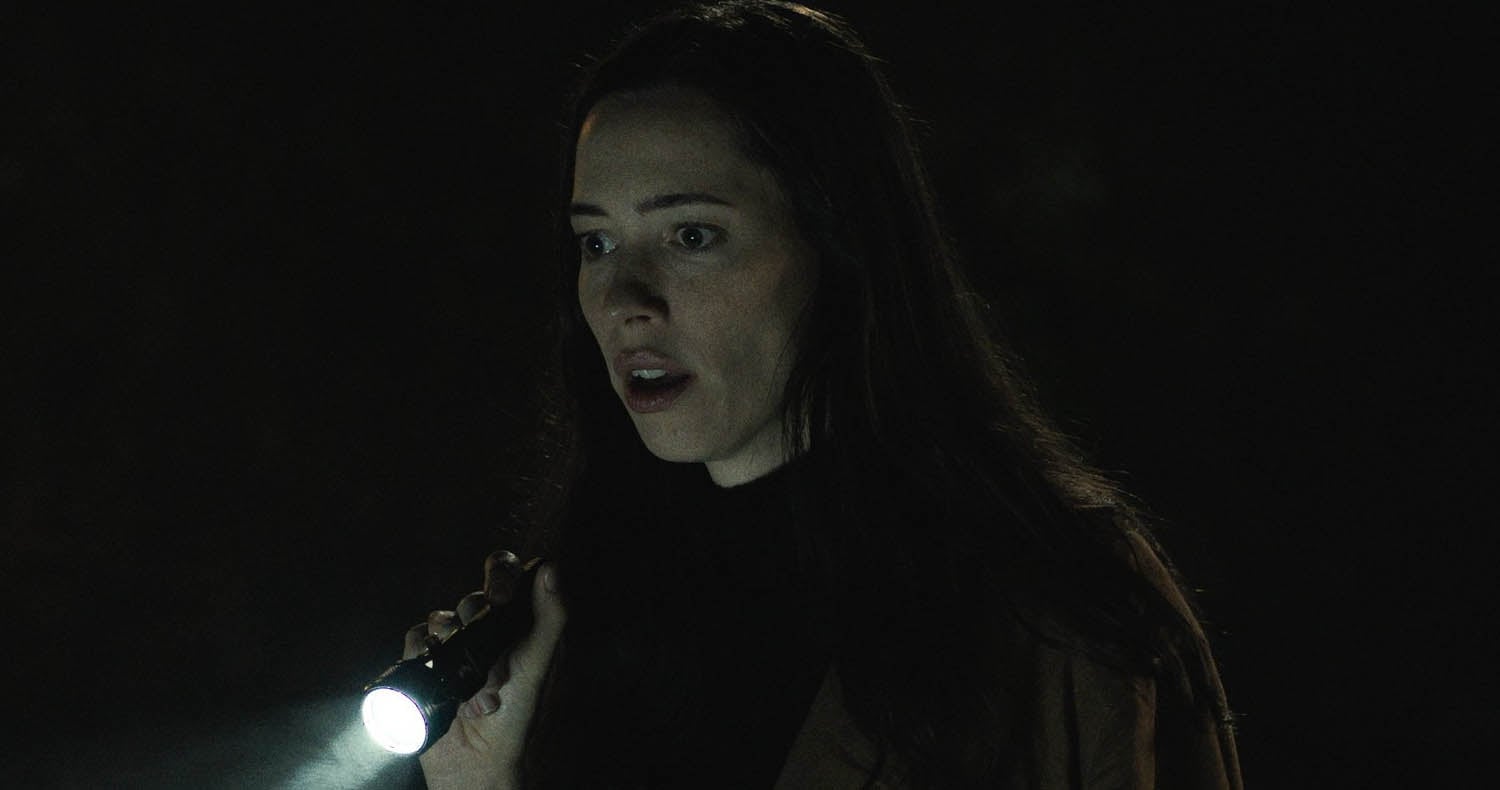
Rebecca Hall has a long and varied résumé that includes appearances in the MonsterVerse and MCU franchises, as well as turns for household names such as Steven Spielberg (The BFG) and Christopher Nolan (The Prestige). All the while, she still makes time for scrappy indies from the likes of Nicole Holofcener (Please Give) and Antonio Campos (Christine). What unites all these projects across genre and scale is Hall’s penchant for conveying a richly realized interiority through a lived-in physicality.
David Bruckner’s The Night House places Hall at the center of the type of film she often elevates in a more supporting capacity. Bruckner steers a script that shifts from quiet drama to psychological thriller to supernatural horror—sometimes within the same scene. What ultimately steadies the film is Hall’s commanding performance as Beth, a woman processing her grief over the recent loss of her husband. Bruckner wisely positions every surprise of Beth’s journey to understand her late partner’s secrets as not only a step forward into a labyrinth, but also as the peeling back of a layer of the character’s psyche. The sight of Hall’s naked vulnerability by the film’s close proves more overwhelming than any genre spectacle.
Prior to the theatrical premiere of The Night House, I spoke with Hall to discuss the film and her processes as a performer. Our conversation covered her recurring thematic obsessions, why she enjoys doing puzzle box movies, and how she holds ambiguity in her performances. The discussion also touched on Hall’s directorial debut, Passing, due this fall on Netflix after a premiere at the Sundance Film Festival earlier this year.
Funny story: I was actually scheduled to talk to you five years ago at Sundance for Christine, but I got axed in the interest of time.
Oh no! I’m sorry.
I looked to see if I could find my questions from then because I felt like I could probably ask a lot of the same ones for this film. Was your approach to Christine and The Night House at all the same given that the characters are two women trying to maintain stability in a world that makes less sense to them with each passing day?
I think that’s a theme that I seem to be drawn to, apparently. But no, the approach wasn’t the same at all. Christine Chubbuck was quite a departure from myself, physically and vocally. Her vocal register was different, a lot of her physicality [was] very different to me, so I really had to spend a lot of time trying to embody that and make that feel lived in, real, and authentic. Beth was more of an instinctive creature. She’s responding to what’s happening to her, and she’s very impulsive, wild, and reckless in many respects. It felt weirdly important not to prepare very much, just to try and believe the scenario and see what happened—and be as intuitive and impulsive as I could. I think that’s probably true of what happened.
Given the bent toward the supernatural in The Night House, the film requires you to play out a number of scenarios from which you really can’t pull directly from any life experiences. When it comes to these moments, how conscious are you of horror genre conventions when thinking about how to play these scary or unsettling beats?
Well, I try not to be too self-conscious about it. I don’t think that I could have rendered it better for thinking about how it was landing on the audience. I think it’s like anything: You try and play something truthfully, and that’s going to be the best results. I think I did think about…no, I hold to that! [laughs] That’s all I have to say about that.
You’ve said that the voice is your starting point for connecting with a character. How did you settle on Beth’s husky, deep tones?
Well, I figured that she was drunk [a lot] and not sleeping. I figured that probably, given that the incident that sets this all off only happened four days before the movie starts, she has been drunk and not sleeping ever since. I just landed on a more gravelly area in my voice to sit with.
I feel like a number of your American characters do kind of speak this way, to some extent. I don’t know if that’s just a factor of the movies you choose…
I think it’s my version of being an American. It’s probably just me!

You’re no stranger to films that involve some effects work having done Godzilla vs. Kong and Iron Man 3, just to name two. How do you cultivate that imagination of reacting to things that aren’t necessarily there before your eyes?
Sometimes on Godzilla vs. Kong and things like that, it can be very technical if you have to really track a tennis ball from one place to another and imagine that it’s Godzilla tearing through a city. Which can be challenging, given that you’re just looking at a tennis ball. But, otherwise, it’s pretty much the same as any other aspect of acting. So much of acting is just believing that you’re experiencing what your character is experiencing.
You’ve done a number of films like The Night House now that have a puzzle-box element to them. As a performer, do you feel the burden of trying to guide the viewer through that labyrinth? Or do you just focus on playing the emotional element and trust that the director will shape it to make sense in the edit?
I like to hold the narrative of a film in my head because I feel it’s part of my responsibility to make sure that all the dots connect. But I don’t think you can play multiple interpretations in a performance. I think you can only play what the character believes in the moment. Certainly, for Beth, she takes a lot of what she experiences at face value after a point and rolls with it. That was easier than you’d think. She chooses to believe because she wants to believe, or she’s not thinking, “Is this happening in my head? Or is this really happening?” She’s just accepting it and dealing with the battles that she’s got to deal with. It’s interesting that you point that out, I have done a number of those movies that have that puzzle-box element. I think I like that as a viewer. I like films that hold a lot of ambiguity and can take many interpretations.
Do you try to hold that ambiguity in your performance as well? Or do you think it’s important for you to kind of make up your mind as to what’s happening?
Yes and no. I have a preoccupation as an actor with what a character wants to put out in the world, what they’re trying to hide internally, and how they perform for the public. I believe that a character will choose to be like, “In this moment, I am angry. In this moment, I’m crying.” But their internal thing is, “In this moment, I’m trying not to cry.” So there’s a kind of ambiguity, but I’m still playing one thing because the character’s only fixated on the external performance. You start to bring in the ambiguity when you think about how good or bad they’re doing that and how much on the stuff underneath they’re betraying. I think about a lot of characters like that because I think human beings are like that.
The part of The Night House that really stuck with me was the first 10 minutes, which unfold essentially in silence as you try to get comfortable in the house without your husband there. How do you approach a challenge like holding the screen alone and being required to just exist convincingly as your character?
It’s really scary when you’re not doing it, and it’s really scary when you’re thinking about it and intimidated going into it. And then, when you’re doing it, you just believe. You’re just like, “I’m just a person throwing the macaroni out, sitting down on the couch, and turning on the DVD player.” It does come down to that. You can’t get too lost up your own thought process.
Was that sequence scripted?
Yeah, it was very specifically like, “she does this, then she does that, and then that.”
How, as a director, do you bring out in others that interiority that you convey so well when you’re in front of the camera?
I’m fairly sure they’re just very good actors. Passing is literally about these dualities and how nothing exists in categories, everything actually exists in a gray area. The irony of the black-and-white film is that it’s actually gray. So, it’s like a simile. I suppose everyone that I cast in the movie understood that if you take the story at face value, literally nothing happens. I mean, barely anything happens apart from a couple of big things, but really nothing happens until that. I said to them it doesn’t matter that nothing happens. There has to be so much tension underlying everything that everyone is saying at any given moment that it makes a tea party a psychological thriller. We thought we thought about it a lot, and we discussed it a lot. It’s my constant fixation: How is the character doing it? The person they’re supposed to be versus the person that they want to be? And where do they land?
To bring it back to The Night House, you mentioned Passing is a story about two worlds where nothing is black and white. What is this film if not the story of a woman caught between two worlds feeling at home and none of them?
Yeah, true. Continuing themes.
Since 2001, we've brought you uncompromising, candid takes on the world of film, music, television, video games, theater, and more. Independently owned and operated publications like Slant have been hit hard in recent years, but we’re committed to keeping our content free and accessible—meaning no paywalls or fees.
If you like what we do, please consider subscribing to our Patreon or making a donation.