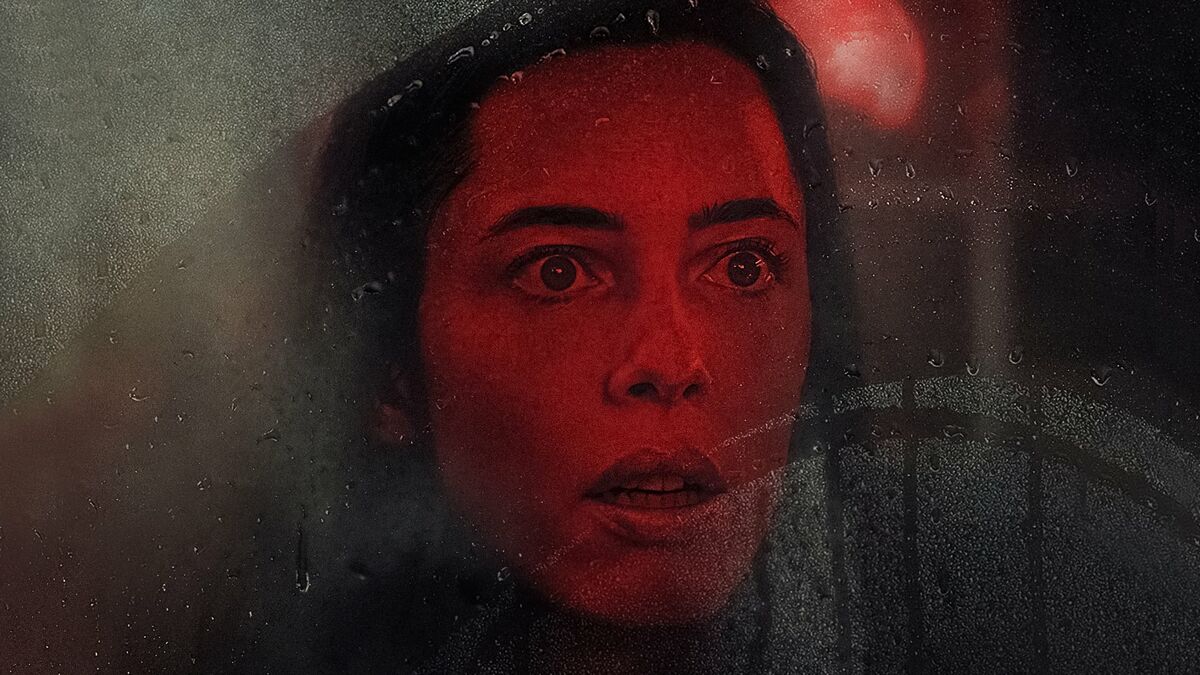
David Bruckner’s The Night House is about the suffocating presence of absence. Beth’s (Rebecca Hall) husband, Owen (Evan Jonigheit), recently committed suicide just outside of the lake house that he designed and built for them, and his death haunts more than just the rowboat by the dock where he pulled the trigger. When their stereo clicks on in the middle of the night, blasting a song that reminds Beth of Owen, and bloodied footsteps mysteriously appear on the dock, we’re primed for a traditional ghost story about a woman’s sadness and anger over her seemingly happy husband’s tragic death.
The filmmakers, though, are hellbent on upending the clichés that practically define such stories, and they do so in surprising and intriguing ways. In a telling moment, Beth opens up to her best friend, Claire (Sarah Goldberg), about how she was officially declared dead for four minutes following a horrific car accident when she was a teen, and that she saw no white light at the end of the tunnel. “There’s just tunnel,” she declares definitively—a statement that makes plain the woman’s eerie familiarity with the crippling absence that death promises.
As Beth begins digging into Owen’s personal effects, searching for some sort of reason for his death, she’s forced to grapple with the sense of unease and incompleteness that often grips survivors of suicide loss, only to find disturbing secrets that further escalate her suffering and confusion. It’s a psychological journey brought to thrilling, knotty life by Hall, who even injects a dark sense of humor into the proceedings as Beth confronts Owen’s demons.
Beth’s disorienting journey eventually provides some answers, but The Night House shrewdly avoids making them simply about a husband’s deceptions or indiscretions, at least in the traditional sense, where a wife is left to piece together her now-fractured life. Instead, the film goes about braiding together the lingering aftereffects of Beth’s youthful trauma with those of her recent one, positioning the void of death as its central force of terror.
Bruckner does a superlative job of laying out the geography of the lake house, where much of the story unfolds, rendering the film’s eventual twists and turns all the more harrowing. In The Night House, absence itself is the villain, taking on a variety of chilling forms, such as the negative space within the house that transforms into a malevolent presence and closes in on Beth. Bruckner also deploys a few jump scares, but they emanate so organically from the film’s carefully crafted atmosphere of dread that they feel less like cheap thrills and more like chilling punctuations to the horror that’s always lurking in the background.
While Beth’s sleuthing into Owen’s possible real-world misdeeds occasionally feels at odds with the story’s more supernatural elements, The Night House eventually ties these seemingly disparate threads together in unnerving fashion. The film initially suggests that it will be a reckoning with Owen’s demons, only to cleverly reveal itself to be about Beth’s own. Stopping short of veering into some kind of feminist screed, The Night House elegantly sets up numerous misdirects, made possible by expectations created by sexist horror tropes.
That the film’s finale is a bit underwhelming, avoiding the bleakest of endings in favor of something more sentimental, is disappointing. But Hall’s unwavering commitment to her role and The Night House’s inventive story do more than enough to reinvigorate a subgenre of horror that has been all but tapped out, using a haunted-house scenario as a vessel to demonstrate that the most horrifying demons usually come from within.
Since 2001, we've brought you uncompromising, candid takes on the world of film, music, television, video games, theater, and more. Independently owned and operated publications like Slant have been hit hard in recent years, but we’re committed to keeping our content free and accessible—meaning no paywalls or fees.
If you like what we do, please consider subscribing to our Patreon or making a donation.