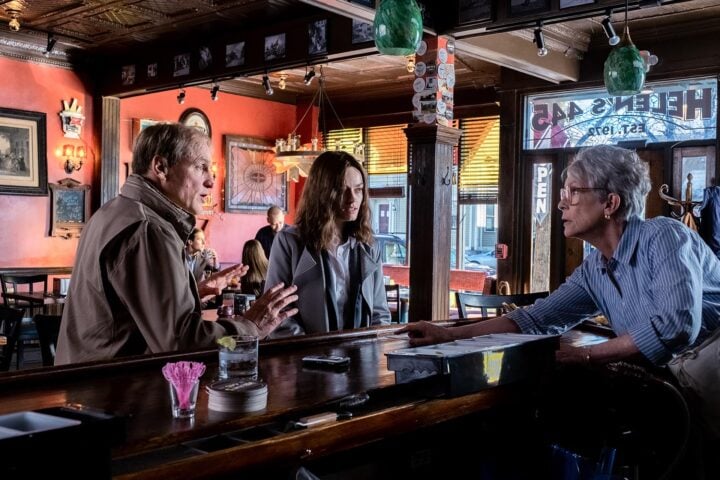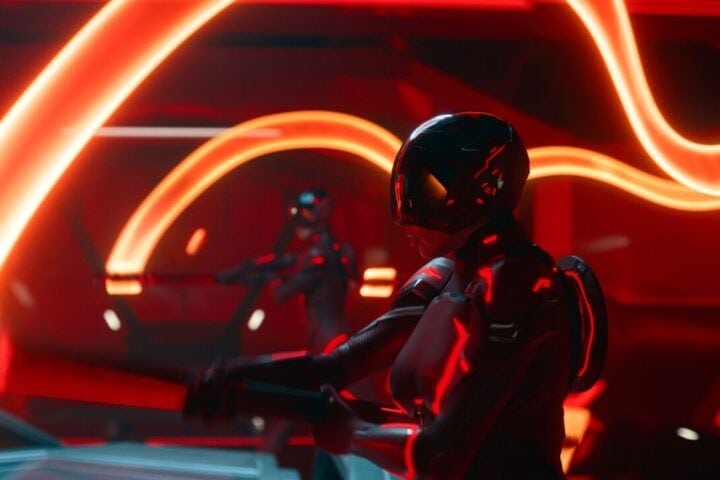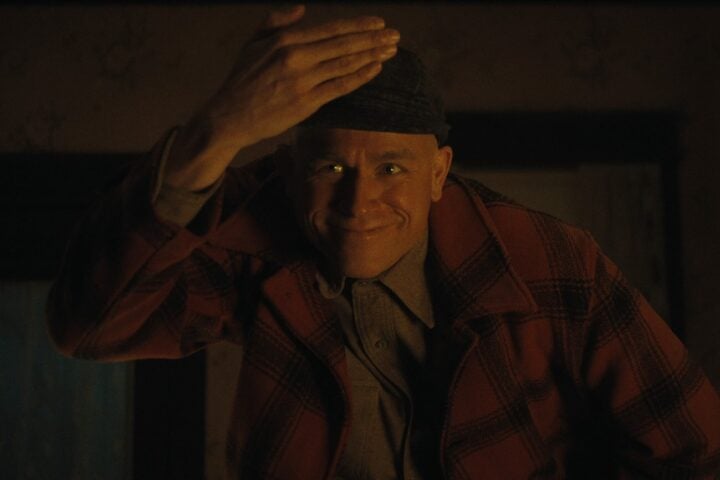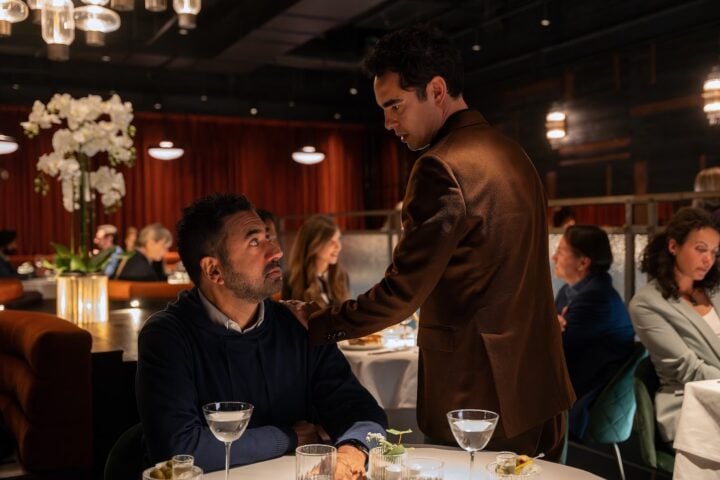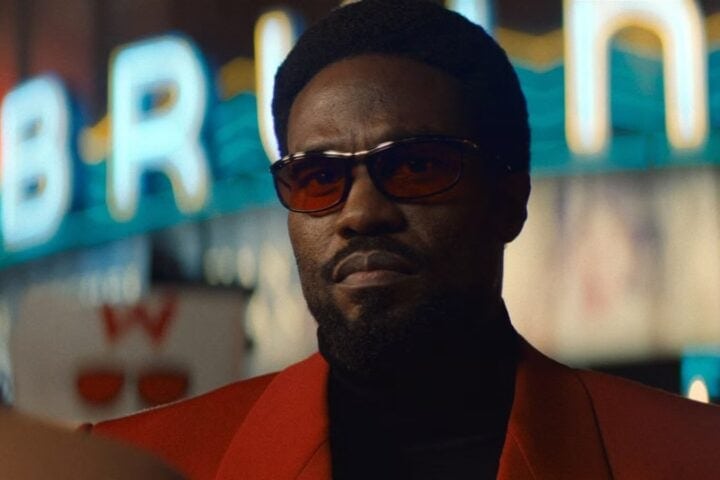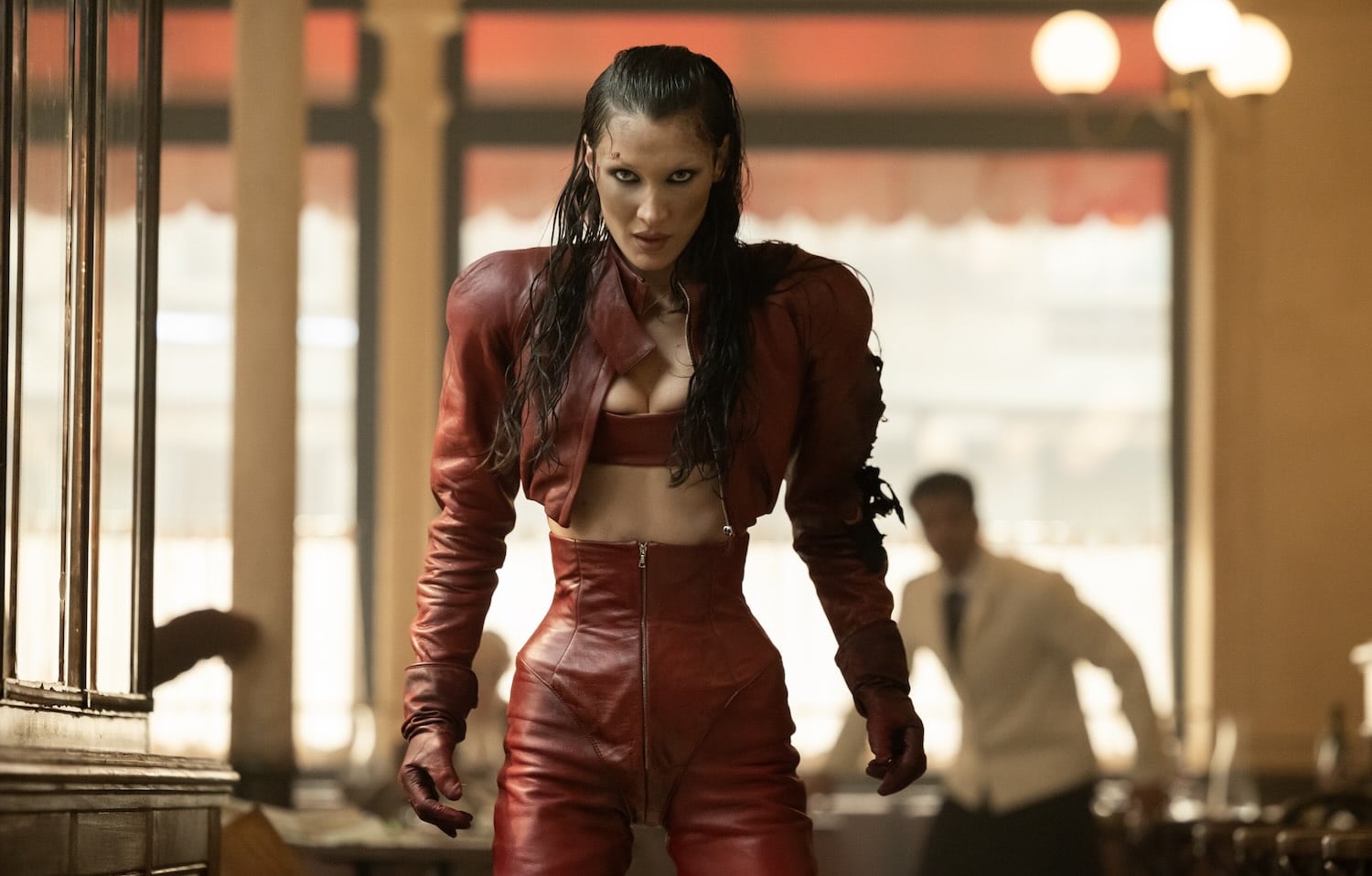
Ryan Murphy’s The Beauty fancies itself a propulsive sci-fi thriller that examines the lengths people will go to destroy their bodies in order to perfect them, when really it’s a misguided slog. The series centers on F.B.I. agents Cooper Madsen (Evan Peters) and Jordan Bennett (Rebecca Hall), two partners-with-benefits investigating a sexually transmitted virus at Paris Fashion Week that causes its victims to metamorphose into impossibly gorgeous versions of themselves—with an explosive expiration date. Repeatedly, we watch as characters endure a night of 118-degree fevers and spine-snapping, then emerge the next morning from viscous Alien-like cocoons with scorching cases of Instagram face.
Anything that works conceptually about The Beauty is lifted straight from its source material, a visually striking and surprisingly meditative comic book series that’s set two years into the virus’s outbreak. The graphic novels are both more nuanced and noirish, all sharp angles amid grainy, desaturated city interiors that juxtapose the literal glow that emanates from the infected.
Sadly, that visual flair and intrigue are absent here. The production design and color palette are simultaneously ostentatious and bland, and rather than keeping the virus’s origins mysterious and focusing instead on its societal implications, the series lays out a rudimentary global conspiracy involving a Promethean geneticist (Rob Yang), a cartoonishly sinister billionaire (Ashton Kutcher), and a sociopathic assassin who’s hired to tie up loose ends (Anthony Ramos).
The characters, when they’re not cliché-ridden blank slates, are universally reprehensible, and neither psychologically complex nor funny enough to sustain our interest. Cooper and Jordan fare best in this regard, considering they’re not hellish to spend time with but merely stupid and dull. They deliver such profound ruminations as “Everything we do from the minute we hit puberty to the second we die is about sex” and “The world is on fire, right? Live, laugh, and fuck.” As much as The Beauty may want us to ponder the callous injustice of evolutionary biology or the Freudian quagmire of sexual liberation’s incompatibility with civilization, you’ll be too busy asking yourself questions like, “Wait, who’s that guy?,” “Where are they?,” and “How do I cancel my Hulu subscription?”
Structurally, The Beauty’s episodes seem to begin and end at arbitrary junctures (their runtimes can be as short as 24 minutes or as long as 51), and the scenes that comprise them—filled with prolonged conversations between irredeemable black holes of personality—drag on and on. After a while, it starts getting difficult to remember which actors correspond with which characters post-transformation. Major interactions occur off screen, big twists are explained rather than shown, and timelines and settings jump around haphazardly.
But The Beauty’s greatest sin is its icky, unbending cynicism. Its ethos boils down to: beauty standards are toxic, corporations are greedy, and humans are all vain walking lobotomies. The villains’ ludicrous scheme to package the virus as a miracle drug is allowed to proceed with little logical interference. (And the elephant in the room is how weird it is that Kutcher, whom Demi Moore has accused of infidelity, is starring in a comeback vehicle aesthetically and notionally identical to The Substance but inferior in every conceivable way.)
In small doses, this dark cloud of disdain can be perversely amusing. Glimmers of Murphy’s trademark snark do appear, like when an obese, self-described incel (Jeremy Pope) wails about how lost and purposeless he feels, then sincerely asks, “Do you think I should do stand-up?” And when the series focuses on how the virus’s Faustian promises afflict the mindsets of a teenage girl (Emma Halleen), transgender scientist (Rev. Yolanda), and the father (John Carroll Lynch) of a terminally ill child, it at least scrapes at wider social consciousness. Otherwise, The Beauty is less interested in unpacking society’s ugliness than exacerbating it.
Since 2001, we've brought you uncompromising, candid takes on the world of film, music, television, video games, theater, and more. Independently owned and operated publications like Slant have been hit hard in recent years, but we’re committed to keeping our content free and accessible—meaning no paywalls or fees.
If you like what we do, please consider subscribing to our Patreon or making a donation.