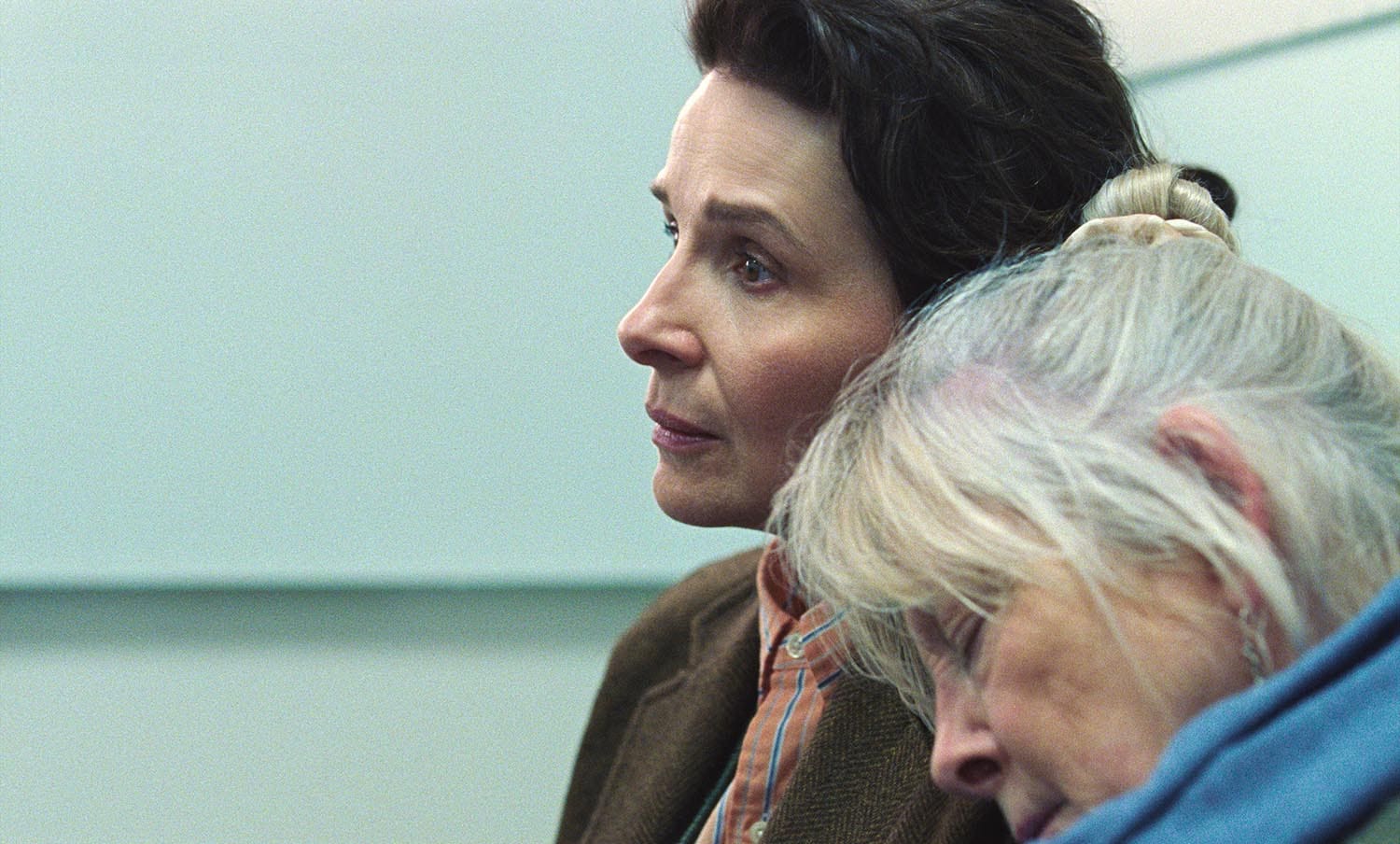
No filmmaker has shown the aging body on film quite like Lance Hammer does across Queen at Sea, his first feature since 2008’s Ballast. The decay of bodies, namely those of Martin (Tom Courtenay) and his wife Leslie (Anna Calder-Marshall), is on full display across this unvarnished portrait of a family torn apart by dementia. It’s as if Hammer is daring us to look away as the film’s camera peers at bodies bearing the marks of death’s imminence.
Martin and Leslie are a burden for their family and one slip away from a final catastrophe—or a final relief. For it would surely be a lot more convenient for Amanda (Juliette Binoche), Leslie’s daughter and Martin’s stepdaughter, if the couple simply disappeared. She would be able to leave London, where Martin and Leslie share a home, and go back to her tenured professor job in Newcastle with her teenage daughter, Sarah (Florence Hunt). Instead, she’s stuck between mourning a mother who barely recognizes her and suffering over the practical decisions of care with the very lucid Martin, with whom she has a mostly cordial relationship.
Hammer’s film begins with Amanda arriving at her parents’ home with Sarah in tow and catches a butt-naked Martin on top of Leslie. Amanda immediately berates Martin, reminding him that she’s told him to stop having sex with Leslie, who’s supposedly too ill to consent (and whether that’s true or not is something that Hammer, provocatively, keeps ambiguous). She then calls the police, at which point the family is subjected to a series of dehumanizing legal and social services protocols, and which Hammer captures with flawless precision.
Queen at Sea is a visceral study of the irresolvable complexities of a family whose dysfunctions exacerbate as parents age—or, more accurately, a family rendered dysfunctional by the inevitability of death. In any case, it’s the insidious dysfunction of the state and its inept institutional theater of care that seems to be the family’s ultimate downfall.
The film also paints a subtle yet unforgiving picture of puritanical fears. We see the deployment of a care system driven by an awkward incompetence at dealing with sexuality, human touch, and the body—one that’s seemingly incapable of taking into account the singularity of every human subject. In this, the casting of Binoche is crucial, as Amanda’s French roots (her father was presumably French) allows the actor to function, narratively, as both an integrated local person used to a nation’s systemic flaws and a foreigner to the ills rendering the British landscape a particularly depressing place for the young and old alike.
The doom and gloom of an ecosystem of care that further saps the little life that’s left in elderly bodies is rendered palpable by Amanda’s mix of resignation and anger, but also by the film’s locations. Take the high-rise apartment that Amanda and Sarah rent for Amanda’s improbably long sabbatical in London. This institutional-looking building stands in stark contrast to Martin and Leslie’s house, which comes with its burdens (such as overtly steep stairs) but is surrounded by nature—the idyllic backdrop for the couple’s daily walks.
The atmospheres that these two homes exude are echoed by the gap that separates the devotional love between the older couple from the fickle romance between Sarah and her teenage crush, James (Cody Molko), who have little to talk about beyond the right angle to record a TikTok video. Sex is the one thread that links these two couples, yet each one makes a very different use of it. Whereas Sarah and James go through the mechanical motions of a sexual encounter devoid of magic, Martin and Leslie make love as a way of resisting the end of life and renewing their profound connection—a profundity antithetical to a younger generation too alienated to have anything of substance to bond over.
It’s difficult to imagine anyone but Binoche expressing so many conflicting feelings with such nuance. Her ability to wield the infinite possibilities of emotional expression—what philosopher Gerhard Richter has referred to as the uncatalogability of the face—brings uncanny gravitas and an unnerving realism to the film. She shows us the face of an unresolvable impasse, where keeping an ailing mother in the familiar surroundings of the home, placing her in a nursing home, and yearning for her demise are all unbearable propositions tearing the mind apart.
As much as Binoche is the backbone of Queen at Sea, Courtenay and Calder-Marshall’s raw performances are no less impressive. In a sequence late in the film that takes place at a park, where an emotional Amanda and her stoic stepfather try to make amends, he asks her if she understands that life for him is basically trying to forget death is the next step. Binoche delivers the simplest of lines with what feels like the weight, and the texture, of all emotions known to humankind wrapped up in one: “I do.” The line feels, simultaneously, like the warm embrace the characters will never actually give, and a punch in the pit of the viewer’s stomach.
Since 2001, we've brought you uncompromising, candid takes on the world of film, music, television, video games, theater, and more. Independently owned and operated publications like Slant have been hit hard in recent years, but we’re committed to keeping our content free and accessible—meaning no paywalls or fees.
If you like what we do, please consider subscribing to our Patreon or making a donation.