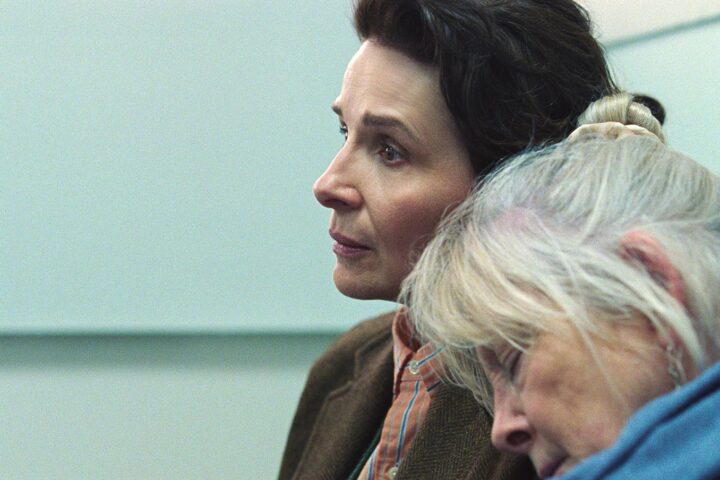
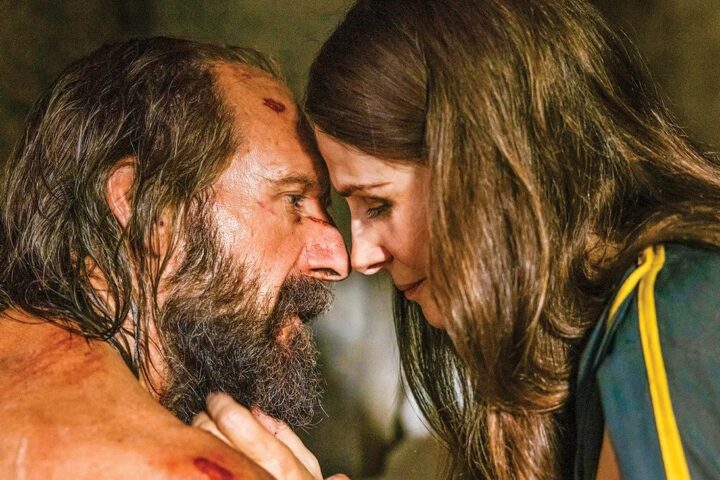
Tran Anh Hung’s The Taste of Things is almost halfway done before it even hints that there’s something going on within its fin-de-siècle setting besides the creation and consumption of beautiful meals. The film’s first half hour is in fact just that, with Eugénie (Juliette Binoche), a veteran cook in the manor home of Dodin (Benoît Magimel), the epicure for whom she’s been working for over 20 years, making an extravagant, multi-course meal for him and his friends. The men eat the food, then compliment Eugénie on her cooking.
Given the close yet unfussy attention paid to the choreography of cooking, with Jonathan Ricquebourg’s camera flowing sinuously through the kitchen and peeking into pots as ingredients are added and steam billows out, it would have been satisfying if Hung had just concluded the film with well-fed Frenchmen chatting over a digestif. Fortunately, he’s interested not just in the food but what it represents to the people obsessing over it.
Based loosely on Marcel Rouff’s novel The Passionate Epicure, the film is at its core about a pairing of passions. After Dodin’s guest have departed for the night, it’s revealed that Eugénie and Dodin are also occasional lovers in an arrangement whereby she keeps her freedom. When Dodin asks whether he will find her bedroom door unlocked that night, Eugénie replies that he will simply have to find out. Though he’s besotted by her and keeps proposing marriage, she brushes him off with the confidence of a woman who knows her value. In a lovely scene where they sit quietly under the moonlight, a table between them set with cheeses and a tea service, the two seem many years into a comfortable marriage of mutual respect and shared desires.
Eugénie’s occasional fainting spells and a doctor’s inability to determine the cause indicate that this idyll will not last forever. That looming danger is one of the film’s few concessions to the dictates of reality. Hung isn’t trying to create silly Chocolat-style escapism, as the focus here is more on the arduous creation of the food and the satiated looks that it creates rather than beauty shots of the dishes themselves. But the atmosphere is nevertheless somewhat fanciful.

The introduction of “Prince of Eurasia” (Mhamed Arezki), whose zeal for gourmet pursuits rivals even Dodin’s, seems like a fairy-tale-like bit of Orientalism. Though Rouff’s Dodin was a restauranteur, Hung’s version makes almost no reference to a world beyond the man and his well-fed friends’ meals and chats. Their lives are presented here as one lengthy yet well-paced buffet of intellectual banter, pleasant walks, fine wines, and better food. Excepting the looming potential tragedy of Eugénie’s condition, the only remote challenge that Dodin faces for much of the film is the question of whether to serve a simple pot-au-feu to the prince.
As a good student of Robert Bresson, Hung has never let his work get overly focused on story. There are few current directors, except maybe Terence Malick or Apichatpong Weerasethakul, more attuned to the specifics of atmosphere and place. The sensualism of The Taste of Things is as visually ripe and tactile as anything in Hung’s debut feature, The Scent of Green Papaya, or The Vertical Ray of the Sun, though it feels somewhat more restrained.
The eroticism here is largely decanted through moments of culinary excess. Twice when Dodin enters Eugénie’s room, he sees her naked before the screen goes tastefully black. On the other extreme, consider the scene where Dodin and his friends consume a meal of ortolans. The eager gluttons are each served one of the fattened, glistening songbirds. Shrouding themselves under white napkins, they noisily ingest the ortolans. After the brief orgy of crunching and slurping, they remove the napkins and share a look of sated and slightly ashamed exhaustion.
The moment is especially well played by Magimel, whose slightly sleepy expression and voluptuous manner marks Dodin as a creature of bodily pleasures. But Binoche’s work is impeccable by comparison. While her presentation of Eugénie shows a person of greater rigor than Dodin (who, it goes without saying, is able to have the more louche life because of the support of his cook and lover), Binoche infuses it with just as great a carnal appetite.
It’s an old psychology cliché that people use food as a way of either sublimating or substituting for love. In The Taste of Things, there’s no separation. The love of food and romance are viewed as all one singular desire for everything beautiful and fleeting in life.
Since 2001, we've brought you uncompromising, candid takes on the world of film, music, television, video games, theater, and more. Independently owned and operated publications like Slant have been hit hard in recent years, but we’re committed to keeping our content free and accessible—meaning no paywalls or fees.
If you like what we do, please consider subscribing to our Patreon or making a donation.