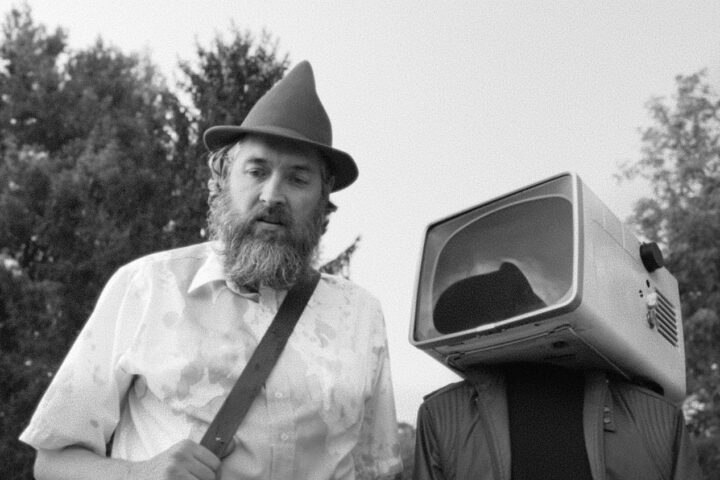
“Thinking about Youngstown is making me start to panic,” wrote Pete Ohs in a 2019 iPhone note to himself in preparation of his debut feature. He then went on to detail his ideal project: “Like a table made of bubbles/you can not/put anything on it/that is not what it is and not what it is for.” The image of a “table of bubbles” stuck as an encapsulation of a creative process that seeks to rekindle the magic of moviemaking innocence.
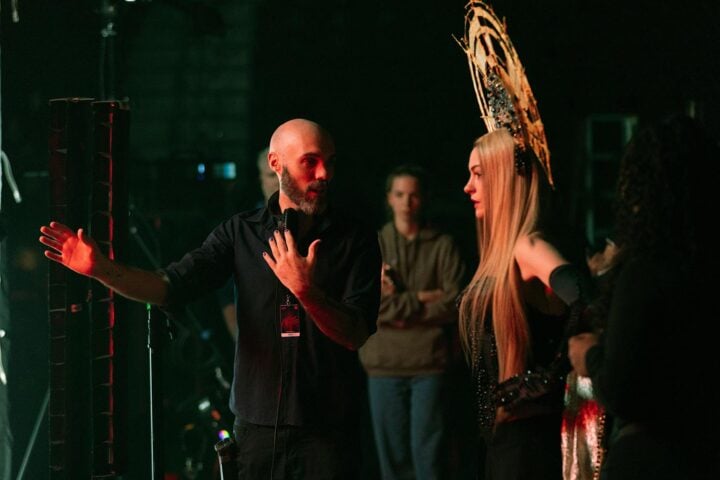
“I definitely get tired of hearing myself say ‘table of bubbles,’” Ohs admits during our talk about Erupcja, his sixth feature made in the style, “but it also does function really well as this playful and accurate metaphor to describe what it is I’m doing and where I’m coming from.” On a functional level, this involves him inviting his actors to serve as collaborators on a loose idea primarily tied to the location in which they will shoot for two weeks. Each morning, the team gets together and writes the scenes that Ohs will direct, shoot, and sound record later in the day.
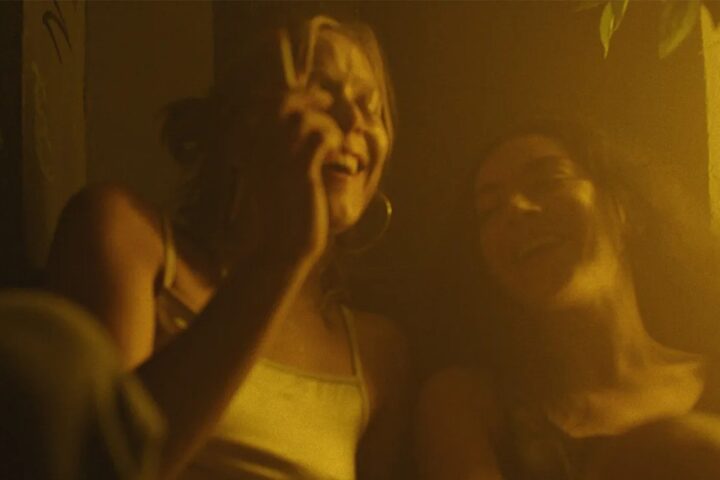
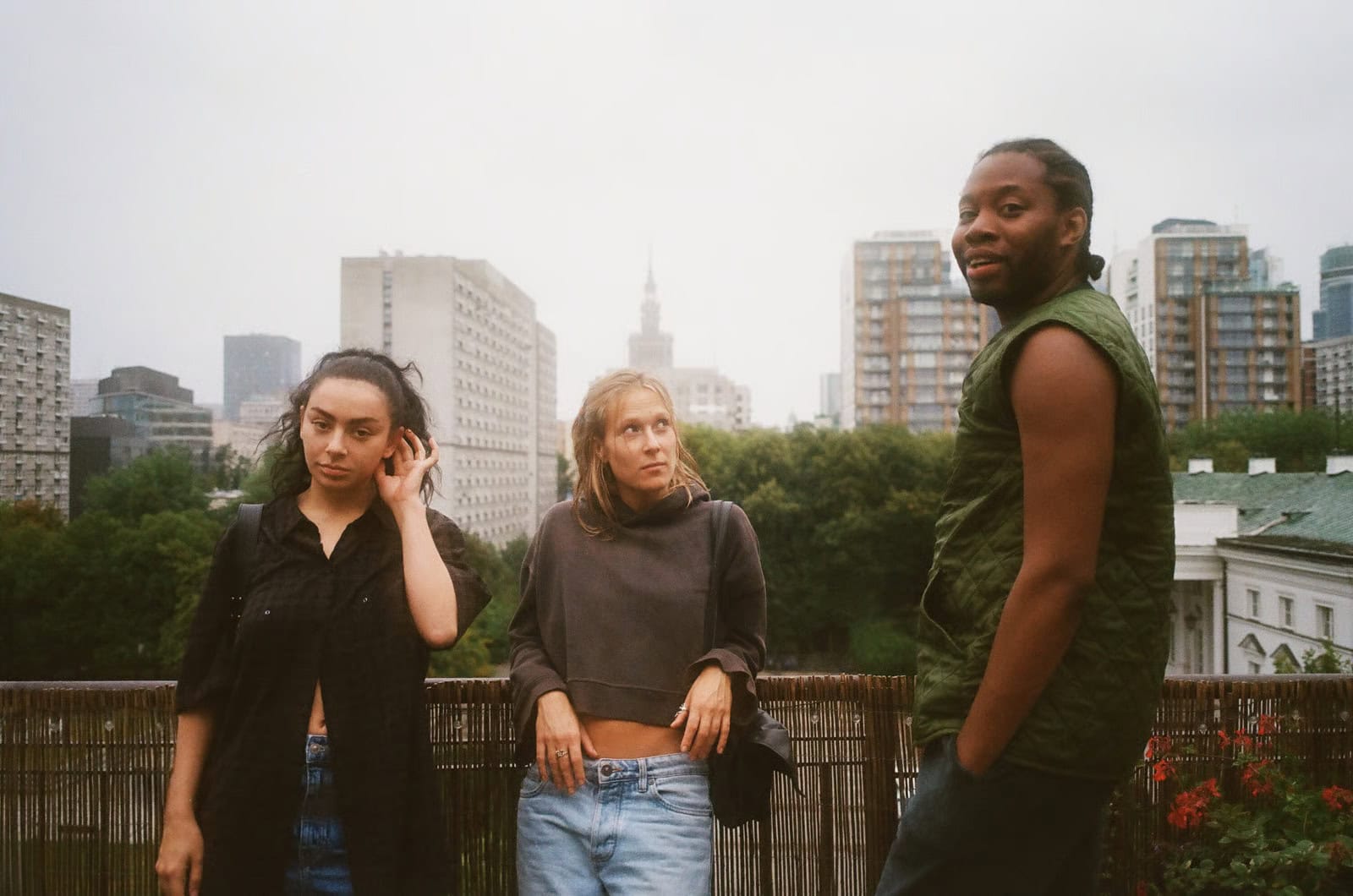
The presence of Charli XCX, whose scenes were filmed shortly before she embarked on her Brat Tour in summer 2024, will draw more eyes than usual to Ohs’s work. But casting a global pop star does nothing to exaggerate or encumber the scrappy charms of his DIY filmmaking. Ohs’s task remains the same as ever in Erupcja, a slender, 71-minute city symphony set in Warsaw. It’s to capture the magic generated through an act of collective creation.
A charming anti-rom-com, Erupcja charts the unpredictable whims of the capricious Bethany (Charli XCX) as she drifts away from her uptight boyfriend, Rob (Will Madden), while on vacation in Warsaw. Her reunion with an enchanting childhood friend, Nel (Lena Góra), only further scrambles Bethany’s sense of self as she shies away from commitments.
I caught up with Ohs on the opening day of New Directors/New Films, where Erupcja made its New York premiere. Our conversation covered why he likens his filmmaking style to a scientific method, how the “table of bubbles” comes together in production, and what his creative partners’ varying backgrounds add to the work.
What sparked your interest in volcanoes as an organizing principle of this project?
When I was first pitching Charli, I knew that one character spoke Polish, one character didn’t, and somehow volcanoes were involved. The only reason volcanoes were involved was because, about a week and a half prior, Jeremy [O. Harris] and I were hanging out at a cocktail bar with director Oliver Hermanus, who Jeremy knew through Paul Mescal. When you start hanging out with Jeremy, you start arriving at cocktail parties with people. We were just talking about our lives, and I mentioned that I had been living in Warsaw. He said, “I was stuck in Warsaw once.” And we were just like, “What do you mean stuck in Warsaw?” He literally said, “In 2010, I was living there when that volcano in Iceland erupted, and I couldn’t leave for a month. Just that sentence had narrative potential in it, and that just got stored in the back of my mind. I had lived in Iceland in 2010, so the fact that it had some resonance for me was enough to be like, “Okay, that’s a kernel. What happens when you put these things into a pot and start to stir them up?” For me, that’s enough to start brainstorming and get the train moving.
Has your “table of bubbles” approach changed since you tried it in Youngstown?
The way it changes is that there are new collaborators, and they invariably bring in things that are different. But the core principle of “What would you do if you were 15?” continues to be the guiding light. If anything, in Youngstown and Jethica, I came a little more prepared. On Youngstown, I had a full outline of the movie and started to try to write scenes. With each one, it’s been whittled down. Now, I make sure I have at least half of an outline. I don’t go too much thinner than that, but what that half of an outline looks like at this point is just bullet points of scenes that are very much ready to change the moment we arrive. If anything, the change has just been my own trust in the process. Each time, it works. What I mean by “works” is just that I enjoyed the experience, and something at least legible came out.
Do you have to keep proving it works so as to strip away much of that structure?
Yeah, I didn’t go to film school, so I don’t have to do that thing where you’re unlearning the things they taught you. But I did study computer science, and I feel like I’m approaching things from that mindset. I’m almost doing the scientific method of testing a hypothesis, and I’ve been testing with all these movies is, “How much do you need? What do you not need? How little can you get away with?” Because as you realize you don’t need something, it becomes empowering.
Now, you’re free to function with even less, thus you need less from other people, and then you can make decisions. As I’ve been making things, I feel like I’ve experienced all these truths about what’s important to me, to life, and to create things. Even though I’m not trying to repeat myself, because I like doing new experiments, there are things I’m also trying not to let go of. I’ve written a script now, so it’s not that I refuse to do these things. But even as I do that, I’m trying to still carry with me the things I’ve learned by making all these movies every single year and not just revert to the old, broken ways that are the reason I moved away from that.
Your core collaborators bring a lot of different backgrounds—Charli from music, Jeremy from theater. How, if at all, did they shape what Erupcja became?
Every new collaborator is going to bring something different, and I’m open to that. That’s the point of bringing in somebody new. What’s cool is that by not being very attached or controlling, I find the overlaps in the different processes will naturally find themselves, and then you’ll happily live within those spaces. For Charli, the way she makes music is very collaborative. She has her core group of writers, creators, and producers who get together in a studio and figure stuff out, feel it out, and follow their intuition, which is very much how my film shoots go.
Jeremy is a writer who’s written things on his own, but he’s also led writers’ rooms and collaborated with other writers. Thus, he also brings that experience to film shoots, which function as writers’ rooms with the actors. I didn’t realize that’s what I was doing until we were making The True Beauty of Being Bitten by a Tick, and he was like, “This is a writer’s room.” Then, he got out a whiteboard and was writing down the act structure, the turn, and how he would break it down when he’s running a room. That was informative and exciting.
Then Lena, the other new collaborator on this one, had made an English-language movie, Roving Woman, that she shot in America as a Polish person with a Polish crew. Interestingly, she was doing the opposite of what she had done. That was interesting, to see her experience in America and how that informs or influences me coming to her homeland and doing the same.

How does the overall process of putting the film together each morning work? How do you lead people through days of writer’s block or creative frustration?
It’s kind of like being Buddhist, letting go, accepting this is what it’s going to be, but continuing forward. The actual act of doing it is writing scenes into the Notes app on my phone, often as I’m falling asleep and about to pass out. I’m trying to sketch what we know, at least the first scene of the day, just to get some flags planted. Then, I pass out, wake up, and immediately pick the phone back up and keep going with that sketch until everyone else shows up for breakfast. I just start sharing, basically asking them for help. We all need to keep trusting our intuition.
It’s always going to be filtered through me. I’m the director. I’m the person at the wheel. I will make sure we’re safe. But it’s this requirement to keep moving forward. How I’m able to reassure the group is because I’m also editing this movie. I know how many tricks and opportunities there are later to keep making sense of stuff. But as long as it keeps feeling right, it’s okay to keep moving forward. We don’t need to understand it all yet. We actually don’t all need to understand it ever, but we will understand much more as we keep getting further down the line and the edit comes together. There’s more road.
Is it like an exquisite corpse style of writing if you’re not really thinking much more than a day in advance about the scenes?
We go with half of an outline, so we know up to the midpoint of the movie. I’ve read screenwriting books. I’ve read Save the Cat! I’ve watched lots of movies and done analyses of them. I’ve studied feature film storytelling. So, I feel like I have that pretty well internalized. Things always change, even in that first half, in big and small ways. But that first week of the two-week shoot is the first half of the movie. That one, we sort of know what it’s going to be. Then, we take a day off, and the second half is the big question mark.
But, at that point, we already know all these things that we can’t change. We’ve learned so much about the story and the characters. We’re at the top of the mountain, so now we just need to let it coast down the hill so it has an inevitability to it. If you don’t know what the next day at least is going to be, I find it’s too unsettling for everyone. We actually need to know, roughly, what the next day and a half is going to be. So, here are the three scenes we’re doing tomorrow. We may not know what we’re gonna say. We don’t know what the dialogue is, but these are what’re gonna happen next. Then, the day after that, we’re probably going here and here beyond that. I’m sorry I can’t tell you, but as we keep moving forward, it will come into focus.
How does that change the job for the actors if they’re working without an endpoint they can build an arc toward?
You don’t know the specifics of it, but there are also things I believe in just about the shape of stories. The story begins with people arriving in Poland, and guess what? It’s gonna end with some people leaving. That’s just the shape of a story, and that gives comfort to it. I also like thinking about chess. I know how to play, but I don’t actively play. I like watching online chess, and the grandmasters have all their different openings that can go very deep. But at a certain point, they’ve reached the end of their preparation. Now, they just have to play, and often, they play intuitively. But it’s just from their understanding of like, “I know how this game works, I know what all these pieces do, and I will trust that I can keep finding the best moves.” I feel like I’m engaging with the filmmaking process that way, and then I encourage my collaborators to do the same. That first week, we have set the stage, we have played our opening, and now, just know that you know how to play. We will get to an ending, whatever that is.
There are these really fun moments of the unknown. We have Rob, who wants to propose. We have Bethany, who doesn’t want to get proposed to. We’ve brought them to this party, and as we were there at that party, we thought Rob was going to propose. We thought he’s going to propose in front of everyone, and that’s going to be this big, embarrassing thing. But as the night unfolded, doing these scenes, we fell into this beautiful moment where Nel and Bethany have started dancing together. As I’m filming it, I’m like, “He’s not proposing. He’s leaving.” That’s where we were at in the filming. It’s not that we’ve committed to anything on the other side of that. We get to just keep following it, so in that way, it is exquisite corpse-ish. What has happened today directly informs the next things we do, and what hasn’t happened as well.
Your frequent collaborator Albert Birney is the one who suggested the narration in Erupcja, which you’ve described as unlocking the film. Is that the first time you’ve really reshaped something with an element that wasn’t there in production?
It’s not the first time; there are always discoveries. This one was definitely a big shift. I would say that aspect of it is uncommon, to have something that really made it a different movie, and a movie I liked much more! I was so grateful I found it. Until that addition, there was this big void in my heart, knowing something was off. The creative process is moving towards the unknown. You don’t know if you’re gonna find it, but you know it’s missing. You’re trying to keep moving forward. You’re open to it, but you’re aware that time and energy are limited. You’re like, “I might run out of time.” So, the fact that it arrived through Albert, I was very grateful for. Those things do always come, big and small, but this was a big one.
I wasn’t aware you were also the sound recorder before watching Erupcja, but one of the first notes I took was “bags on the cobblestones are loud.” That detail works so well literally and metaphorically. Is that the kind of thing you catch and incorporate, being so close to every facet of production as a one-man band?
Definitely. When I think about how that moment came to be, one aspect of it is editing other people’s movies. I got to edit a few movies by Danny Madden, who comes from the world of animation, and he’s a sound freak. In animation, everything needs to be built from sound. There are no on-set sounds; it’s all this world you have to create. He talks a lot about “sound opportunities,” so now I have that in my head where I’m always looking for every kind of sound. The door opening and closing, somebody tapping [their fingers], or a thing like a suitcase.
But then the other thing is that I had a Polish girlfriend when I was living in Poland, and she’s a very respectful person. When we would come back home at night with a suitcase, she was like, “Carry it. Don’t drag it. People are sleeping.” And when you’re told that, and you actually listen to yourself pulling it, you’re like, “It’s really loud, yeah. I should carry it.” So as we’re filming this moment and I’m having them drag it, I’m thinking, “They shouldn’t be dragging it. But what does that mean about these characters? Oh, they’re outsiders. They’re not being necessarily as considerate of these other people. Okay, this is a really cool character attribute!”
And then, just in the making of it, I’m always thinking about interesting shots and perspectives, where can I put the camera that I haven’t put it before. There’s this point of view of the suitcases I did, and I saw the sound opportunity. So I got my Zoom microphone, put it inside the suitcase, pressed record, and I dragged the suitcase around. Eventually, Danny does the sound design, and he’s like, “Get good foley when you can on set, it’ll just be more specific and interesting.”
I get that, and then I edit this sequence together. It wasn’t initially right at the beginning. You show the movie to your trusted friends. This filmmaker saw it and was like, “What did you start it with? Just put the suitcases first.” And I was like, “That’s really cool. That’s really smart.” So I do that, give the cut to Danny, and he’s like, “Great, I love these suitcase sounds. They need to be louder.” He puts more sounds, like the actual rumbling of volcanoes and rocks in there, which melds all the metaphor, experience, look, and emotion of what that moment is. I want to share all that, because it’s a one-man band, but it’s not just coming from me at all.
Since 2001, we've brought you uncompromising, candid takes on the world of film, music, television, video games, theater, and more. Independently owned and operated publications like Slant have been hit hard in recent years, but we’re committed to keeping our content free and accessible—meaning no paywalls or fees.
If you like what we do, please consider subscribing to our Patreon or making a donation.