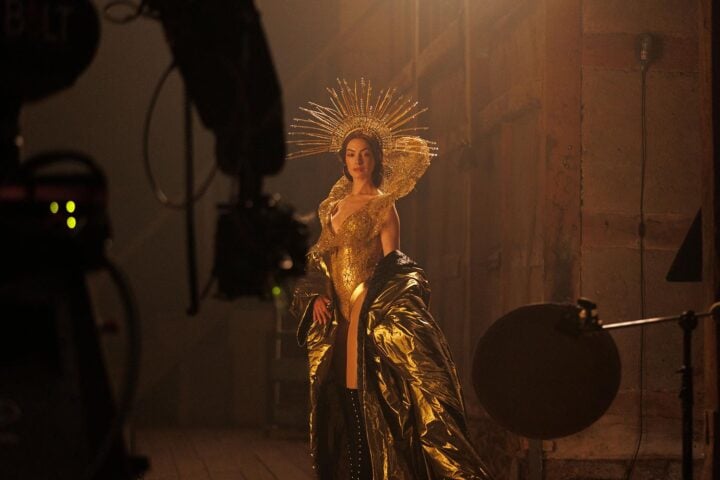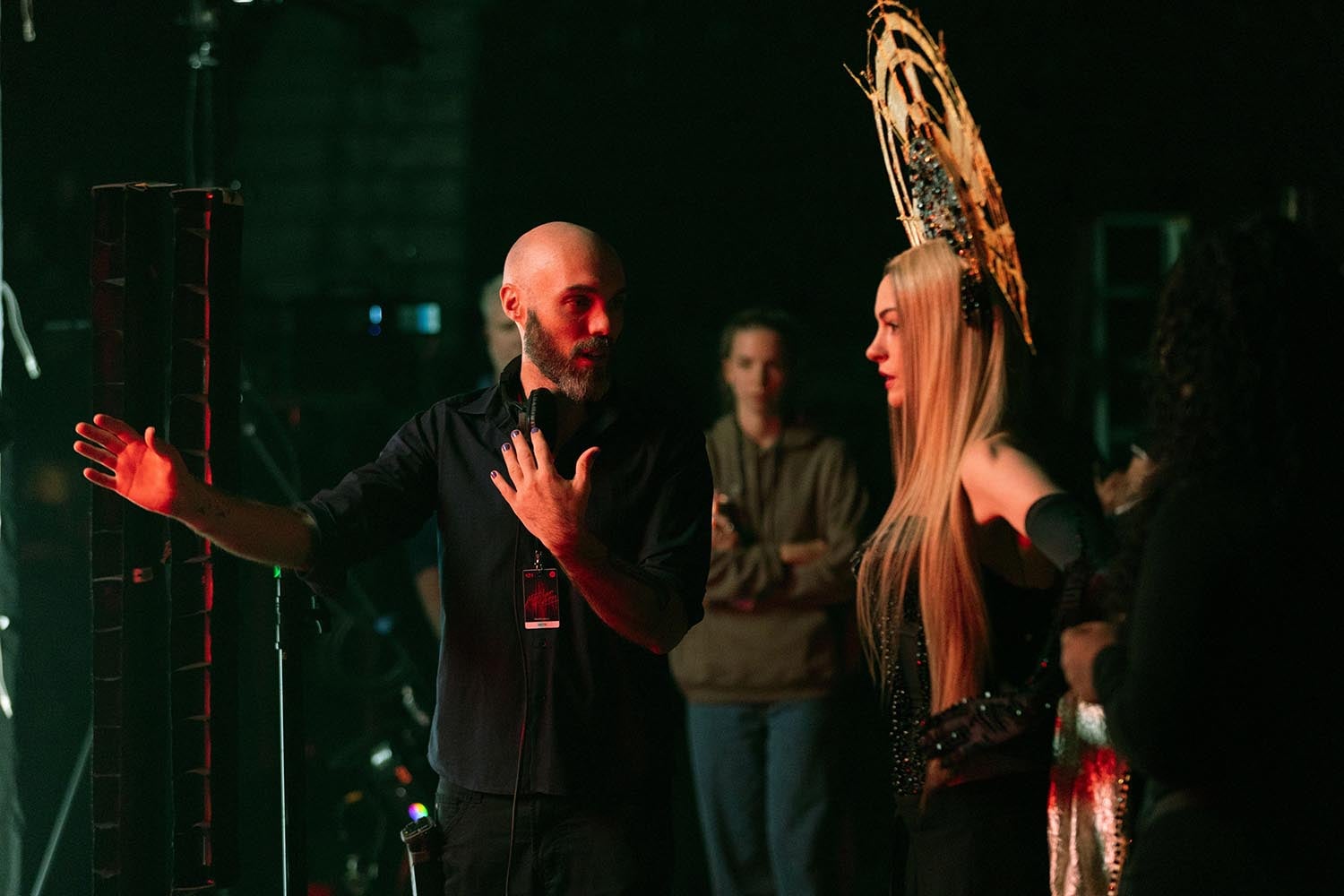
David Lowery turns theatricality into cinematic ecstasy with Mother Mary, about a pop star at a spiritual and creative crossroads. Having survived a highly publicized accident during her last concert tour, Mother Mary (Anne Hathaway) arrives at the doorstep of her former best friend and collaborator, fashion designer Sam Anselm (Michaela Coel), begging for a dress that will inspire a reinvention on the eve of her comeback performance.
A phantasmagorical chamber piece interrupted by memories made flesh, surreal nightmares, and stunning musical set pieces written by Charli XCX, Jack Antonoff, and FKA twigs, the film sees Lowery taking his expressionistic impulses to another level with boldly theatrical flair.
Though Lowery is synonymous with soulful crime dramas (Ain’t Them Bodies Saints) and finely textured adaptations of well-worn children’s stories and ancient fables (Pete’s Dragon, The Green Knight), there’s a metaphysical undercurrent in his work that’s taken a back seat since 2017’s A Ghost Story. Mother Mary sees him again operating in the vein of that fascinating, challenging, and deliberate work, so as to tap into another dimension of human experience.
Ahead of Mother Mary’s theatrical release, I sat down with Lowery to discuss the creative uncertainty that lead him to write the script, the process behind the production of the soundtrack of pop bangers, and what motivated the film’s exuberantly theatrical style.
We’re in the midst of a mini-boom in horror films centered around pop stars. I’m thinking Trap to Smile 2. But I’m even thinking back to Vox Lux, which, while not overtly horror, kicked something off that’s characterized this decade and this specific micro genre. What do you think is in the ether?
I think pop superstardom is one of the highest forms of currency a celebrity can have these days. At the same time, we’re acutely aware of all the downsides of it. We’ve seen pop stars crash and burn so many times. We understand the psychological pressure of being someone in that position who means so much to so many people, and that’s inherently scary. The idea of going out on stage, for many of us, is already scary, but when you’re going out [on stage] with the stakes that high, there’s something that feels very akin to a horror film. Even within the world of pop stars themselves, when you look at their music videos, when you look at their performances at the VMAs, you see a lot of horrific imagery and a lot of those fears coming to the surface.
And, of course, in the social media age, there’s no real separation between the personal and professional anymore.
It’s one of the craziest things that a lot of pop stars are using their real names and that they’re both a public persona represented by that name but also someone that’s [attempting to stay] incredibly private. They deserve both. They deserve to be both, but both of those individuals are so often wrapped up under the same nomenclature, and that’s a bizarre paradox.
Your film is so much about artistic processes, whether that be the writing of music or the making of a garment, and I love how you characterize the creative spirit as being open like a door to both good and hurtful things. Can you sort of speak how that discussion unfolds for you in regards in the film as an artist?
When I would try to boil this film down to a thematic conceit for people, I would say that it’s about taking heartbreak and turning it into something beautiful. That’s something that artists have always been doing. So many great pieces of art come from the worst day in that artist’s lives. That’s really fascinating to me, the idea that something that makes you feel in the moment like you want to die could make someone else feel like they want to dance. It’s a beautiful metamorphosis that occurs in the act of creation where you’re taking something terrible and turning into something spectacular and beautiful and something that will make, not only yourself as the artist, but the people that are hearing it feel better about whatever they’re going through in their lives. So much of my work comes from personal experience, personal feelings, and I’m always trying to take those feelings and communicate through them and turn them into something meaningful for other people, but also for myself.
This is a film that came out of a period when you were feeling torn as a storyteller. Did Mother Mary help mend your artistic crisis? Did it exacerbate it?
It exacerbated it in different ways [laughs]. Turns out that spending two years working on something that’s essentially a therapy session requires a separate set of therapy just to deal with that. But the movie was born of a rare moment of doubt about my own personal trajectory as a person, as an artist, as a filmmaker, as a storyteller.
Can you expand on that?
I wasn’t sure if I was using my skills as well as I could. I wasn’t sure if I was putting my energy toward things that were most deserving of it. I reconciled that feeling very quickly, because I’m someone who loves all types of movies, all forms of cinema. I’ve always said that I would be depriving myself of something if I excluded one type of movie from the list of things that I might make someday, and yet, in that moment, [it] was such an acute crisis. It felt so panic-inducing that I needed to deal with it. My way of dealing with it, for better and worse, was to just start writing a dialogue between one version of myself and another, and that’s what birthed the script.
It’s funny because the movie is so intimate, especially as a two-hander, but at the same time, paradoxically, it’s massive. It takes me back to A Ghost Story, which is similarly intimate and humongous at the exact same time. Is that sort of dichotomy something you lean into consciously or do these things grow out of control in a more unconscious, organic way for you?
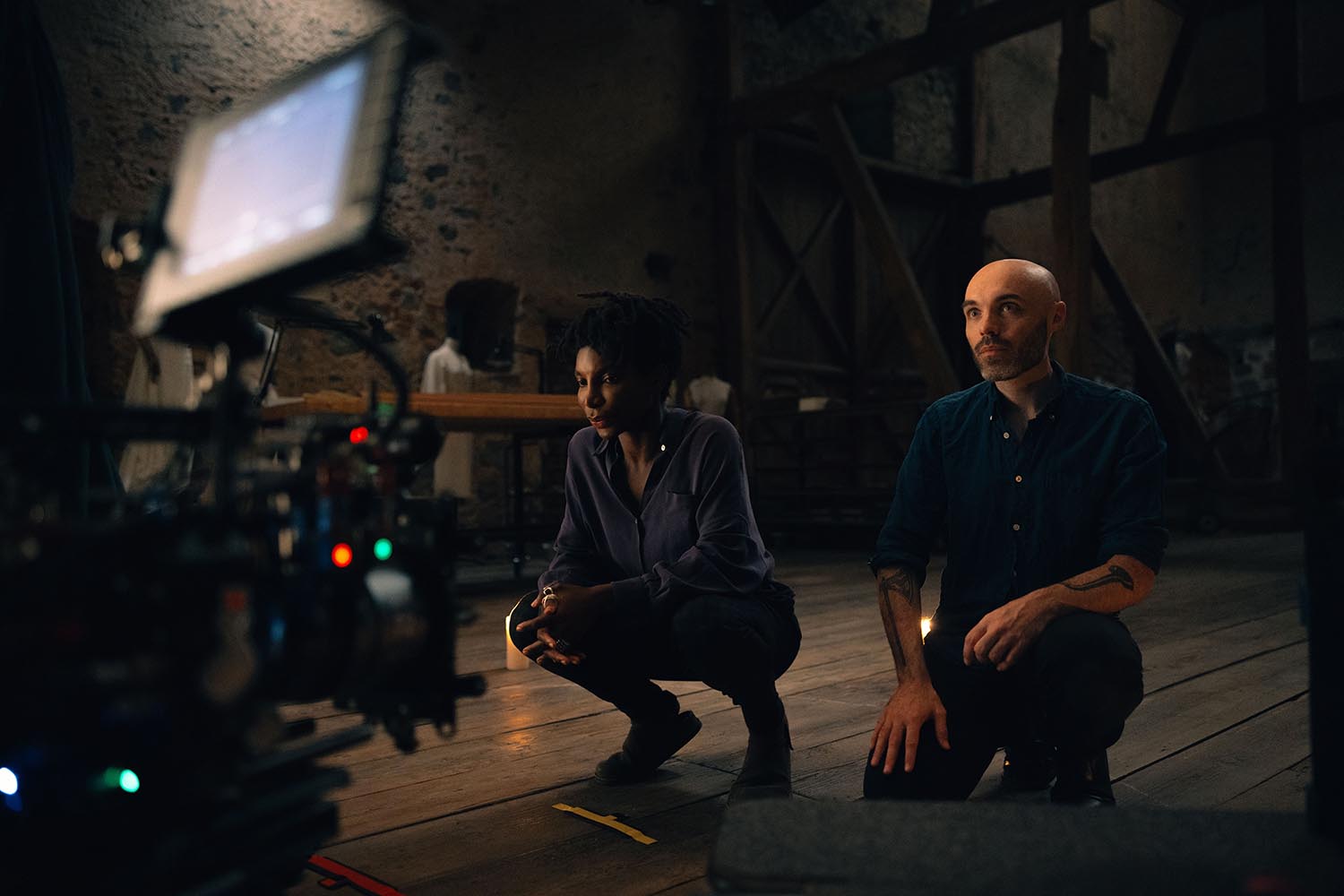
I’m always trying to do myself the favor of making these movies as easy for myself as possible, and then, somehow, they become impossibly challenging, because my ambitions grow not just as a filmmaker but as a storyteller. The stories that I’ve created can’t be contained to the initial limitations that I’ve set them within. I don’t know what that says about me, but I certainly went into both A Ghost Story and Mother Mary thinking it was going to be incredibly easy. How hard could it be to have two people in a room having a conversation? Cut to me on the outside of it, having finished the movie, thinking, “This is the hardest thing I’ve ever done.” My beard is much grayer than it was when I started for good reason. It was incredibly challenging because the scope of it grew both practically but also emotionally.
This is an entirely woman-centered film. There’s this idea that Lars von Trier writes himself as his women characters, even though they go through horrible things, right? What urged you to write this personal story about the creative act but sort of conceptualize it about women and their relationships with each other?
There wasn’t a conscious intent to gender the movie in any way. It wasn’t about the female experience as I saw it. The characters just…they’re representative of me in the same way that you describe Lars von Trier’s characters being representative of him, but they’re that chromosome of me. I’ve done the thought experiment since then: “What if I made the movie again but with a different cast?” It’s not the fact that they’re both women nor is it the fact that they’re a pop star and a fashion designer. It’s their tonality. In some ways, it would be reductive to say, “What if I were to do the all-male version of Mother Mary?” You couldn’t just put any actor in there. Anne Hathaway and Michaela Coel, they specifically worked for this movie in a way that other actors might not have. Even though it’s so women-centric, it isn’t about being female. It’s about something much more universal.
I imagine this project required a similar push-pull as what goes on between Mary and Sam between you and all the collaborators, the musicians, obviously the making of the outfits. What did that collaborative tension bring to the process?
In some ways, it was a lot like any collaboration on a film, [where] you bring the best people together who understand what you’re after, and you trust them to do a better job than you could do yourself. At the same time, we were doing so many things with this movie that were ancillary to the filmmaking process. We had to write what’s essentially an album of music that needed to stand on its own. We had to create an history of dresses that feel like they would have been worn outside of this movie on red carpets or to award shows and performances and concerts. I have my own tastes as an audiophile; there’s songs and music that I love, but I don’t know how to write music. I love fashion, but I don’t participate in it, as evidenced by what I wear. So, I had to not only trust the artisans who were helping us create these art forms, but I had to educate myself on an entire new discipline and learn how to talk to them in their language.
What did you learn about making pop music specifically?
There were things that I just didn’t know about pop music! Going into this movie, I was like, “If you can sing well, you can sing a pop song.” But no, there’s a very specific [skill] to singing the way a pop star in 2026 sings if they’re going to be a major star. And then think about the difference between a big pop star in 2026 and 2003. What’s the difference there? Because we wanted this character to feel like she had been around for that entire period. So, it was a lot. It was a tremendous amount of trust, but also a huge amount of education because I did have to give notes. Some of these things I was giving notes on, I was clueless. I was like, “I don’t know how to tell you why this doesn’t feel right yet. It’s not right yet.”
Charli was really helpful in that. I remember, one time, she’d sent over some lyrics, and I texted back some revisions. I had the gall to revise Charli XCX! She was like, “Cool, we can do that if you want, but here’s why it doesn’t work.” It was such an education into how a pop song is constructed. In that moment, I realized, “Oh yeah, that’s why she is Charli XCX. She knows how to do this. I do not. I’m going to stay in my lane.”
Something that I really connected with is how stage-bound or purposely theatrical so much of the film is. The staircase sequence where Anne’s going up and down and up and down really stuck with me…
Oh, great!
What motivated that stylistic choice?
Happenstance. If you were to read the script a few weeks before we started shooting, that sequence was represented but had an entirely different form. The movie was going to be intercut with what would essentially be a behind-the-scenes documentary of Mother Mary’s tour. It wasn’t literally a documentary, but we were going to treat it like that, like Madonna: Truth or Dare. There was a montage of her going from one show to the next, hopping on a private jet, flying to Paris, hopping on another jet, flying to London. At a certain point, late in the game, we realized we could not pull this off. It was making another movie on top of another movie on top of a stadium tour. So, I just had to think to myself, “How do we take a montage and turn it into a single shot?” Out of that was born what we call “the staircase sequence.”
So much of the movie is the scene where she meets FKA twigs for the first time. That was originally like six different scenes. She finishes her show. She goes backstage. She meets twigs. They hop in a car. They go to a club together. Then they go back to the hotel. I had to think to myself, “We can’t pull this off. If we pull it off, we’re going to fail. How do we succeed? Reconceive it.” So, I again thought, “How do I take these six scenes and compress them into a single shot?” Out of that, an entire aesthetic was born that was, I think, superior.
I think it’s far better now than it would have been, but it was entirely based on these limitations that we ran into. We really had to just trust our instincts, kind of like tune into the universe and figure out what this movie was telling us it needed to be.
Mother Mary’s tagline reads, “This is not a ghost story.” What kind of story is it?
It’s a story about a pop star who needs a dress. I’ll leave it at that.
Since 2001, we've brought you uncompromising, candid takes on the world of film, music, television, video games, theater, and more. Independently owned and operated publications like Slant have been hit hard in recent years, but we’re committed to keeping our content free and accessible—meaning no paywalls or fees.
If you like what we do, please consider subscribing to our Patreon or making a donation.