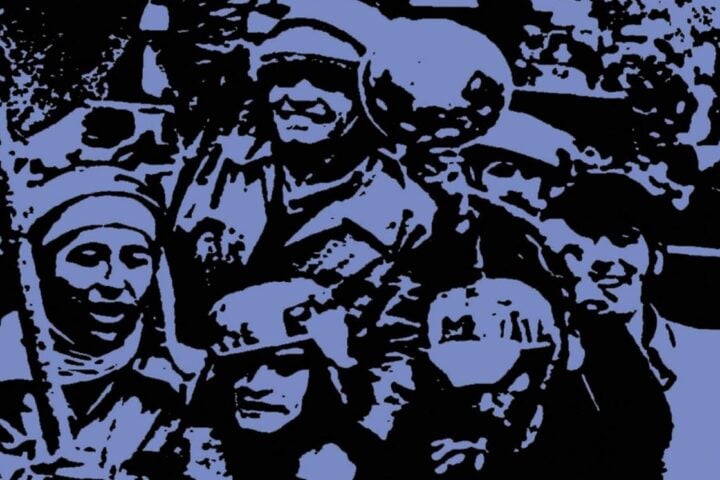
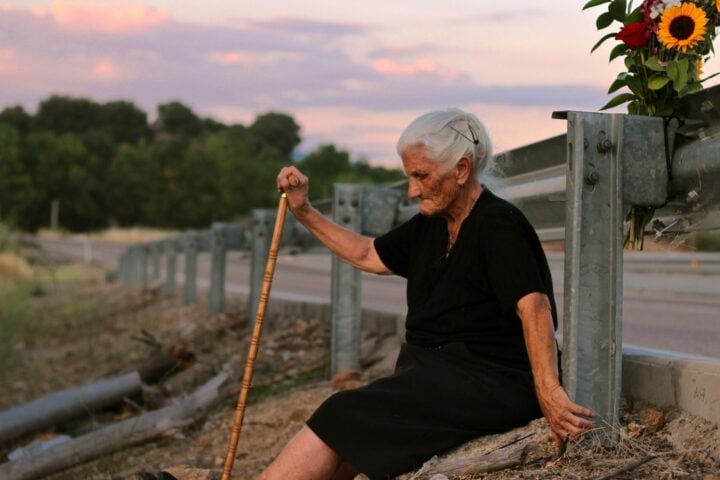
Since the 1973 coup d’état that overthrew Chile’s elected socialist president, Salvador Allende, the legacy of that event has obsessed Patricio Guzmán. From the three-part The Battle of Chile to The Cordillera of Dreams, Guzmán has examined the tragic events of Augusto Pinochet’s coup and the repression that followed it with a jeweler’s eye. His latest documentary, My Imaginary Country, is also haunted by Allende and Pinochet, but this time the filmmaker is covering a completely different rupture in Chile’s fraught history.
The protests that broke out in Chile’s capital, Santiago, in October 2019 were ostensibly about a metro fare increase. But within days, they had escalated to encompass a laundry list of complaints with President Sebastián Piñera’s government. In his narration, Guzmán mentions being told by filmmaker Chris Marker that “when you want to film a fire, you must be ready at the place where the first flame will appear.” Guzmán then sardonically notes that while he wasn’t able to film the initial spark that set off the anti-government street protests in 2019, he came back the following year to find that the fire was not close to going out.
Rather than ruminating on the battles of the past—though clips from his earlier work about the coup are used to establish some historical backdrop—Guzmán takes his camera into the heat of this new battle, and appears surprised and even optimistic about what he discovers. Still used to seeing politics and strife through the Cold War’s binary perspective, the filmmaker initially seems somewhat bemused by the disinterest in leaders and ideologies that he witnesses in Chile’s 21st-century protest movement: He realizes that despite the similarities between their concerns and what motivated activists of his generation, “This is new.”
Guzmán has remained obsessed with Chile despite having lived in exile since the early 1970s, and now wonders whether he even knows the country at all anymore. That curiosity runs through My Imaginary Country, registering in his quizzical voiceover and the drone shots that swoop over the crowded streets as though seeking a leader in the roaring, flag-waving throng. Uncertain at first about the eventual outcome, the filmmaker takes on a more upbeat tone, describing this street revolution as violent but also filled with “joy.”
The documentary’s talking-head interviews, which are interwoven with footage of confrontations between armored riot police and protestors, the student-led movement’s campaign of fare-dodging set off a domino effect by spreading to the wider population. Many relate a long-simmering fury at the indignities forced on the population (vanished pensions, terrible housing, no good affordable healthcare) by a government still in thrall to the no-holds-barred market capitalism that Pinochet imported from the University of Chicago. Others are less economic in nature and more connected to the nation’s soul, particularly the outrage over acceptance of sexual violence, which Guzmán captures through a stirring street performance of the feminist anthem “The rapist is you.”
Throughout the documentary, Guzmán marvels at the protestors’ demand for a new constitution that they believe will be more attuned to the people’s voice. But unlike other broad-based, leaderless protest movements with a lengthy laundry list for how to upend society, the one that the filmmaker documents comes across as explicit, determined, organized, and in it for the long haul. My Imaginary Country’s most visually arresting scenes are those that capture the crowds in Santiago’s Plaza Italia, chanting and dancing like a new and joyful kind of army. But its most moving are the ones near the end that reveal the progress that’s being made toward ending what Guzmán calls “Pinochet’s constitution.”
The energetic and forward-looking tone of My Imaginary Country contrasts sharply with that of The Cordillera of Dreams, which is almost frozen in the past. However, Guzmán draws enough linkages between the two documentaries to make the newer film appear at times like a continuation of the first. He makes an explicit visual connection with his opening shot, which mirrors the prior film’s concluding images of paving stones mined from the Andes of Chile. Only in this film they’re being smashed up by protestors to hurl as weapons.
By the end of My Imaginary Country, Guzmán has still not moved past the trauma of history. Nor, he suggests, has Chile. Not yet. But he does leave open the possibility of a future not beholden to that trauma and a nation that might now be able to write a new history for itself.
Since 2001, we've brought you uncompromising, candid takes on the world of film, music, television, video games, theater, and more. Independently owned and operated publications like Slant have been hit hard in recent years, but we’re committed to keeping our content free and accessible—meaning no paywalls or fees.
If you like what we do, please consider subscribing to our Patreon or making a donation.