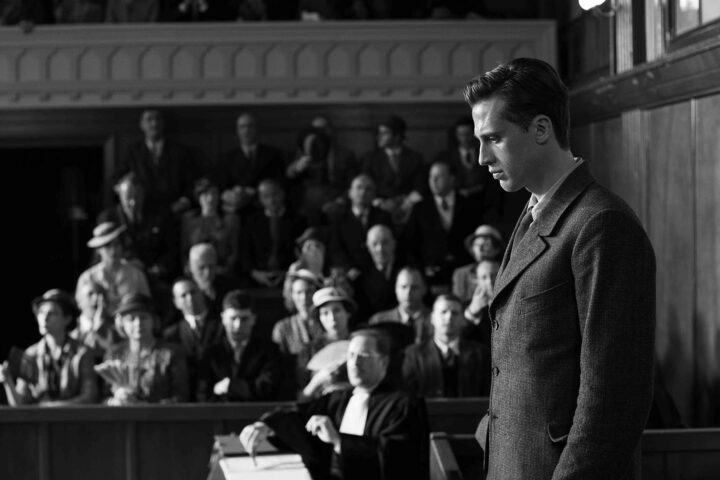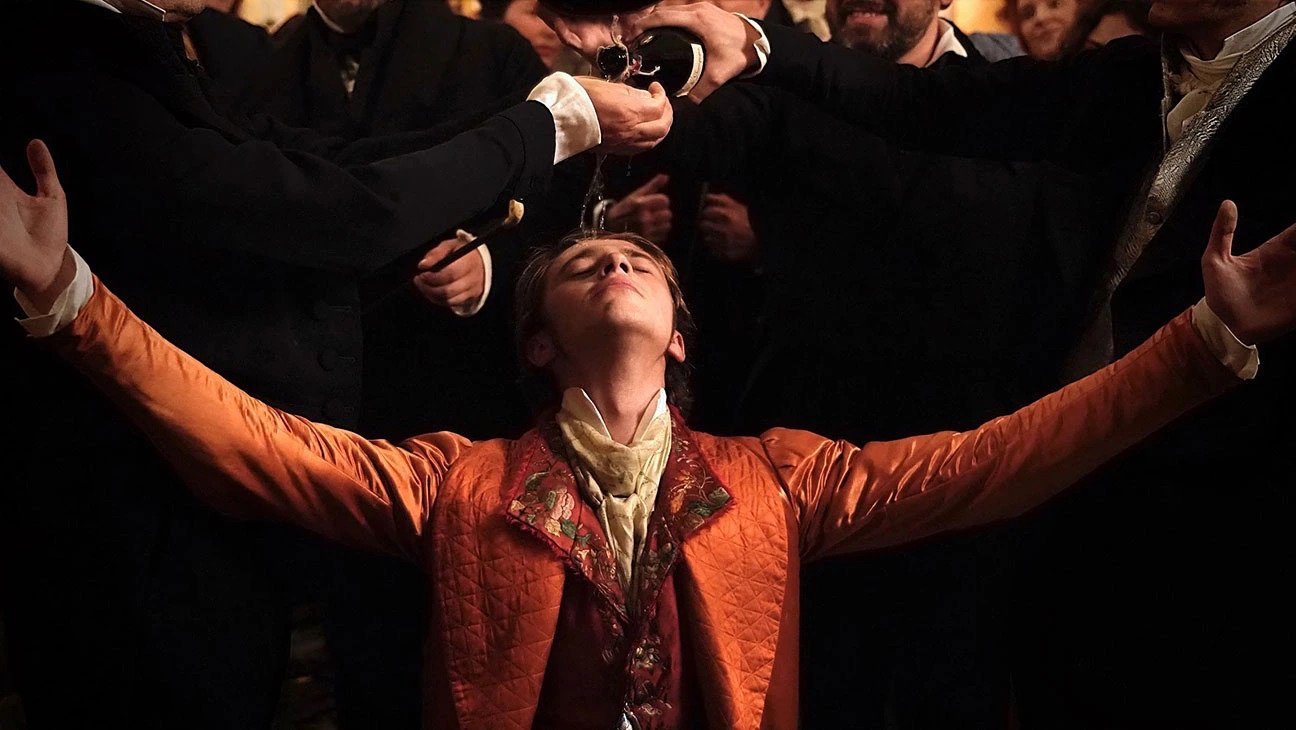
In Xavier Giannoli’s Lost Illusions, an adaptation of Honoré de Balzac’s Restoration-era novel, any question of journalistic integrity is immaterial, as all news is fake by definition. Few scenes illustrate this with more cynical glee than the one in which a naïve Lucien Chardon (Benjamin Voisin), newly arrived in Paris from the provinces, visits the city’s most influential publisher, Dauriat (Gérard Depardieu), hoping to sell his manuscript of juvenilia.
Lucien’s new mentor, Lousteau (Vincent Lacoste), assistant editor for a liberal journal called Le Satan, has brought him to this office sandwiched between brothels and gambling dens for a different purpose. He intends to show Lucien the real machinery underlying the supposedly pure arena of literature. Dauriat, a former grocer, can neither read nor write. He publishes solely on the basis of what will sell. Writers don’t become known through the strength of their writing but by cultivating famous friends or, better yet, famous enemies. To fabricate controversy, he bribes critics from competing journals to write conflicting reviews.
Dauriat has paid Lousteau to write favorably of a new book by Nathan (Xavier Dolan), a royalist dandy. Lousteau claims that to write a review, it’s better not to have read the book, and sets Lucien up for an ad hoc savaging of Nathan’s work. Lucien calls it “a curious sum of nothingness,” provoking laughter and applause from the room, even as he accidentally describes himself, his words, and his future career as a journalist.
Likewise, the casting of Depardieu (infamous for his alleged sexual violence and, up until Russia’s invasion of Ukraine, mutual admiration of Putin) as a grotesque self-parody, like John Wayne’s ranchman character in John Ford’s classic western The Man Who Shot Liberty Valence, only drives Louseau’s lesson home. Art, politics, morals, opinion—all are reducible to the flow of francs from one pocket to another. Depardieu was paid, after all, to play the role.
Ambitious, desperate, entranced by the promise of wealth and influence, Lucien rapidly takes to his lucrative job at Le Satan, writing under his maternal patronymic of de Rubempré, indicative of his pretensions to nobility. On the theater beat, where even applause and boos are bought and sold (it’s hard not to see the spectacle of the theater as an analog to cinema), he falls for a red-stockinged actress, Coralie (Salomé Dawaels), and decides to use his pen to elevate her to stardom. This sparks the jealousy of his former lover in the provinces, Louise de Bargeton (Cécile de France), even though she’s abandoned him for being her social inferior, and she decides to work with Nathan in orchestrating Lucien’s downfall.
Lost Illusions leans heavily on voiceover narration that, for better or worse, draws attention to its source material and exaggerates the novelistic mode of its storytelling, particularly at the end, when a certain character outs himself as the narrator and throws his every word into unreliability. The omnipresent voiceover leaves no doubts as to the themes and subordinates image to text, as if the film were merely an elaborate illustration.
Unlike so many costume dramas, Lost Illusions doesn’t merely wrap up the politics of our time in gauzy nostalgia. After all, its themes are those of Balzac, a royalist so committed to realism that he ended up sabotaging his own ideals. Disillusionment, all too obviously, is the order of the day, and Giannoli sacrifices the cinematic spectacle of Lost Illusions on the pedestal of Balzac’s message, all the timelier for its timelessness. Fake news is not some 21st-century aberration. Even during the Restoration-era of Giannoli’s adaptation, when capitalism was still getting off the ground, journalism served as a vehicle for empty spectacle, a sleight of hand distracting from the accumulation of wealth and power. In one form or another, spectacle has always existed, even if capitalism has proliferated its forms and sent them into overdrive.
Since 2001, we've brought you uncompromising, candid takes on the world of film, music, television, video games, theater, and more. Independently owned and operated publications like Slant have been hit hard in recent years, but we’re committed to keeping our content free and accessible—meaning no paywalls or fees.
If you like what we do, please consider subscribing to our Patreon or making a donation.