Albert Camus’s The Stranger has always presented a tantalizing riddle to filmmakers seeking to adapt it: It’s a rigidly interior novel whose narrator experiences the world cinematically. Meursault, a man seemingly without a consciousness, lives strictly in the present moment and the realm of the senses, with a heightened sensitivity to colors, shapes, textures, and physiognomies, viewing others around him at a remove, as if through a camera’s lens. People and concepts that exist outside the frame, for him, may as well be fiction.
Luchino Visconti’s 1967 adaptation of Camus’s deceptively complex and mysterious classic brought the blazing colors, sandy grit, and scraggled faces of the novel’s interwar Algiers to life, but it lost much of the interiority and subtext in the process. François Ozon’s new black-and-white adaptation, if not on par with the full sophistication and ambiguity of the novel, is superior, boasting a perspective of its own that brings contemporary psychological and political understandings to what was always present in the text—and a few things that weren’t.
Benjamin Voisin, who previously starred in Ozon’s Summer of 85, plays a young and implicitly autistic incarnation of Meursault. This Meursault feels truer in certain ways to the spirit of the novel than Marcello Mastroianni’s take on the character in Visconti’s adaptation, projecting a blankness and simplicity of expression as he absorbs and mirrors the harsh realities of his French colonial milieu—the arbitrary separations and brutal hierarchies—like a perplexed child.
In the wake of his mother’s death, Meursault comes under the influence of Raymond Sintes (Pierre Lottin), who makes Meursault an accomplice in his violent exploitation of the local Arab population by appealing to his desire for masculine acceptance, and Marie Cardona (Rebecca Marder), a former colleague who, in Ozon’s telling of the story, seems to see in Meursault a lost boy in need of the affection he may not have received from his own family.
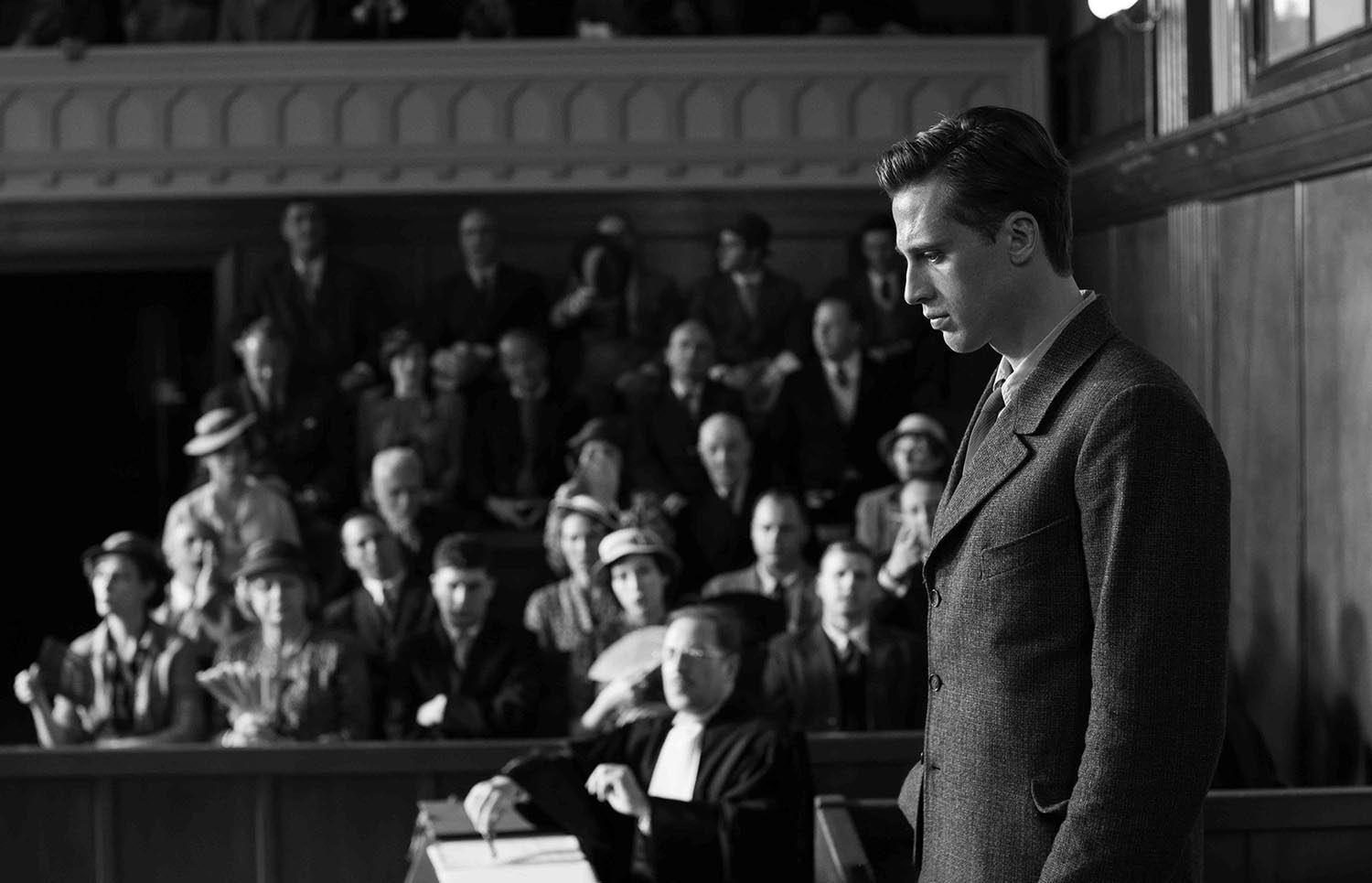
Across the film’s meditative first half, it’s clear who Ozon is rooting for. When Meursault is put on trial for the senseless murder of an Arab man (Abderrahmane Dehkani) involved in a dispute with Raymond, the prosecution fixates on his lack of outward emotional responsiveness—more so than on the victim. To Ozon, what’s “absurd” here is colonial society’s quickness to set apart and demonize a neurodivergent man whose criminal act merely reflected, without self-awareness or pretense, the violent and racist values of his social environment.

Capturing Meursault’s taciturn alienation in still, tight monochrome compositions and extended passages of silence while doing away with all but a sliver of first-person narration, Ozon wishes to both embody and observe the character clearly from without—in ways the framing of the novel could never allow. In particular, the filmmaker highlights the subjectivities of gendered and racialized others relegated to the margins of Meursault’s consciousness.
This is where Ozon makes his clearest additions and editorial choices, in ways sure to divide literary purists, with bits of added and restructured dialogue alongside performance choices meant to direct modern audiences toward the filmmaker’s moralistic take on the material. Marie, an enigma in the novel, is self-possessed and compassionate—that is, a modern woman—as portrayed by Marder, her affection for Meursault self-driven, genuine, and psychologically legible to the audience in ways he himself can’t quite comprehend.
More conspicuous is Ozon’s highlighting of Arab perspectives, no doubt a response to postcolonial critiques of the novel taking Camus to task for failing to include any. From an ironic introductory newsreel going over the history of Algerian colonial conflict in a nutshell, to point-of-view scenes of Arab citizens observing the pieds-noirs with mixed curiosity and fear, to additional appearances and dialogue for Djemila (Hajar Bouzaouit), the Arab woman (unnamed in the novel) viciously abused by Raymond, Ozon peppers and bookends the film with scenes eager to spell out the backdrop of colonial injustice as vital context to the story.
This is a well-intended response to a Western cultural tradition that’s casually overlooked such context, but also a patronizing overcorrection that flattens the text’s farther-reaching explorations of free will, consciousness, and socialization; it doesn’t quite gel with the intended myopia of Meursault’s story as Camus told it. This is still Meursault’s story, in the end, and Ozon’s changes don’t add much beyond didactically reminding us that the Arab population of Algeria so casually dehumanized in Meursault’s eyes were people too, who did not, in fact, think highly of their treatment under French colonial rule—something Camus, perhaps naïvely, trusted a conscientious audience to put together for themselves. Ozon’s film is nonetheless haunting, transportive, and tragically humanist, a worthy introduction to the text for the skeptical (or a refresher for the lapsed) and a memorably grim drama in its own right.
Since 2001, we've brought you uncompromising, candid takes on the world of film, music, television, video games, theater, and more. Independently owned and operated publications like Slant have been hit hard in recent years, but we’re committed to keeping our content free and accessible—meaning no paywalls or fees.
If you like what we do, please consider subscribing to our Patreon or making a donation.