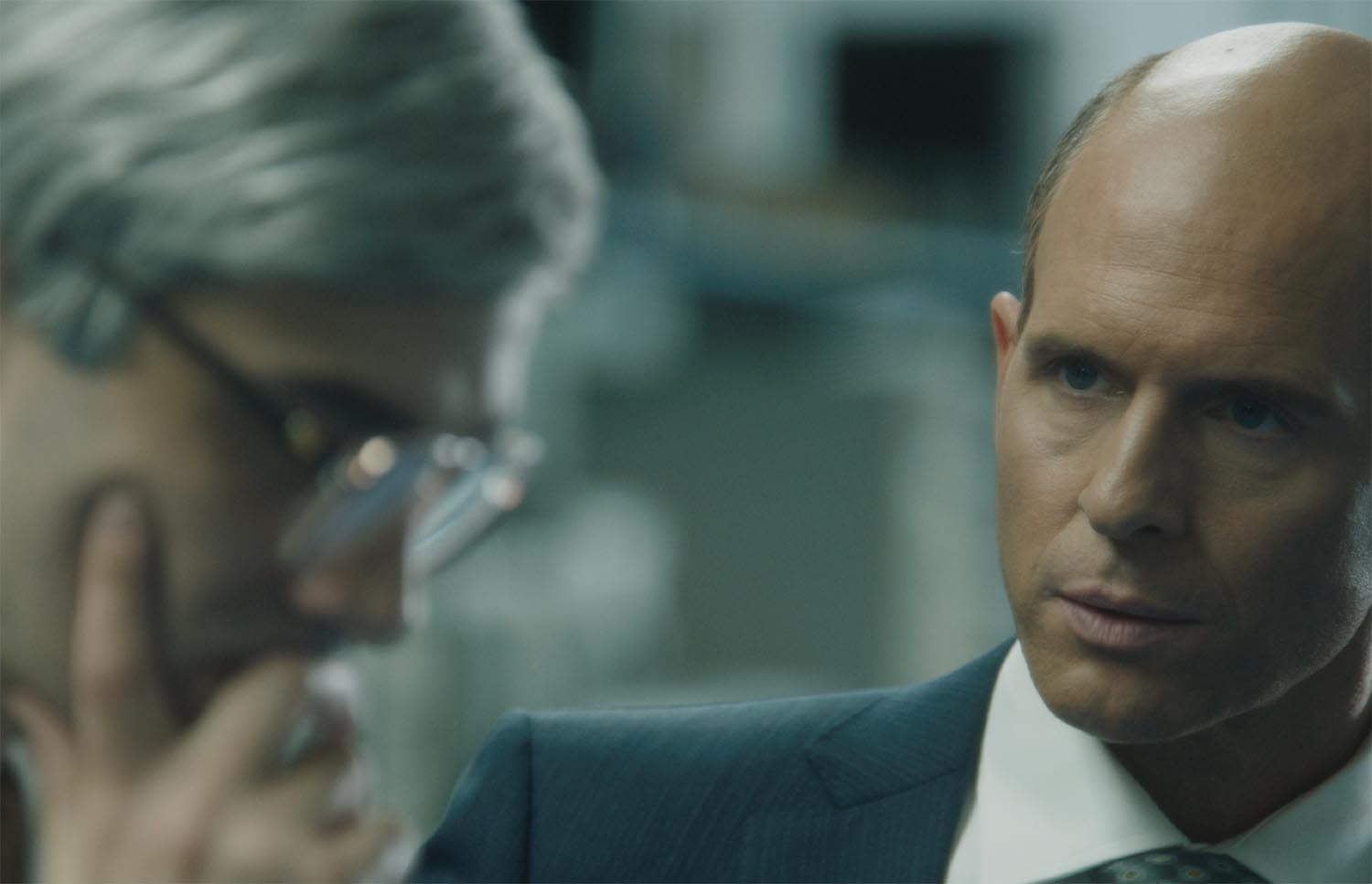
Matt Johnson’s BlackBerry, a chronicle of the titular device from invention to obsolescence, arrives in theaters at the nexus of two cinematic trends. On the one hand, miniseries like The Dropout and WeCrashed locate a kind of schadenfreude at watching corporations collapse due to criminality or corruption, respectively, and the capitalistic imperative of growth at all costs. On the other, there are films like Air and Tetris that leverage familiarity with consumer products to elevate brand-building into a newfangled IP adaptation.
BlackBerry is both and neither. Yes, it’s a tech origin story, albeit with far more modesty befitting the founders from Waterloo, Ontario who sought to resolve immediate inconveniences with the mobile product rather than revolutionize communication. The promise and pitfalls of this strategy come to vivid life in the film through the dichotomy of its two leads. Jay Baruchel’s Mike Lazaridis quiet, reserved founder behind Research In Motion (RIM) brings the brain behind product to bear, while Glenn Howerton’s boisterous businessman Jim Balsille brings the relentless market savvy. (Johnson, in front of the camera as Lazaridis’s compatriot Doug Fregin, represents the closest thing a company can have to a soul.)
What emerges isn’t reducible to sponsored content or a simplistic case study. It’s a complex web of events and characters that captures all the emotions of business’s boom and bust cycles. Johnson proves adept at navigating the silliness as well as the serious of his subject matter, and nowhere does that emerge more than in the dynamic performances of Baruchel and Howerton.
I spoke with the two actors prior to BlackBerry’s theatrical release, and our conversation covered how they worked within Johnson’s unconventional style as well as how the film speaks to the unexpected “culture clash” between Canada and the United States.
Matt Johnson said he had an approach of “directing [from] inside the movie.” Did you feel something different than working with a traditional actor-director?
Jay Baruchel: I don’t know that there’s a traditional actor-director. Even though a lot of people will do shit the same, and wrong, everybody’s got their own way in. MJ’s approach is unique to MJ, but that’s what’s so exciting about it. Glenn and I were given a tremendous amount of space to just create and find out who these guys are. The way that Matt approaches things was often we literally didn’t know where the cameras were. And we often didn’t know we were on camera.
There were moments in that movie that we weren’t aware that we were acting, but Matt saw something that could be a thing, and he found a way to put it into this special fucking stew that he calls a movie. Him being on the floor, he’s got a million things to worry about and his focus was never split. Never fucking once. His focus was always vivid. He always had an answer to every question, and if you ever pushed back on anything, he would humor that discussion in an honest, meaningful way. It’s what you thought a director is supposed to be. You work with a lot of people that have that gig that maybe shouldn’t, and he’s somebody who should because he cares deeply about filmmaking in a really pure way. It’s impossible not to be inspired by it.
How did you all go about calibrating performances off each other, especially since Jim and Mike flex their power and smarts in equal and opposite directions?
Glenn Howerton: It doesn’t take tremendous detective work to figure out how to play a scene when it’s written so well. It just really comes alive when you read it. Then it just becomes a matter of familiarizing yourself with the script so much that you’re aware of where you’re supposed to be, where you’re where your head’s at in any given moment, knowing what the thoughts and motivations are, and then letting it all go. Getting into a space and just playing with your other actor. Going off of Jay, who was wonderful to work with because he would never give me the same thing in any given take. It was always a different thing, which keeps me on my toes, fresh, and sharp. Working with people who have that playful energy on set, it makes even working on something slightly more dramatic a lot of fun.
While budget and other concerns kept you to only a few takes per scene, did you find you were seeing more of the instinct-driven first takes winning out in the final film or later ones where you got to hone a moment more?
JB: I think you develop it over the whole movie. I only got my sea legs three-quarters of the way in. I couldn’t tell you when I watched the movie if he’s using take one or take seven. I never had a handle on it until I did. But what I always did was know that I believe in my director, and whatever it is that we’re doing, regardless of how I feel about it is going to be good for the movie.
GH: Very early on, it was very clear that we weren’t going to move on from a scene unless he felt like he got it, which makes you feel like you’re in good hands. He was pretty relentless in terms of getting what he wanted, and I can appreciate that.
You each have pretty unique backgrounds with comedy and improvisation, Glenn with It’s Always Sunny in Philadelphia and Jay with a bunch of Judd Apatov projects. Are you able to build on that strong foundation, or does working within Matt’s system mean going back to basics?
JB: Both, for me. I can’t help but ad lib wherever I am. Whether or not they use it or they’re just humoring me, to be honest, I don’t care. I’ll do it no matter what. But it’s always the first day of school, especially because this was my first “at-bat” post-pandemic. But even if it wasn’t, it always feels like the first time I’ve ever been on a set.
GH: Yeah, that’s true. You bring your experience to everything, but you also have to recognize when what you’ve what you’re bringing is a preconceived notion of something that isn’t useful in the moment. Or, when that experience is wonderful to have, because it’s both.

BlackBerry’s visual approach stayed close on your faces in single camera and strayed away from shooting masters. As actors, is that liberating or constraining?
GH: That was great, man. When there’s a lot of coverage, you find yourself trying to recreate moments that you did an hour ago. If it takes an hour to turn the whole setup around, and certainly if you’re fond of improvising, then you’ve got to remember all those improvisations and for the other person’s side. It’s much more fun to shoot a little more run-and-gun. Not that this was fully run-and-gun, but the way he covered it was such that we felt like we could keep it loose. We didn’t always have to keep everything in our heads and do the scene to death.
Matt has a destabilizing effect of using documentary techniques in this fictional story. Do you find that it forces naturalism in your performances?
JB: It all informs itself. I don’t think that Glenn and I make character or performance choices based on the aesthetic of the movie. At least I know I didn’t. But, by the way, how do I know that MJ wasn’t directing us a certain way because he already saw it in his head based on how he knew he was shooting it? For me, as a performer, it’s an impossible question to answer. Maybe I was and I didn’t know it, but I thought the gig was the same. Know my lines when I need to and try to be as honest about it as I could when it’s time to say them.
Matt has said that he hopes BlackBerry helps with the trouble of defining what Canada is. Sarah Polley recently suggested that part of the reason Canada feels as relaxed as it does is because there’s not a strong national story unifying the people, which can be both empowering and endangering. Do you think there can be a Canadian story that doesn’t sacrifice an essential Canadian identity?
JB: There’s no way to answer that in the time I’ve been given, man! I don’t agree with everything MJ says either, and I’ve argued about this with him on camera. He and I are more aligned philosophically about Canadian cinema than we are not. However, I felt there was also a big difference in how and what we believe. I think that the biggest thing holding us back, to the extent that anybody gives a shit, is this obsession with defining it.
I don’t know how many American filmmakers ask themselves when they’re making a thing if this is an American POV or an American story. I think they just tell a story of where they’re from or about what they’re interested in. And by virtue of being where they’re from and making it there, therefore it’s “American.” I think this obsession with trying to pinpoint what English Canadian culture is only does us a disservice. We’re far too self-aware when it comes to this shit. Just tell a story and don’t pretend it’s somewhere else, and that’s that. That’s my oversimplified, chip-on-my-shoulder answer. I could unpack it because this is a subject that there are entire sections of bookstores in Canada just about this. They’re both right, and so am I.
Glenn, from your perspective as being one of very few Americans involved in the production, did the film force you to see your own subject position and nationality in a different way?
GH: I guess I never thought about any of it in those terms…
JB: He had a part in a movie that took place in Waterloo!
GH: Maybe this is an American thing, but I don’t see that much of a difference between Americans and Canadians. Other than Canadians seeming much nicer on the whole and practice humility a lot better than Americans do. I see it as a virtue, though I can see where it stands in their way at times. I never felt like a foreigner on set. But I also grew up as an Air Force brat, so I grew up all over the world. I don’t feel like a foreigner anywhere, honestly. I really don’t.
Your job as actors is to play the character, not play a nationality. It’s people watching it who read those things out of the film.
GH: Yeah, I think that’s right.
Since 2001, we've brought you uncompromising, candid takes on the world of film, music, television, video games, theater, and more. Independently owned and operated publications like Slant have been hit hard in recent years, but we’re committed to keeping our content free and accessible—meaning no paywalls or fees.
If you like what we do, please consider subscribing to our Patreon or making a donation.