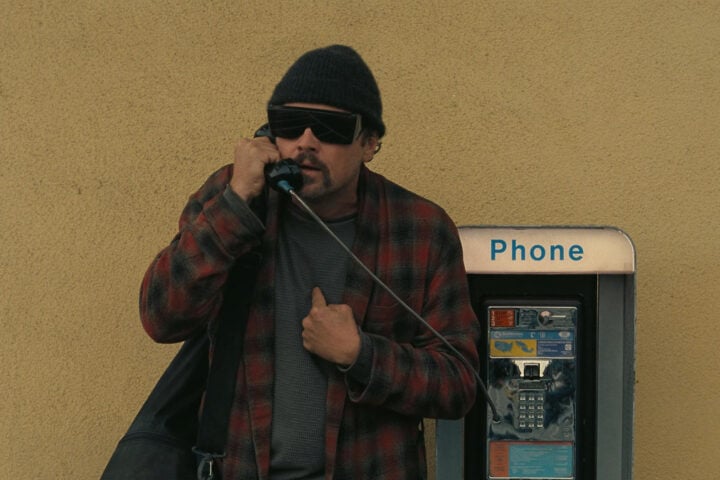
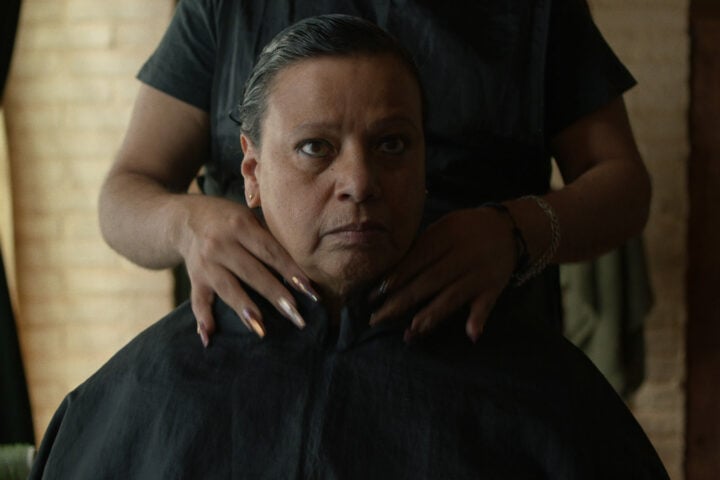
Writer-director Adamma Ebo’s Honk for Jesus. Save Your Soul. is, as its title suggests, about loud noises and redemption. The latter is craved by Lee-Curtis Childs (Sterling K. Brown), the pastor of a Southern Baptist megachurch in Atlanta who was embroiled in a local scandal. As for the loud noises, they’re Lee-Curtis’s chief tactic.
The pastor’s gleaming suits alone—the man has a thing for Prada—are enough to cause tinnitus. But Lee-Curtis’s sermons are more blaring still. “I am the prophet with the beautiful wife and the gorgeous Bugatti,” he says with a grin at one point. As for his self-described “first lady” wife, Trinitie (Regina Hall), she’s loyalty incarnate, sticking by him and helping plot his comeback. “I would sooner kill him than leave him,” she says, and when she holds Lee-Curtis below the surface of a pool during a baptism, for just a little too long, you believe her.
Honk for Jesus. Save Your Soul. is a mockumentary, and its laughs are front-loaded. Ebo charts the course of the Childs’ efforts to restock their dwindling congregation, and to relaunch their church, Wander to Greater Paths. The efforts entail trying to persuade another couple, the Sumpters, not to open their own church, Heaven’s House, on the same day: Easter Sunday. There are echoing rehearsals, in which Lee-Curtis preaches his humility to empty pews, save for Trinitie, who offers pointers on his technique. And, as the day of reopening nears, she daubs her face with chalk-white greasepaint, like the makeup of a mime, and stands at the roadside bidding people to beep their horns. It’s a striking image, rich in humiliation, and it also marks the point at which any remaining humor in the film dies for good.
The film’s focus soon settles on Trinitie. Lee-Curtis, for all his bling and bluster, can’t hold our attention for long, so it’s no wonder that Ebo homes in on Trinitie’s face, as she strains to keep up appearances for the cameras—a far more entertaining spectacle. Viewers of The Office will be familiar with the technique: the smile fixed in place while the eyes betray disaster, occasionally widening into bewilderment. Now and then, Ebo cuts away from the documentary crew (led by a woman, whom we never see, called Anita) to give us glimpses of the Childs’ private moments. One scene, in their bed, shot from above and shrouded in gloom, sums up the whole marriage: stalled by selfishness, and the failure to perform.
In such moments, you want to know what line of inquiry the film is pursuing—what greater paths Ebo has wandered to. We start out with a skewering of commercialized religion, but we wind up in the spiritual slump of a broken relationship, and the wider breakage that follows the fall of a public figure. Of all the things in this uneven, fervent film, none is more wounding than when Lee-Curtis declares the genuine truth of his regret to Trinitie. Her reply: “Then we should probably practice and make it a little more convincing.”
Since 2001, we've brought you uncompromising, candid takes on the world of film, music, television, video games, theater, and more. Independently owned and operated publications like Slant have been hit hard in recent years, but we’re committed to keeping our content free and accessible—meaning no paywalls or fees.
If you like what we do, please consider subscribing to our Patreon or making a donation.