The medium is the message in Agnieszka Holland’s Green Border, a piece of political cinema so freshly ripped from the headlines that you can still feel the jagged edges. Holland shot the film, which chronicles the wide ripple effects of a 2021 surge of asylum seekers along the Polish-Belarusian border, in just 23 days in March of this year and had it ready for fall festivals mere months later. In the end, her sense of propulsive, incandescent outrage is both the project’s reason for existence and its strongest attribute.
Holland, directing in collaboration with Kamila Tarabura and Katarzyna Warzecha, resists the impulse for urgency to trump all aesthetic considerations. Green Border moves beyond documentary-style realism as a shorthand for authenticity, and it’s at its most gut-wrenching when Tomek Naumiuk’s agile camerawork captures bodies in frequent, frightening motion, as well as the illusory sense of security that those bodies feel in moments of rest.
The script by Holland, Maciej Pisuk, and Gabriela Łazarkiewicz-Sieczko fashions the raw nerve endings of a still-unfolding situation into a multi-pronged panorama of the crisis. At the core is always the multinational group of refugees lured by the false promises of Belarusian president Alexander Lukashenko for easy passage into Europe. Even as they fade from centrality to the narrative over the course of the sweeping two-and-a-half-hour runtime, Green Border never forgets that the migrants are the ones who bear the brunt of the pain. As Polish and Belarusian forces alike treat them as a political hot potato to be tossed across national boundaries, their Kafkaesque sense of dislocation moves from the realm of the physical into psychological.
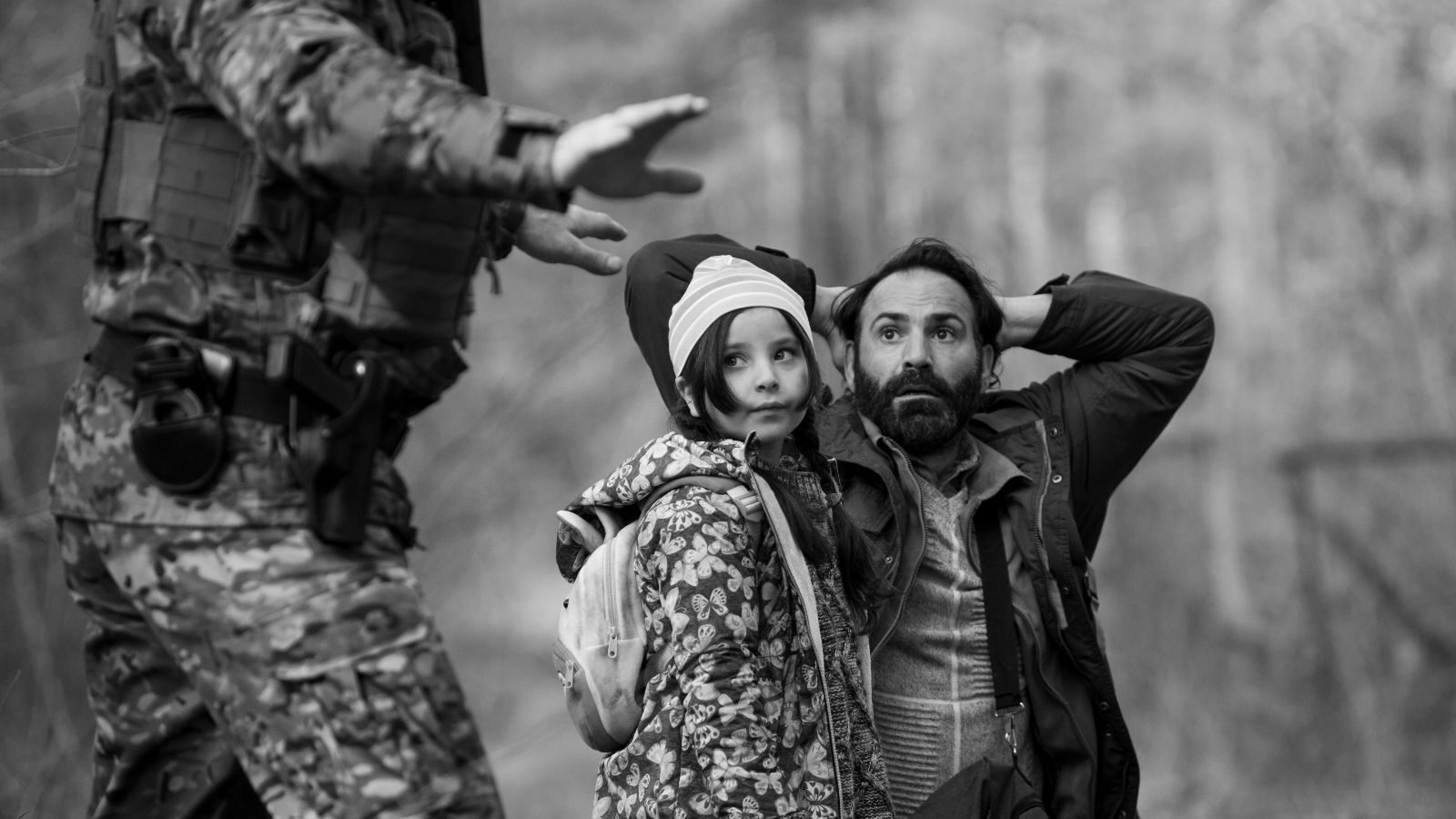
Holland captures the border crossers in the fullness of their humanity, which necessitates undermining the “ideal immigrant” trope. Green Border features several moments where the refugees’ survival instincts manifest as selfishness. The film’s gaze toward these moments is unsentimental yet entirely empathetic. Nowhere is this more evident than when the group’s de facto leader, Afghani teacher and asylum seeker Leila (Behi Djanati Atai), accepts a rescuing hand to pull her out of a swamp. The camera remains on the treacherous terrain and observes without sensationalism as a teenager in her care slips below the surface never to reemerge.
The film doesn’t capture actions in isolation. Holland always presents consequences with the context and circumstances necessary to understand their true impact. Her decision to shoot in crisp black and white hints at forces beyond the frame as well. Holland senses the same winds of fascism chronicled in her Holocaust-set films Angry Harvest and Europa Europa blowing again across Europe. Without overloading the comparison, the simple yet scintillating decision to code her images as more reminiscent of historical memory challenges viewers to view these episodes of barbarism as belonging to a larger struggle for compassion to prevail over cynicism.
But atrocity can anesthetize when people are overwhelmed by its omnipresence. Smartphones have enabled never-before-seen proximity and intimacy to conflict, but alleviating action hasn’t followed suit at the same pace. “Why should I show them?” bemoans one exhausted refugee as he refuses to share his experience for a recording designed to gin up support among sympathetic Poles. “They’ve been watching our stories for 10 years.” As Green Border shifts its focus away from the immediate plight of the refugees, Holland seems to wearily acknowledge that depiction alone cannot stir the senses enough to motivate engagement in the struggle.
The film’s scope widens with time to include more perspectives from Polish citizens, such as hardline border guard Jan (Tomasz Włosok) and largely apolitical psychologist Julia (Maja Ostaszewska). Their necessity to the story is never in question given that the average Western viewer is far more likely to see their own lives reflected through these characters. But the journeys that Jan and Julia undergo feature such obvious narrativization that they cannot help but feel a bit out of sync with the more observation segments featuring the refugees.
These sections, which often play like B plots from a hyperlink film like Alejandro González Iñárritu’s Babel, dilute Holland’s palpable anger. Green Border’s rush to production feels most pronounced here, as the film resorts to many familiar tropes, such as the refugees changing their lives, following a single encounter with a dead body, with a fervency akin to the divine intervention of Paul along Damascus Road. The use of pregnant women as inviolable symbols for the continuation of life feels similarly out of step with the unblinkered realism employed when following the refugees. Jan’s sections, which are the most compartmentalized from the main storyline of the film, are the most susceptible to plot contrivances.
Julia’s presence in the film at least brings her into contact with activists providing assistance within the border’s dangerous exclusion zone closer to her home. Like the refugees, Holland never portrays the group as a monolith. But these courageous organizations are often sanitized, if not outright sanctified, in an effort to provide paradigms of political participation for viewers to emulate. Green Border doesn’t shy away from the disagreement between sisters Marta (Monika Frajczyk) and Zuku (Jasmina Polak) as they debate how far their services should go. This internal dissent, moving beyond the essentialism of action and into a discussion of its extent, is among the most germane to the film’s audience. It’s a pity that this line of inquiry never gets the chance to develop as fully as the situation to which it must unfortunately respond.
Since 2001, we've brought you uncompromising, candid takes on the world of film, music, television, video games, theater, and more. Independently owned and operated publications like Slant have been hit hard in recent years, but we’re committed to keeping our content free and accessible—meaning no paywalls or fees.
If you like what we do, please consider subscribing to our Patreon or making a donation.